


Mail: Webmaster

|

|

|

|
|
 |
 |
|||
Chapter VII
Cutting in Steep Seams
 In steep seams the following factors must be taken into account when cutting :—
| (a) |
A machine, when cutting downhill, will tend to slide and overrun itself until pressure on the picks becomes so great that the machine may stall.
|
|
| (b) |
The cuttings are likely to slide downhill, foul the chain and stall the machine.
|
|
| (c) |
The machine or the cut coal may break free and slide down the face, and thus be a danger to the workmen.
|
Where the gradient is over 20° it is advisable to cut uphill. The coal face should be on a line of full dip and rise. A safety device or brake must be attached to the machine to prevent it breaking away. Two or these devices are described below.
Haulage Winch
A special winch is set in the roadway at the top of the face and a strong rope is taken from it and attached to the cutting machine. The winch is then used to draw the coal cutting machine up the face and also to control it when it is being lowered down the face.
Safety Rope
This device consists of a rope secured to an anchor prop at the top of the face, passed round a pulley mounted on top of the machine (Figure 35), and secured at the bottom of the face to a weight. The pulley on the machine is controlled by an internal ratchet and brake. The machine's own haulage rope is used to pull the machine up the face, but should it break the ratchet on the safety rope pulley will hold the machine in position.
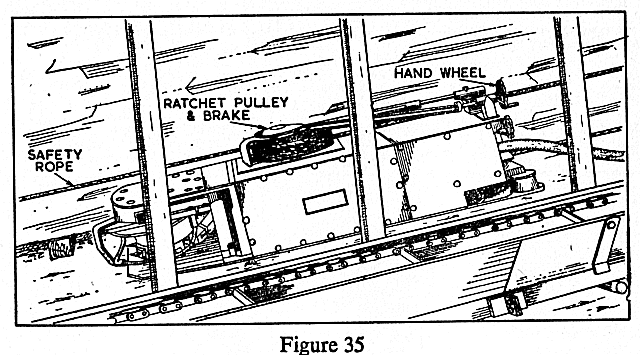
When it is necessary to lower the machine down the face, disengage the ratchet and control the movement of the machine by the handwheel that operates the brake.
Lubrication
In steep seams care must be taken to prevent lubricants leaking into the motor. For this reason grease lubrication is adopted with some machines. The oil is drained from the haulage gear case to its lowest point and grease is put on to the gear wheel once a week. It is advisable with machines using oil lubrication to examine the switch chamber each day to ensure that the oil seals are in good condition.


 |
 |
 |
||

Back |

Home |
Copyright © 1999-2012 by The Durham Mining Museum and its contributors
Page last updated: 01 Jan 2008 |

Search |

|