


Mail: Webmaster

|

|

|

|
|
 |
 |
|||
Chapter VI
Overcutting
 The nature of the seam or of the roof may sometimes be such that it is advisable to make the cut at the top or near the top of the seam. When this is done the seam is said to be overcut.
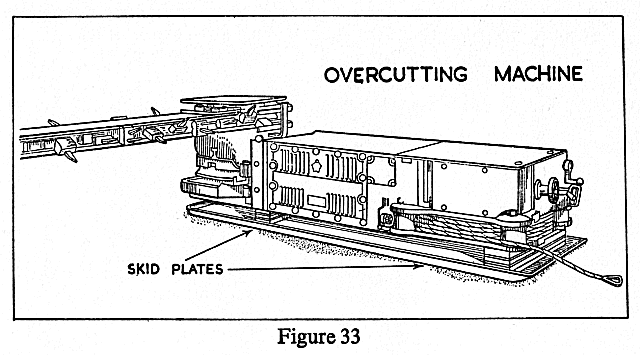
In some cases the machine used for this work is built on skids (Figure 33), which may be adjusted with the gearhead turned over so that the jib is placed on top. In other cases a machine with a special adjustable turret may be used which allows cutting at variable positions up to the roof level (Figure 34).
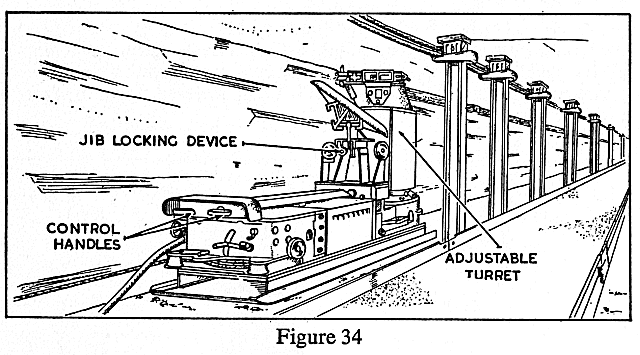
The handle which controls the lifting of the turret is situated at the haulage end, enabling the operator to vary the position of the cut whilst cutting is in progress. The control handle operates a pump driven from the cutting chain transmission gear or from the haulage gear. The pump forces oil into the lifting unit and the turret is raised. Each of the jacks raising the turret is interconnected to ensure an even lift. The hydraulic pressure holds the jib at the required height. A relief valve is attached to protect the turret in case a heavy load is placed on the jib or the turret.


 |
 |
 |
||

Back |

Home |
Copyright © 1999-2012 by The Durham Mining Museum and its contributors
Page last updated: 01 Jan 2008 |

Search |

|