


Mail: Webmaster

|

|

|

|
|
 |
 |
|||
Chapter V
Hints to Cutter Men
 1. If a trailing cable is damaged in any way, use the spare cable that is provided. Note in the daily report that the cable is damaged so that it can be sent out of the pit for repair.
Examine the plugs and sockets and ensure that they are clean and dry.
2. Before coupling or uncoupling the trailing cable to the machine, ensure that the switch on the machine and the isolator on the gate end switch box are in the 'off' position.
Always couple the cable to the machine before coupling it to the gate end switch box.
When uncoupling a cable always disconnect it from the gate end box before uncoupling it from the machine.
3. Carefully examine the machine before switching on the power at the beginning of the shift and again during the shift, paying special attention to cover plates and loose or missing bolts. Report any defect, any undue noise or any unusual rise in temperature of the machine when it is working.
4. Before switching on the machine, warn everybody nearby.
5. Never let the machine drag the trailing cable or air hose. Keep some slack cable or hose close to the machine. Keep the cable or hose clear of the haulage rope and the cutter picks.
6. If any damage or defect is noticed in any part of the trailing cable, switches or machine whilst working, cut off the power and report the damage or defect to an electrician or deputy.
7. Never overload the machine by using blunt picks, running with the cutter chain too tight, travelling too fast, not keeping the gummings clear from the chain or allowing the machine to become wedged too tight between the face and the supports.
8. In other than naked light mines examine for gas frequently.
At least one man with each machine must carry an automatic firedamp detector.
9. When flitting or moving the machine have the cutter chain out of gear.
10. Never leave objects such as wood lids lying about, since they may foul the cutter chain.
11. Trailing cables must be coiled up at the end of the shift to form a figure '8', or better still, hung from bollards. They should also be left in a suitable place clear of traffic.
12. Take care of the trailing cable plugs; in wet places always carry the plugs in the hand instead of allowing them to be dragged along the wet floor.
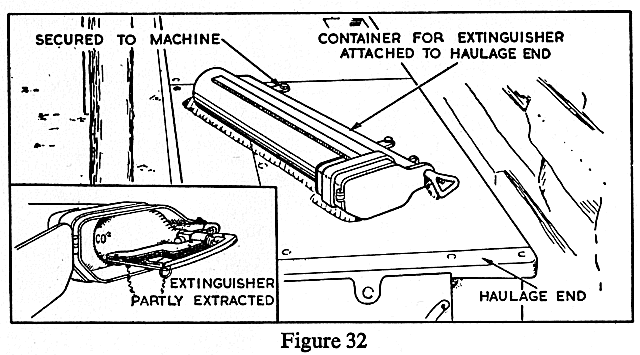
13. Check the fire fighting equipment provided on the machine (Figure 32) or at the gate end.
14. Never stand or allow anyone to stand between the jib and the body of the machine whilst the chain is running.
15. Examine the picks from time to time, when cutting, changing them before they become too blunt. In gassy seams this is very essential, since blunt picks increase the likelihood of gas becoming ignited in the cut through sparking.
16. Should a fire occur in the cut whilst the machine is in operation, immediately stop the machine, clear away the gummings from the cut and then attack the fire with whatever appliance is available. Where a carbon dioxide extinguisher is provided, insert the discharging horn into the cut and then operate the release valve.
The difficulties which arise when cutting are of several kinds, the following are the most common.
1. The anchor prop may tend to pull out. This is most usual in seams with soft floors. Have a 'shoe' arrangement made to fit to the foot of the anchor prop so that the prop does not dig into the floor. Ensure that the anchor prop is set directly in line of pull; if it is set 'askew' the foot of the prop will tend to ride free,
2. The cutting end may tend to leave the face. When this happens, examine the picks, since these will probably have become blunt. Change the picks and set stays or sprags against the haulage end so that as the machine passes the sprag it is kept close to the face.
3. When the floor is uneven pack the hollows with wood or steel bars, so that the machine will ride over them, to keep the cut in its proper position.
4. The machine may stall.
A good cutterman can tell when a machine is becoming overloaded by the change in note of the motor. The variation in note gives warning to reduce or stop the feed, to change the picks or to clear away the gummings from the gearhead.
5. The jib may tend to ride above or below the correct position of the cut. This may in some cases be corrected by running the machine over a small piece of wood. If this does not cause the machine to cut correctly it indicates that the chain may require tightening or that the picks are not set properly. If the machine tends to rise the top picks are set too far out; if the machine tends to dig, the bottom picks are set too far out.
6. Excessive cutting speed may cause the jib to move into the softer parts of the coal or dirt being cut and therefore to rise or dip.
7. The gummer may become jammed. If so, stop the machine and look for and remove the cause. Momentarily reversing the motor may remove the obstruction.
8. The chain may break. If this happens, stop the machine, remove the gummer and free the jib. If necessary draw the jib out of the cut. Repair the broken chain.
9. The jib may become fast. If it does, reversing the chain may free it. If this does not help, pick away the coal to free the jib.
Shots should never be fired directly over a jib since permanent damage to the machine is likely to be caused.
10. With compressed air machines the use of wet air, overloading or throttling of the air may cause ice to be formed in the rotors in such quantities as to lock them. This may be prevented by the use of water traps in the pipe system or by keeping the rotors revolving slowly whilst other work is being carried out. Never switch full air pressure on to a machine running light.
11. The haulage rope may fall and be caught by the cutting picks when slewing the jib. The rope should always be kept taut.
12. The trailing cables connected to the machines may foul the cutter chain or become strained at the point where they are attached to the socket. Make sure they are so placed that this cannot happen.


 |
 |
 |
||

Back |

Home |
Copyright © 1999-2012 by The Durham Mining Museum and its contributors
Page last updated: 01 Jan 2008 |

Search |

|