


Mail: Webmaster

|

|

|

|
|
 |
 |
|||
Chapter III
Lubrication and Maintenance
Lubrication
 It is essential that the machines should be efficiently lubricated and that only the correct grade of oil or grease should be used.
The manufacturers of the machines generally indicate the types of oils or greases to be used. N.C.B. specifications provide a range of gear oils suitable for the lubrication of coal cutting machines.
With compressed air turbines, oil specified in N.C.B. Specification P. 118/1958 may be used.
Care should be taken to ensure that the lubricants are supplied free from grit or water, and suitable distribution containers should be used for transferring the oils from the storage tanks to the machines.
1. On the installation of a machine :—
| (a) |
Fill all the gear cases to the correct level, as indicated by the oil level plugs, with the correct grade of oil.
|
|
| (b) |
Make certain that all grease lubricated bearings are charged with suitable grease.
|
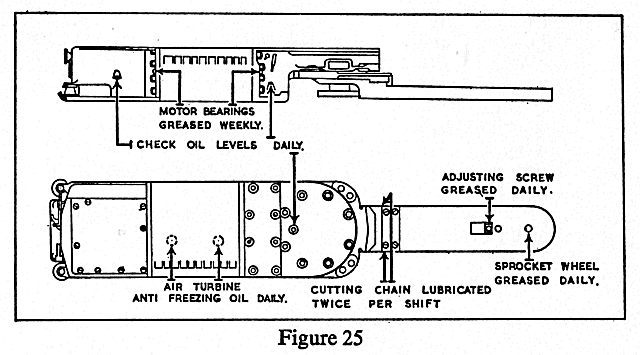
2. Daily lubrication (Figure 25) must be carried out by the operator unless other arrangements are made.
| (a) |
Examine oil levels and replenish if necessary.
|
|
| (b) |
Oil the cutting chain twice during the shift.
|
|
| (c) |
For the lubrication of compressed air turbines, the correct oil, a light oil with a low pour point, should be used; gear oil should not be used.
|
| Note: |
Oil leakage should be very small. If it is excessive, reference to it should be made in the daily report.
|
| (d) |
Apply grease to the sprocket wheel at the end of the jib, if one is fitted, and when necessary to the jib adjusting screw.
|
3. Weekly lubrication (Figure 25) must be made by a special team or by the fitting department.
| (a) |
Check the lubrication.
|
|
| (b) |
Inject grease into the motor bearings. [Overfilling may cause the bearing to heat up.]
|
|
| (c) |
Apply grease to the rope drum(s), sprocket shaft and gearhead bearings of those machines to which grease nipples are fitted.
|
| Note: |
(i) The rope drum and gearhead bearings on some machines are automatically lubricated from the gear chambers.
|
|
| Note: |
(ii) With overcutting machines these points should be greased at least twice a week.
|
|
| Note: |
(iii) Grease not only acts as a lubricant, it also seals the bearings against ingress of dirt and prevents the formation of rust. It is sometimes advisable to inject new grease in order to eject the older, hardened, grease.
|
Maintenance
The fitting department, or a special team, should examine the machine at least once a week, paying special attention to the points listed below. Repairs, renewals or adjustments must be made where necessary.
1. The Haulage Unit.
| (a) |
Pawl springs and pawl tips (examine for wear).
|
|
| (b) |
Friction clutch setting.
|
|
| (c) |
Oil pump filters, if any.
|
|
| (d) |
All set screws and locking arrangements.
|
2. The Gearhead.
| (a) |
Cutter chain engaging mechanism.
|
|
| (b) |
Bevel pinion, which drives the crown wheel (examine for wear).
|
3. The Jib.
| (a) |
Jib race, especially at the 'lead on' edge (examine for wear, particularly general wear on the strips).
|
|
| (b) |
Jip post (examine for looseness).
|
4. The Cutter Chain.
| (a) |
Chain (examine for loose or missing rivets, broken or tight set screws).
|
|
| (b) |
Links and pick boxes. (Ensure that when a pick box is replaced the new box is put on at the same angle.)
|
5. The Chain Sprocket, especially the retaining screw or nut.
6. Pipes, filters and general fittings.
An electrician should examine daily :—
| 1. |
Flameproof enclosures, where firedamp is a hazard, to ensure that there are no missing set screws, studs or nuts in the covers and that the gap between the flanges, as measured by a feeler gauge, is as small as possible. The gap measurement allowed is 0.020", but in working practice it should be very much smaller to ensure greater safety. (See N.C.B. publication, The Maintenance of Flameproof Apparatus.)
|
|
| 2. |
The earthing contacts between plug and socket and between machine sections.
|
|
| 3. |
The trailing cable.
|
Where possible a daily insulation test should be made of the system as a whole.
An electrician should examine the machine at least once a week and repair, renew or adjust as is found necessary.
A weekly examination should be carried out of the internal parts of the switchgear, and of all fuses or other automatic safety contrivances that may have been interfered with.
Insulation and Earth Conductor tests of cables and apparatus should be made each week.
All machines should be brought out of the pit periodically for thorough overhaul in the surface workshops.


 |
 |
 |
||

Back |

Home |
Copyright © 1999-2012 by The Durham Mining Museum and its contributors
Page last updated: 01 Jan 2008 |

Search |

|