


Mail: Webmaster

|

|

|

|
|
 |
 |
|||
Chapter VIII
Transfer Points and Stage Loaders
Transfer Point
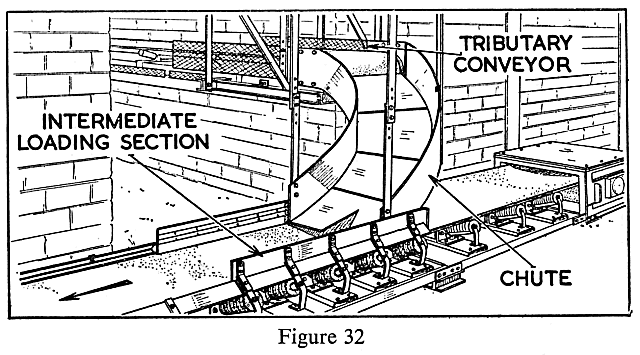
 This is a place along a Gate or Trunk Belt Conveyor where the coal is transferred from one conveyor to another. It consists at some collieries of an intermediate structure on which is built a hopper or special chute to prevent spillage during transfer (Figure 32).
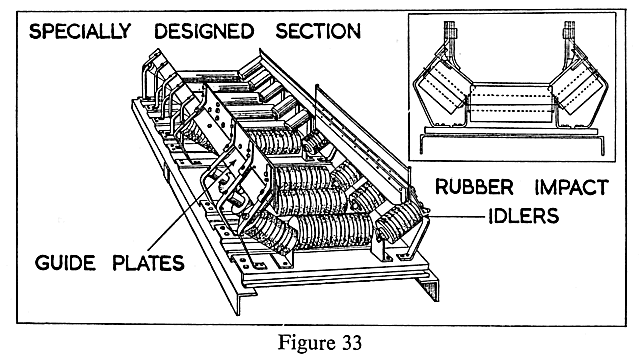
A certain amount of damage is caused to belting at transfer points by the blows from the lumps of coal or stone which fall from one conveyor on to the next. This is especially marked if the coal falls on the belt immediately over a set of idlers. This damage may be reduced by covering the idlers with rubber, as shown in Figure 33.
Stage Loader
This is a short belt or scraper chain conveyor in tandem with the gate conveyor, as shown in Figure 34.
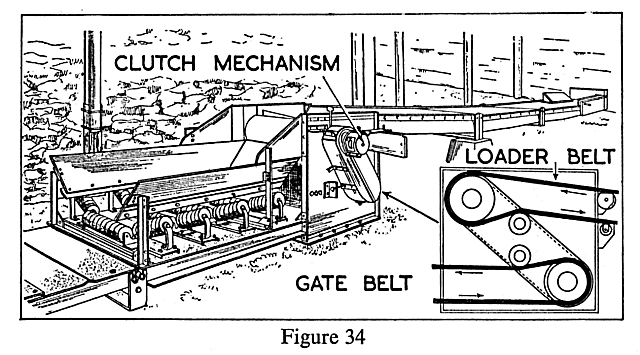
It may be driven either by the gate belt return drum through a clutch or by its own motor.
Coal from the face conveyor is conveyed by the stage loader to the gate belt.
The advantages of using such a loader are:
| (a) |
The gate belt is kept away from the rough conditions that tend to exist near the face.
|
|
| (b) |
The stage loader delivers coal on to the gate conveyor in line with the latter. This assists in the central loading of the gate belt, reduces spillage and reduces the belt 'scrub' which occurs when coal is delivered on to the gate belt from a direction at right angles to it as is done by face conveyors.
|
|
| (c) |
The daily extension of the conveyor is performed on the stage loader and the gate conveyor is extended less frequently. Thus the trouble that arises from frequent extension is confined to the stage loader.
|
Extension of the Conveyor and the Stage Loader
Daily extension consists of inserting intermediate structure and adding lengths of belting or chain to the stage loader structure (Figure 35).
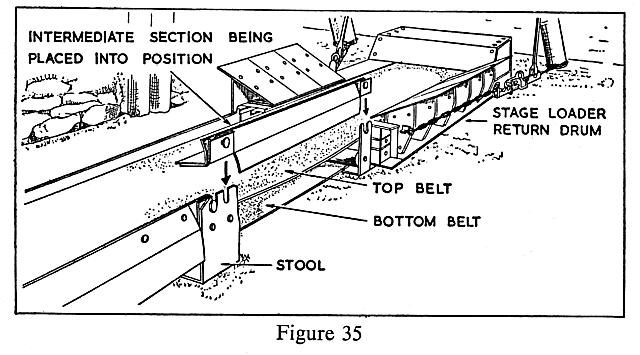
When the gate conveyor is extended sections of the stage loader are removed and stacked at the side of the roadway.


 |
 |
 |
||

Back |

Home |
Copyright © 1999-2012 by The Durham Mining Museum and its contributors
Page last updated: 01 Jan 2008 |

Search |

|