


Mail: Webmaster

|

|

|

|
|
 |
 |
|||
Chapter VII
Care of the Conveyor
The Shotfirer:
 Should see that where the tension end is drawn up to the face:
1. The shots do not disturb the anchor props.
2. The alignment of the conveyor is not upset.
The Cutterman:
1. Should not sprag the cutting machine from any part of the conveyor.
2. Should see that the return drum is properly spragged if the anchor props have to be removed.
3. Should see that gummings are not piled on to the belt.
Fillers:
1. Should not load on to the belt pieces of coal which will not ride correctly.
2. Should keep the return drum as clear as possible of small coal.
3. Should not load the belt whilst it is at rest.
Rippers and Repairers:
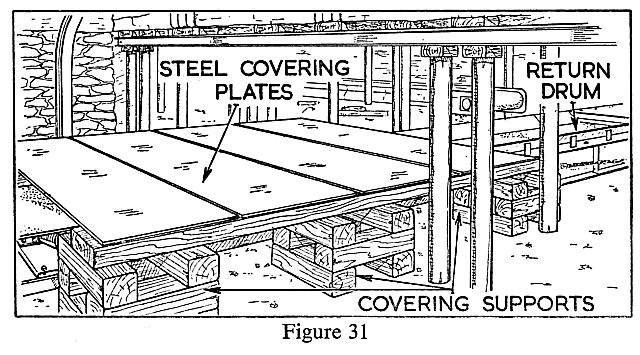
1. Should cover the conveyor structure securely before the ripping is dropped or remove the structure far enough away from the ripping area to prevent damage during blasting. One method of protecting the conveyor is shown in Figure 31.
2. Should, if any stone is filled out, see that the conveyor is properly aligned and secured to prevent damage to the belt.
3. Should not drop large pieces of stone on to the belt.
4. Should see that the conveyor is properly aligned and that all debris around the conveyor is cleared up after work has been completed.
Face Conveyor Attendants:
1. Should signal the face conveyors to be stopped or switch off the power as soon as the gate conveyor stops. This prevents the overloading of the conveyor, spillage, and extra dead load on starting.
Electricians:
1. Should see that the signalling system along the roadway is always advanced up to the face.
2. Should check and test all cables and electrical apparatus attached to the gate conveyor and replace any defective parts.
3. Should see that all cables are well clear of any moving parts, preferably with all spare cable wound on bollards secured to the steel arches or other roof supports.
Fitters:
1. Should inspect all working parts and replace where necessary any that are damaged.
2. Should properly maintain all scrapers so that they carry out their work efficiently.
Workers should:
1. Not remove, unless authorised to do so, any bolts or nuts from the conveyor or its associated equipment.
2. Not remove any cover plate or fence, unless authorised to do so and the conveyor is stopped.
3. Not put stays between the roof and the top of the motor or gearcase.
4. Not put packs under the gearcase or motor.
5. Not put stays between the roof and the belt on top of the intermediate section as this may cause damage to the belt and to the sections.
6. Not inch forward any more than is necessary a belt which is powered by an electric motor. Starting and stopping the belt should be reduced as much as possible.


 |
 |
 |
||

Back |

Home |
Copyright © 1999-2012 by The Durham Mining Museum and its contributors
Page last updated: 01 Jan 2008 |

Search |

|