


Mail: Webmaster

|

|

|

|
|
 |
 |
|||
Chapter IX
Lifting Tackle
 In the assembly of a conveyor all types of lifting tackle may be used such as the sylvester (described in Training Manual No. 1), Yale Pul-lifts and lifting jacks.
The Yale Pul-lift
There are three types of pul-lifts: ¾ ton, 1½ ton and 3 ton. The 1½-ton type is shown in Figure 36.
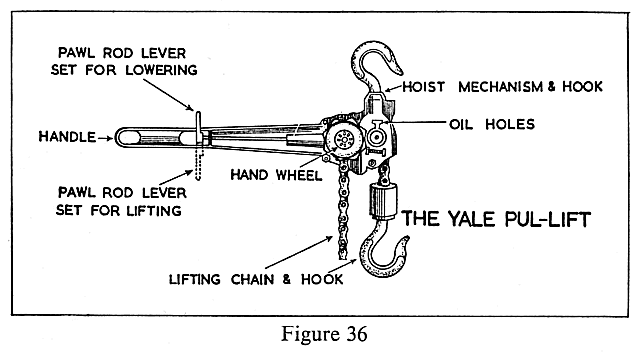
This consists of:
1. The lifting chain with hook.
2. The hoist mechanism with hook.
3. The hand wheel.
4. The load brake (not seen in diagram).
Operating the Pul-lift
To adjust the Position of the Lower Hook
1. Turn the pawl rod lever to the neutral position, and raise or lower the hook by one of the following methods:
| (a) |
Turn the hand wheel clockwise or anti-clockwise.
|
|
| (b) |
For speedier adjustment hold the two lines of chain firmly with one hand and turn the hand wheel to free the load brake. The chain can then be pulled in the direction required.
|
To Lift
Do not attempt to lift a load greater than that for which the pul-lift is designed.
1. Check that the pul-lift will work correctly.
2. Place the upper hook in position.
3. Adjust the position of the lower hook until it is attached to the object to be raised.
4. Turn the pawl rod lever so that the marking 'Up' is visible and the lever seats in the handle slot.
5. Move the operating lever downwards and then upwards until the object is raised to its required position.
To Lower
1. Turn the pawl rod lever so that the marking 'DN' is visible and the lever seats in the handle slot.
2. Move the operating lever downwards and then upwards until the object is lowered in position.
Lubrication
1. Keep the chain clean and lubricate it with machine oil.
2. Oil holes are provided with ball valve oilers. Use light machine oil.
3. Do not over oil, otherwise excess oil may run into the selfsustaining brake mechanism.
The Lifting Jack
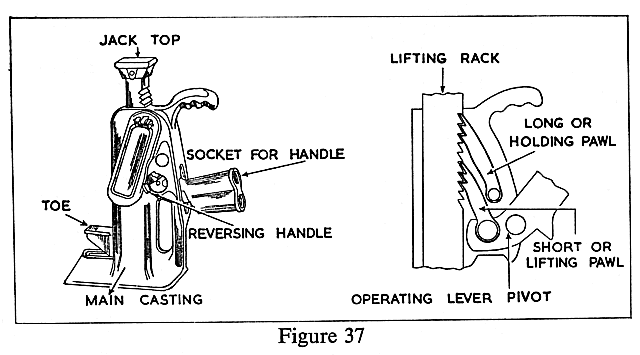
The usual type of jack used underground is the single acting variety which, as shown in Figure 37, consists of:
| (1) |
The main casting which provides a housing for the rack and the mechanism, and provides also a wide base for the jack to stand on.
|
|
| (2) |
The lifting rack which slides up and down inside the main casting. To the top of the rack is fitted a lifting plate, or jack top, and at the bottom is fitted the toe which is also used for lifting.
|
|
|
One side of the rack has a series of teeth which engages with the mechanism.
|
||
| (3) |
The mechanism and handle. The handle fits into the socket which is attached to the main casting by a pivot. From the pivot, a short (lifting) pawl engages the teeth of the lifting rack. A long (holding) pawl also engages the teeth of the lifting rack. A reversing lever, marked 'up' and 'down', is attached. This allows the rack to be raised or lowered.
|
Operating the Lifting Jack
Lifting
Do not attempt to lift a load greater than that for which the jack is designed.
1. Check that the jack will work correctly.
2. Place the reversing lever in the 'up' position.
3. Place the baseplate in a firm position so that the toe or jack top is squarely under the load (Figure 38).
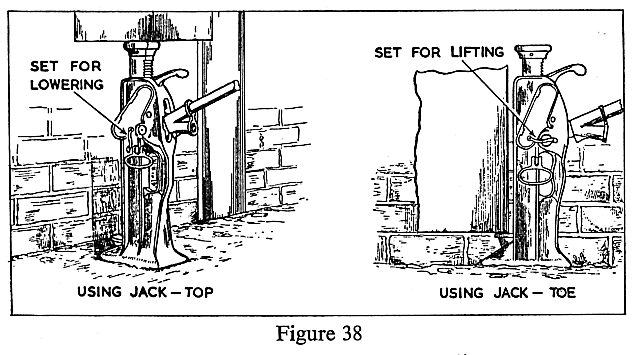
4. Place the handle in the socket and press it downwards. The short pawl engages a tooth of the rack and forces it upwards. The long pawl then engages another tooth and holds the rack in position whilst the handle is being raised to make the next movement. Operate the handle upwards and downwards to raise or push the object into the required position.
Lowering
1. Place the reversing handle in the 'down' position.
2. Move the handle upwards and downwards, thus operating the mechanism and lowering the rack.
3. Remove the jack from under the load only when it can be moved freely.
| Note: (a) |
Do not stand over the handle when it is being moved from the downwards to the upwards position, since if it is not properly controlled it may fly back.
|
|
| (b) |
Place suitable supports under the load before getting beneath it for any purpose whatever.
|


 |
 |
 |
||

Back |

Home |
Copyright © 1999-2012 by The Durham Mining Museum and its contributors
Page last updated: 01 Jan 2008 |

Search |

|