


Mail: Webmaster

|

|

|

|
|
 |
 |
|||
Chapter VI
Lubrication
 Although lubrication is usually carried out by the fitting staff it is important that all workers should recognise the importance of good lubrication. Only the type of oil and grease prescribed by the management should be used.
When Installing the Conveyor
1. The moving of a conveyor from one position to another may cause the oil in the gearbox to be lost. When a new conveyor is installed the gearbox is dry. It is therefore essential, before running the conveyor, to fill the gearbox with oil until the level plugs are reached.
2. After a fortnight's running, the oil should be drained off and fresh oil added.
Every Day
1. Check when the belt is stationary that the level of the oil in the gearbox is up to the oil level plug. If necessary, top up with the recommended grade of oil.
2. Where compressed air is used to power the motor, check the level of the anti-freezing oil.
Every Week
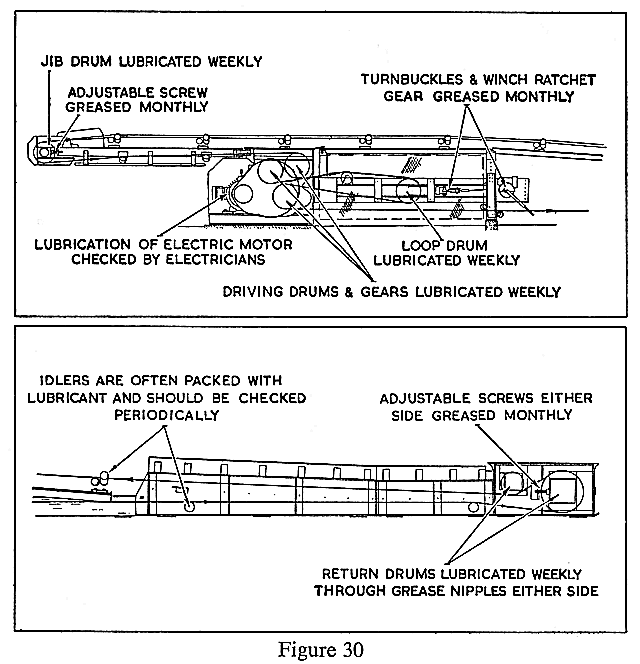
1. Grease the nipples on all drums at the drive head, jib head, loop take-up and tension end.
2. On turbine types, inspect the oil level in the reversing gearcase and add oil if necessary.
Every Month
1. Pack with grease the driving drum bearings, if they are not provided with lubricators.
2. In turbine drives, insert grease into the end of the motor.
3. Inject grease, where necessary, into the rollers of the intermediate structure and the winch ratchet gear, especially where the gateway is wet or dusty.
Notes
1. The lubrication of electrical motor bearings will be carried out by the electrical staff.
2. Air Brake. Keep light oil in the brake casing to the level of the plug on the side. Have plenty of turbine oil in the brake cylinder to keep the piston and spring from rusting.
3. Fluid Coupling. The oil level should be checked when the coupling is cold, and the filling plug should be set at the recommended angle. It is necessary to check this oil level only, say, once a year unless the coupling gets very hot when running and there is evidence of oil leakage around the coupling.
4. The machinery must be kept properly lubricated and the correct grade of oil must be used for the gears. Inspection covers must be kept properly in position to prevent small coal entering the gear case, clogging up the gears, and causing excessive wear of the teeth.


 |
 |
 |
||

Back |

Home |
Copyright © 1999-2012 by The Durham Mining Museum and its contributors
Page last updated: 01 Jan 2008 |

Search |

|