


Mail: Webmaster

|

|

|

|
|
 |
 |
|||
Chapter V
Important Points in Belt Maintenance
 1. The whole of the conveyor, the drive, intermediate structure and return drum must be in one straight line. This, more than anything else, ensures that the belt will run centrally on all parts of the conveyor.
2. Each section of the conveyor must be firmly set so that it does not rock about or get out of alignment. If this happens, it may cause the belt to ride to one side of the structure.
3. The drive and the return drum must be securely anchored. If these parts move in any way during the running of the conveyor, the belt will tend to run to one side and may fold over on the drums and so be damaged.
4. The whole of the conveyor should be properly levelled, section by section, because if the sections are not level, the belt will tend to climb to one side.
5. All changes in gradient should be properly graded so that the empty belt will run on all the rollers of the intermediate sections.
6. The belt joints should be made correctly, care being taken that:
| (a) |
if two lengths of belting are to be joined they are of the same width;
|
|
| (b) |
where rotting of the end of the belt has taken place, the rotted portion is cut away so that the fasteners may be fixed to good belting;
|
|
| (c) |
the ends of each length are cut square so that the lengths of belting when joined together will run correctly on the conveyor;
|
|
| (d) |
all hooks of the fasteners are properly bent over and all rivets properly hammered over so that they will not catch on the conveyor structure;
|
|
| (e) |
lengths of belting are correctly aligned, because if they are staggered the projecting ends may catch on the structure and tear;
|
|
| (f) |
joint pins are long enough to pass through all the fasteners to even out the tension over the whole width of the belt;
|
|
| (g) |
joint pins are not so long that they project from the joint edges, thereby fouling the sides of the conveyor, and causing the belt to slip or break.
|
| Note: |
If the above points have been properly attended to, the belt should run centrally on the structure. If, in spite of these precautions, however, the belt runs over to one side of the conveyor, it may be possible to course the belt into its central path by moving the idlers as shown in Figure 29. This is known as 'Training the Belt'. It is usual to move the third set of idlers on the inbye side of the point at which the belt runs most out of line.
|
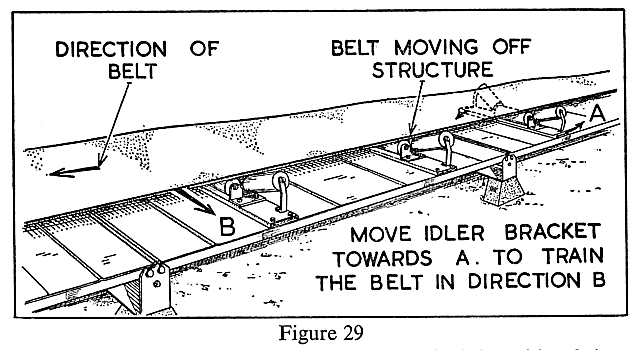
Some conveyors are now fitted with idlers which swivel automatically should the belt begin to run out of line. This helps to ensure that the belt is kept running centrally on the structure.
7. The belt should be made to run centrally on the return drum and on the driving drums. If it does not, it may tend to double over and split.
8. When starting the conveyor allow the belt to gather speed before loading it. If there is any belt slip, increase the tension in the belt at the loop take-up or tension end.
9. Excessive tension in a conveyor belt increases the effort required to drive it round and is thus wasteful of power. It also increases the likelihood of cuts and breakages and of the belt fasteners being pulled out.
10. Stop the face conveyors immediately if the gate conveyor stops, to prevent the piling up of coal at the transfer point. When the gate belt starts again, allow it to pick up speed before switching on the face conveyor. If there are two face conveyors, allow a space of time to elapse between switching on the first and second face conveyors.
11. Any defective joint which is liable to break in the drive or return drum should be repaired immediately.
12. Any torn belt edges should be trimmed to prevent the belt from tearing further. The torn belt should be replaced by a new length at a convenient time during the shift.
13. Joint pins should be examined for wear and replaced before breaking point is reached.
14. Where an ordinary fastener corrodes owing to dampness, it may be advisable to use a stainless steel type of fastener.
15. All belting should be periodically examined, and any badly worn or damaged portions should be replaced to avoid breakages during the shift.
16. Spare lengths of belting with fasteners affixed, and the length marked on them, should be kept in the gate to replace any damaged pieces of belting, so saving time in making new joints.
17. The belting on the conveyor should contain as few short lengths as possible.
18. All bent or damaged side plates, stools or standards, bottom belt cover pans or rollers should be replaced so that the belt will not be subject to excessive wear.
19. The rollers should be kept clean, so that they rotate freely and do not add to the friction of the belt.
20. The plough near the return drum must be maintained in proper working order so that the drum does not become clogged up with small coal.


 |
 |
 |
||

Back |

Home |
Copyright © 1999-2012 by The Durham Mining Museum and its contributors
Page last updated: 01 Jan 2008 |

Search |

|