


|

|

|

|
|
 |
||||
 |
 |
|||
The After-Damp.
 The after-damp encountered in the Durham collieries after the explosions appeared to possess very deadly properties. At Trimdon Grange, Tudhoe, and Usworth it caused the death of persons who descended after the explosions ; and in many cases the explorers suffered severely from it. It appeared to contain some gas other than those usually met with in mines under ordinary conditions, or such as are generally supposed to result from the combustion of fire-damp.
The gases met with in the ordinary working of coal mines are firedamp, or light carburetted hydrogen, and stythe, or carbonic acid gas. Sulphuretted hydrogen is occasionally observed. Fire-damp indicates its presence by its effect on the lamp, and is found next the roof, when pure. It does not appear to exert any prejudicial effect on the human system, even when respired to a considerable extent. Stythe is usually met with in shallow pits. In air mixed with it a lamp or candle burns dimly, and it is found near the floor. Miners frequently work in air so mixed with stythe as to render it necessary for them to place their candles close to the root and as far from the face as possible, and this not for an hour or two, but for days, without feeling any directly bad results. The writers have frequently examined parts of mines, where there was great difficulty in preserving a light, without feeling any ill effects. Sulphuretted hydrogen is readily detected by its smell. The constituents of after-damp are generally supposed to be carbonic acid gas, nitrogen, and water vapour, the two latter being non-poisonous. The presence of any of these gases in the air in such quantity as to be quickly harmful to life would be at once shown by their effect on lights.
After the explosions in Durham, it was evident that some other gas was present in the air; the lamps burnt brightly, and when they gave no indication of the presence of any kind of gas, men were overpowered. The writers have been affected under such circumstances on entering parts of the pits where ventilation had not been restored, and have been present when persons lost consciousness, and had to be carried back into purer air, and yet no indications were given by the lamps.
It was observed that the oil in some of the lamps of victims, who had perished from after-damp while waiting for rescue, was exhausted, as if the lamps had not been extinguished by the after-damp which killed the bearers, but had burnt until the oil was consumed.
At Usworth, an attempt was made to arrive at some knowledge of the gases present after an explosion in a dusty mine. On the 7th March, a stopping to cut off the air from a fire was erected in the intake at A, Plan 1. On the 9th March, a stopping was erected in the return near the same point. On the 13th March, a plug was removed from a pipe through the stopping in the return, and some of the gases which issued from the pipe was collected, by one of the writers, in two glass vessels.
Dr. Bedson, Professor of Chemistry at the Durham College of Science, Newcastle-on-Tyne, kindly furnished the following analysis :—
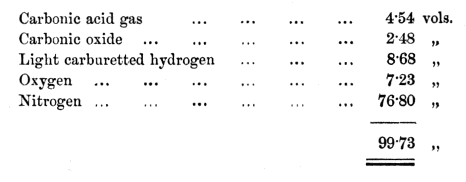
The stoppings being to the rise of a large extent of workings, firedamp was likely to be found near them. The presence of a fire beyond might have had some influence on the production of the carbonic acid and carbonic oxide gases.
The writers, knowing the poisonous nature of carbonic oxide, think it probable that the after-damp owes much of its extremely deleterious effects on the human system to the presence of this gas.
It appears, from experiment, that carbonic oxide does not indicate its presence in air by any effect on the flame of a lamp, until present in volume exceeding 10 per cent.





 Contains public sector information licensed under the

