


|

|

|

|
|
 |
||||
 |
 |
|||
General Review Of The Explosions (cont.).
 In three of the four explosions where the origin is referred to a shot, inflammation of the coal dust is assumed to take place on a main intake, in the absence of any gas other than the merest trace, and in one inflammation of the dust is assumed to take place at the face of a working place where some fire-damp would be present in the air. This inflammation continued as such, on the main intake, for from 50 to 75 yards in each direction, and for about 80 yards from the shot at the face. Some change then took place, and the further combustion was attended with violence, which continued in all the explosions up to their limit, except where the workings at the face were traversed, and here great violence was not observed, but more signs of burning were apparent, possibly owing to the difference in the character of the dust.
What is the reason of the change from inflammation, unattended with violence, to inflammation with violence, the writers can only conjecture. It is possibly owing to the compression of the air in front of the inflamed dust and air mixture by the expansion of the air behind it, from the heat evolved. The combustion of the dust taking place in air so compressed would be assisted, as Mr. Galloway has pointed out,06 by the heat evolved during compression, and it is possible that in compressed air even at ordinary temperatures, dust would burn more readily.
There appears to be some probability that at the point where ignition of the dust first takes place, the passage may not be completely filled with flame, thus at Usworth it was observed that in one direction from the shot the two wagonwaymen and the deputy overman were not much burnt, and in the other direction some dry rope, like tow, attached to the fence protecting the air pipes at the bend, and on the side opposite to the shot, showed no appearance of having been subject to flame.
After the explosion was fairly established, conditions quite different to the ordinary conditions of a colliery would exist, which appeared to be sufficient to insure the continuance of both flame and violence over the whole of those roads containing an uninterrupted supply of coal dust. These conditions would be :— ( 1) A wave of air preceding the explosion, and filling the air in the roads with coal dust. (2) Flame following instantly into compressed air charged with dust.
The writers think it would be almost impossible to assume that the whole of the main intakes over which the Durham explosions extended contained fire-damp in any appreciable quantity. At Seaham it would be necessary to assume the gas coming down the shaft, or three separate issues to take place about the time of the explosion on the three main roads diverging from the shaft.
At Tudhoe, where the air in the East and West Pits came direct from the surface by separate downcast shafts, it would be necessary to suppose two distinct issues of fire-damp.
At Usworth the air had passed no working places before reaching the shot, and could not be supposed to contain any fire-damp, beyond the merest trace.
At West Stanley some fire-damp would be present in the air where the shot was fired, but no appreciable quantity could be assumed on the main intakes.
At Trimdon Grange fire-damp was probably present in the landing, but on the main intakes it would be practically absent.
The result of experiments in boxes of limited length and area, and under conditions, and with dust differing widely from that probably present at the explosions under review, has led to the opinion that firedamp must always be present in definite quantities. It will be observed, too, that in those cases where the explosions are concluded to have originated in the absence of any appreciable quantity of fire-damp, that much damage was not apparent until inflammation had continued for a considerable distance. It would appear that with boxes, unless gas was present, inflammation alone could be expected.
When some of the working faces had been traversed by the explosions, as was the case at Trimdon Orange, West Stanley, and Usworth, the evidence of force was much less at these points than on the intake and haulage roads. The timber supporting the roof in the working faces was not disturbed to any considerable extent, while on the intake and haulage roads it was swept out for long distances. At the working faces deposits of coked dust were abundant, while their absence on the haulage roads was marked.
The reason of these differences may be the different conditions which exist in these roads and passages. In the following examination of some of these conditions, the return airways, along which the explosions did not extend, with the exceptions already stated, will be included.
The intake and haulage roads contain the freshest and coolest air, travelling generally at the highest velocities, and the air on these roads will not contain more than a possible trace of fire-damp.
The working faces give off fire-damp, which will be present in the air passing along at less velocity and higher temperature. This air will also contain the results of respiration and combustion from the men, horses, and lamps it has passed over.
The return air roads contain, in the air traversing them, all the gas issuing from the working face, and from abandoned parts of the mine, and also the results of respiration and combustion. The air travels in them at velocities varying greatly and depending on the number of roads open. The temperature of the air in them is higher than on the intakes, but lower than at the working face.
The intake and haulage roads contain both upper coal dust and bottom coal dust. The working faces contain bottom dust only. The return air roads are generally practically free from coal dust.
The intake and haulage roads are confined at the sides by stoppings of varying strength, and by doors. The working faces present more open passages in direct connection with each other. The return air roads are not so confined as the intakes, but more so than the working faces. The air on the intakes is usually drier than that at the working face or in the returns.
The presence, on the intake and haulage roads, of fine coal dust of a particular character, may possibly be the cause of the greater disturbance on these roads, and the absence of coked dust may be due to this dust not readily coking. The greater confinement to which the explosion is subject on these roads may also contribute to the greater violence.
The following table shows the number of fatal explosions in the collieries in Durham, Northumberland, and Cumberland since the year 1873, and the number of deaths supposed by the writers to be due to fire-damp and coal dust respectively :—
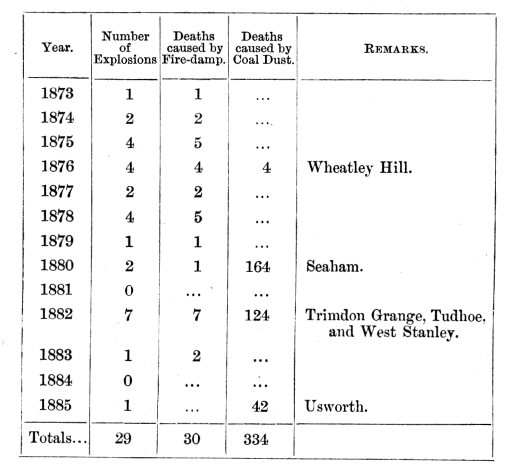
In the foregoing table it is supposed in two cases — a small explosion at Wheatley Hill Colliery, and the explosion at Trimdon Grange Colliery — that an explosion of fire-damp was the source of inflammation of the dust, and it is assumed that the person whose light ignited the gas was, in each case, killed by an explosion of gas. The remaining lives lost by these two explosions are ascribed to coal dust. At West Stanley Colliery it is more difficult to state the principal agent to which the initiation of the explosion was due, as some gas would be present, although probably not sufficient to cause explosion in the absence of dust. The two combined, ignited by the flame of a shot in the stemming of which there may have been coal dust, are assumed to have initiated the explosion, which continued along those roads on which dust lay; and dust is assumed to be the leading agent, and the loss of life is ascribed to it. Coal dust alone, or combined with possible traces of fire-damp, is assumed in three cases to be the fatal agent, viz., at Seaham, Tudhoe, and Usworth.
06 See Nature, Vol. 33, page 366.





 Contains public sector information licensed under the

