


|

|

|

|
|
 |
||||
 |
 |
|||
Usworth Colliery Explosion (cont.).
 It will be noticed that it was concluded, that while lighting the touch-paper attached to the shot, one of the stonemen used the bottom part of his Clanny lamp as an open light, and, as he afterwards screwed on the upper part, no explosion can have resulted from this naked flame; and the writers conclude that, when the shot was lighted, the pit was in its ordinary state.
It was suggested that gas might have been present in the stenton D or Cross-cut E (Plan 3). The roof of these places was below the level of the main road, and there was a free outlet to a higher level,05 and the writers do not think it possible to account for the presence of a gas lighter than air here.
The writers conclude that the concussion of the shot filled the air with dust ; this was accompanied, or immediately followed, by an issue of flame, which caused an ignition of the dust, and results followed which will be discussed hereafter.
Having dealt with the origin, the writers will follow the explosion to the shafts first, and then in the contrary direction.
The full force of the explosion appears to have been attained on reaching the top of the stone drift; and from here, by the main road to the shaft, a distance of 2,170 yards, no increase or diminution of force was noticeable. The absence of dust, owing to the presence of moisture, arrested the explosion at the shafts.
It made four side excursions on its road to the shaft :—
| 1st. — It passed to the face of the Low North. This road was very dusty on the bottom. There may have been some dust on the upper parts of the road before the explosion, but probably not much, as the coal was led by horses against a very small current of fresh air. It probably passed to the face of the Low North, mainly by the bottom dust. A short distance up the Low North road it blew out the door in the travelling way, and flame passed into this road in this direction, and probably off the main road further out. |
| 2nd. — It passed up the Middle North to the stables. The quantity of dust on the upper surfaces of this road would probably be limited, as the coal was led out of the Middle North by horses passing against a feeble current of fresh air. At the stables the bottom was damp, caused by the urine from the horses and ponies, and more dampness was caused by two large water tanks, out of which the horses and ponies drank, scattering some water in their vicinity. |
| 3rd. — It passed a short distance along the Barmston abandoned way. |
| 4th. — It passed a short distance along the Lawson's road. This road was a horse road, and the coal was led against a feeble current of fresh air. There was a considerable quantity of dust on the bottom, but it was not probable that there would be much dust on the upper parts before the explosion. The bottom dust was stony, and this appears to have arrested the explosion. |
Passing from the shot in-bye, the first branch road was the Hitch North haulage road. This was reached by the explosion before it had attained its full force. Flame had passed a short distance down this road, but no force sufficient to cause any disturbance, The coal on this road was hauled by a compressed air engine against a small current of fresh air. The roof stone had not been taken down, and there was little timber set in the road. The conditions were not favourable to the deposition of much dust on the upper parts of the road, and it was proved that water, led from the face of the Narrow Board, had been poured in large quantity on this road, near its junction with the main road, shortly before the explosion. The water ran down the road for 80 yards, and then passed through a stopping to the east. These facts account for the explosion being arrested in this direction.
The coal on the Narrow Board haulage road was led by engine power, against a current of air equal to 28,700 cubic feet per minute, as far as the Hitch North air way, and equal to 18,700 cubic feet per minute beyond that point. There would be dust both on the upper parts and floor. The explosion passed to the face of the Narrow Board, and on its arrival there, would appear to have passed round the workings to the north, and returned across the road, as evidenced by indications left at (89) and (44). The full force of the explosion was manifested a few yards down the Narrow Board, from its junction with the Cross-cut haulage road, and this force appeared to continue almost to the face, a distance of 880 yards. Near the face signs of burning, in the shape of deposits of coked dust, increased in number, and the force decreased.
At the junction of the Hitch North air way with the Narrow Board haulage road the current of air divided into two main splits. The explosion had not passed along the air way; this road was not used as a haulage road, and its consequent freedom from coal dust did not permit the explosion to traverse it.
Returning to the junction of the Narrow Board and Cross-cut haulage roads, and proceeding along the latter, the full force of the explosion was attained a few yards from the junction, and continued nearly up to the face of the Cross-cut, a distance of 960 yards. A side excursion being made along the Right Hand road.
The coals from the Cross-cut were hauled from the point where the Right Hand road left it by engine power, beyond this it was a horse road.
The following analyses of dust and coked dust, from the field of the explosion, were made by Dr. Bedson, of the Durham College of Science, Newcastle-on-Tyne. The specimens were collected on the 4th April, 1885, or 38 days after the explosion :—
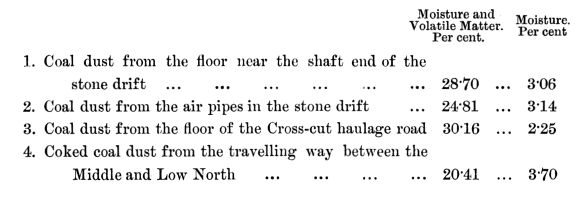
Specimen 2, from the flanges of the air pipes in the stone drift, had a feeble coherence, and may have been slightly coked.
Dr. Bedson analysed some upper dust from an engine haulage road in Washington Colliery, adjoining Usworth Colliery, with the following result :—
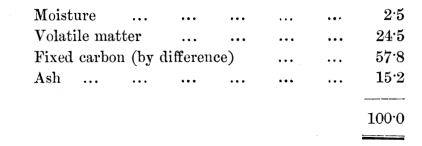
It contained 1.69 per cent, of sulphur. Its temperature of ignition lay between 190 degs. and 200 degs. (374 degs. and 392 degs. F.)
05 See Sections along lines x and y, Plan 3.





 Contains public sector information licensed under the

