


|

|

|

|
|
 |
||||
 |
 |
|||
Usworth Colliery Explosion (cont.).

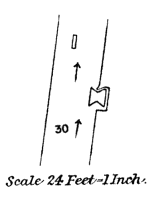 Returning to the main haulage road, 22 yards in-bye of the Low North full way, was the empty way. About 20 yards up this road, at (30), was the upper part or box of a tub laid to one side. It had been traversed by force, as shown by arrow. The out-bye end was broken and forced in-bye, and the inbye end was broken by being forced against a solid projection on the side of road. Part of the side of this tub was found some yards in-bye of the tub.
(31) Here were two empty tubs; one of them had both ends bent in-bye, or to the face of the Low North, the other tub — and nearest the main haulage road — had been twisted round, and the iron baud binding the top torn loose. It afforded no decisive indication.
Passing in-bye from the Low North on the main road, the road was much blocked by fallen stone, most of the timber having been blown out, but afforded no indications as to direction of force; things that would have afforded information being buried under the fallen stone. This continued until indications of passage of any force ceased almost entirely. The only indication of direction of force this length of road afforded was dust, which was found deposited on such timber as was left standing on the side nearest the shaft.
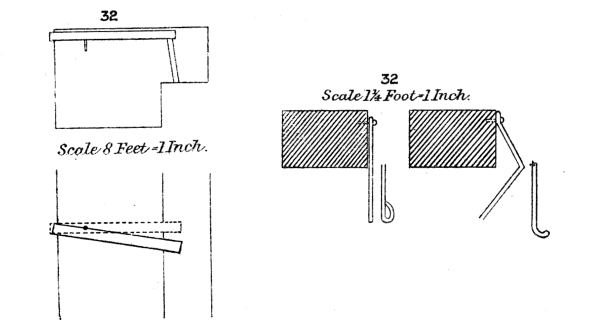
There were, however, at (32), two things observed which appeared to indicate force having passed in-bye. It became necessary to examine these with great care. A balk, supported at one end by insertion in a hole cut in the side of the road, and, previous to the explosion, by a prop under the other end, was found unsupported by any prop, and the loose end pointing in-bye.
The road was examined, and a prop of the length required to support the balk was found a few yards out-bye. It was observed that the balk had supported the rapper wire (a rope made of iron wires, and about the thickness of a pencil) ; this wire had been threaded through an iron hanger nailed to the balk, about 2 feet from its supported end and on its out-bye face. The ring at the end of the hanger was found to have been forced open, and the hanger itself was bent, as shown in the sketch. 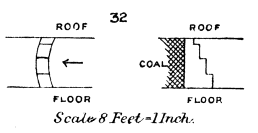 It appeared most probable that some weight had, at the time of the explosion, fallen on the rapper wire in-bye of the balk, and that this had put a strain on the hanger, bending it as shown, and bursting open the ring. A force applied to the wire capable of doing this, would be likely to twist the balk in the direction in which it was found. Some timber, a few yards in-bye of the balk, had fallen from a considerable height at the time of the explosion. The other indication, appearing to point to force passing in-bye, was a column of brickwork (the remains of a door frame), next the side of way. As shown in the sketch, the brickwork was slightly curved in-bye, about 3 inches out of the perpendicular. It appeared more probable that the curving of this mason-work was due to pressure of the roof than to any force exerted on it at the time of the explosion.
Beyond here (32), on the main haulage road, for a distance of about 150 yards, little damage was done; and when this part of the mine was arrived at it was hastily assumed by some that the limit of the explosion had been reached; but it was found that the damage recommenced, and extended far beyond this undamaged length of road. Starting from the out-bye end of this undisturbed section of road, the first 70 yards was a stone drift, driven to cross a downthrow trouble of 10 yards. There was, near the leader or fissure of the trouble (which was crossed near the outer end of the stone drift), and for a distance of 10 or 15 yards, heavy timbering, which was undisturbed. Large balks were placed at intervals of 2 or 3 feet, to support the roof. Just beyond this timbering was a wood fence to protect the compressed air pipes at a bend; this fence was undisturbed. Up to this bend, the air pipes were, in the undisturbed section of the main road, supported at a height of about 4 feet from the bottom, and at intervals of about 5 feet, by iron bands nailed to the timber, and passing round the pipes. From the bend pipe passing in-bye they rested on the floor. Beyond the bend pipe there was, for a distance of about 60 yards, very little timber in the drift, only light pieces let into the stone near the roof to carry the rapper wire. These were not displaced.
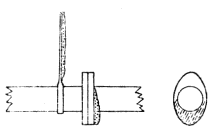 Near where the drift cut the bed of coal on the dip side of the trouble was, on the north side of the road, a stenton or passage in the coal, connecting the intake and return air ways. Up to this stenton, in the undisturbed section, there was a deposit of fine coal dust on the out-bye face of the timbering. and to a smaller extent on the in-bye face. On the hangers and flanges of the air pipes, where they were above the bottom of the road, there was a deposit of dust on the out-bye side, and this deposit was thickest next the lower part of the flange.
In the stenton already mentioned were two man-doors before the explosion; these doors had been blown in the direction of the return (33). floors set in light brickwork, and offering a surface of 30 or 40 square feet, are easily displaced, and such displacement affords no indication of the passage of great force. The remains of the doors, a large quantity of fine coal dust, some straws, used as a fuse for firing shots, some clothing, a hewer's wooden stool, and an old shovel were blown a few yards in the direction of the return. There were about six straws fastened together, but one was found sticking in a crack in a fragment of wood. The timber supporting the roof in the stenton and return was not disturbed.
Nearly opposite the stenton, on the main road, was an empty coal tub undamaged; a few yards further in, workmen's tools, placed upright against the wall side, were not blown over. Two Clanny lamps were found near the stenton, one was slightly damaged near the top, but the glass was unbroken ; the other was broken in two pieces, the poles having been snapped. It was locked, and the bottom part and the poles were in one piece, the glass being broken; the upper part was crushed flat. About 20 yards from the stenton, going in-bye, two undamaged Clanny lamps were found. A little further in-bye, timbering was undisturbed, with the exception of a prop, to which a notice board was nailed; this prop was slightly inclined in-bye at its upper end, where the board was nailed. A rapper and its framework were undamaged. A compressed air engine was undamaged. A workman's bottle was found standing upright, and his Davy lamp was hanging on a prop uninjured. Where the Hitch North haulage road leaves the main road, two full tubs were standing undamaged. They were, as well as props in the road near them, coated with coal dust on their in-bye ends or sides. Skating deals, similar to those already described, were unmoved. The first pair of canvas doors hanging in the Hitch North road (34) were blown down, and towards the face, one door was observed 3 yards from where it had hung, and lying on the rapper wire. The second pair of canvas doors on this road were not blown down. At a landing, about 180 yards along the Hitch North road, were some full and empty tubs; these tubs were not damaged, but appeared to have been forced in-bye a short distance against each other. There were no indications of any great force having traversed the Hitch North way. Returning to the stenton in which the doors stood, it was observed that out-bye, from the stenton in the return and in the direction of the staple shown on Plan 1, the props were coated with dust on the in-byeside, or in the direction of the explosion. This deposit of dust was thickest nearest the stenton. On the main haulage road, going in-bye from the stenton, the balks next the roof had a thin coating of dust on their out-bye sides, and this was so for a short distance down the Cross-cut haulage road. Large sheaves or rollers, having a vertical axis, and placed near the floor for a few yards down the Cross-cut haulage road, from its junction with the main road, were coated with dust on their out-bye side.
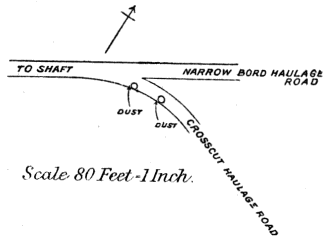 Passing in-bye, from the junction of the Hitch North with the main road, a distance of 20 yards, another junction was arrived at. The main road continued in a straight line, and was called the Narrow Board, whilst a road called the Cross-cut passed to the right. Taking the Narrow Board haulage road, the disturbance was observed to recommence within about 10 yards of the junction. (35) Here an old door, which had been used as a lime board, was found in two parts, the smaller part furthest from the shaft. It was not definitely ascertained where this door had stood before the explosion, but probably it had been placed against the side, near a cabin a few yards out-bye from where it was found. At (36) was some timber displaced, and showing force passing in-bye. A gate on one of two stables, at (37), was wrenched off its hinges, and blown into the stable a few yards. Past the stables the road was blocked with falls of stone, and these falls continued more or less to within a short distance of the face.
At (38) was a set of tubs standing on the Narrow Board haulage road, and connected at the end nearest the shaft by a chain to the side of way. This set consisted of 24 tubs; the first 17 tubs were buried under a large fall of stone, and could not be observed. The 18th and the 19th tubs were not injured. The 20th tub had its in-bye end bent out-bye. The 21st tub was lying on its side, but not damaged. The 22nd was not damaged, except where a wheel of the 21st tub had struck it. The 23rd tub had its out-bye end forced in-bye. The upper part of the 24th tub was torn off the tram, and found a considerable distance nearer the face.
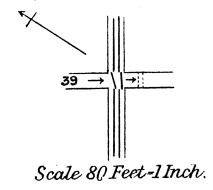 At (39) the rails appeared to have been struck by a force, as shown by arrow, or sideways, and were torn from the sleepers.
(40) Here were two canvas doors before the explosion. These doors were carried in-bye a considerable distance. At (41) a balk, unsupported at one cud, had the loose end forced in-bye. (42) Here was a landing or station, from which the tubs were drawn out-bye by engine power. The landing extended from the Narrow Board haulage road up a road to the north. Some tubs were in this landing, and the following was noted :— The 1st tub was broken up, the upper part was wanting. The 2nd and 3rd tubs were water tubs, and were partly filled with water. The out-bye end of the 2nd tub was forced in-bye, and part of the in-bye end of the 3rd tub was blown in-bye; the 4th tub was not damaged. Part of the ironwork of a tub was lying opposite the 2nd tub, and woodwork, which appeared to belong to the 1st tub, was lying opposite the 4th tub. Some other tubs were glanced at, but did not appear much damaged; they were partly buried under falls of stone.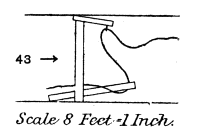 (43) Here was some timbering and rapper wire, showing force passing in-bye.
At (44) was the only example observed by the writers at Usworth of a stopping having been blown on to a main haulage road.
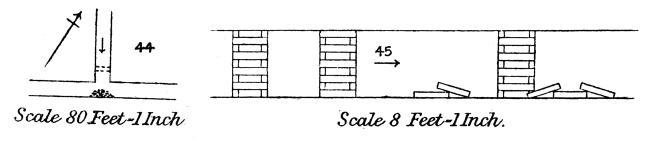
At (45) were a series of chocks supporting the roof; one chock was blown down, and the pieces making it up were scattered in-bye, as shown in sketch.
At (46) the props standing were coated with dust on the in-bye face. (47) Here a tub, which had stood before the explosion against a chock, had been forced over the chock and in-bye; it was not standing on the rails, but at right angles to them. It was on its wheels, but had apparently been overturned in-bye, the coal emptied out of it, and replaced on its wheels by the explosion.
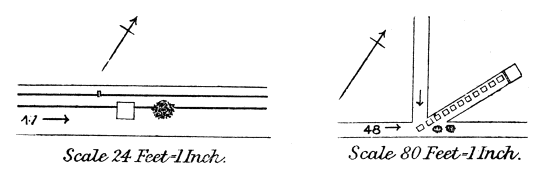
At (48) was a passage in which full tubs were placed in order to be ready for haulage by engine power. Eleven tubs were standing here. The two first tubs had been overturned in the in-bye direction, and part of the coals emptied out of them. Two heaps of coals lay a few feet inbye of the tubs. The tubs had been replaced by the explosion on their wheels. Past this point the face was neared, and the force appeared to decrease. Timbering was not displaced.





 Contains public sector information licensed under the

