


|

|

|

|
|
 |
||||
 |
 |
|||
Usworth Colliery Explosion (cont.).
 The props between the shaft and the door blown down were coated with dust on the in-byeside, or side opposite to the direction of the blast, thus —
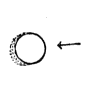 An arched road, as shown on sketch, connected the two pits and was about 40 yards long. Two men were preparing to sink the smaller downcast shaft to a lower level; they were near the bottom of it at the time of the explosion and were the only survivors on the plane of the explosion. They were knocked about by the force of the blast, but were not seriously injured, and had no bones broken. One of these men had an eye injured by rubbish or dust being blown against it, and he was marked about his face by coal dust. They had placed in the shaft, or at one side of it, a few planks to keep the shaft water off them while at work; these planks were blown down, but no damage was done to the shaft. At (5) the doors in a road leading from the smaller downcast pit to the upcast pit were blown out, and in the direction of the upcast: a large quantity of coal dust was blown into the return, but no disturbance was observed through these doors. The timber supporting the roof was not moved. The props were coated with dust on the side opposite to the direction of the blast. The upcast pit was not affected by the explosion. A gust of air had ascended it and blown open two doors on the surface leading into the Fan drift; one had closed again, the other was found open: At (6) the brickwork and door of a loose box, in which a pony stood, was blown inwards. The pony was not injured, and was the only surviving pony on the plane of the explosion. At (7) a large balk of timber, about 12 inches square and 12 feet long, was supporting the roof and rested, before the explosion, on masonry at one end and on a prop at the other. The prop was blown out and the balk was blown on the fulcrum of its supported end against the next balk, and in the direction of the shaft, indenting the balk where it had struck it.
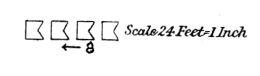 At (8) a number of empty tubs standing in the empty way near the shaft had their ends furthest from the shaft bent towards the shaft.
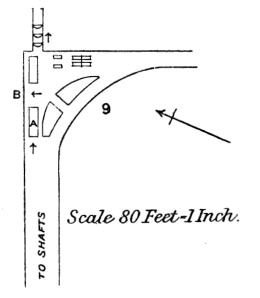 (9) A haulage engine and two multitubular boilers stood here. The smoke box door of the boiler nearest the shaft at A was forced against the tubes. The safety valve was nearly torn off.
The steam pipe, at its junction with the steam dome, was broken, and the gauge glass was broken.
The brickwork, forming the side of the boiler house at B, was forced, as shown by arrow. The gauge glass of the other boiler was broken. The smoke from these boilers passed along a flue under three man-doors. These doors were blown into the return, and the damper of the boiler flue was blown about 30 yards to the return. Timber set in the return, a few yards from the doors, was not disturbed. It was coated with dust on the side opposite to the direction of the blast.
After passing the haulage engine, going in-bye, the main haulage road was much blocked by fallen stone, the falls extending as far as the troubles shown on Plan 1. These falls, as well as others, were caused by the force of the explosion blowing out the timber supporting the roof stone, which fell in consequence. Near the troubles the road was completely closed, and no passage was available until two days after the explosion. A balk at (10) let into the sides of the road, and not blown down, showed that force had been exerted on it towards the shaft.
Passing in-bye from the troubles the road was, for a considerable distance, little obstructed by falls of stone; top coal had been left next the roof stone There was little timbering in.
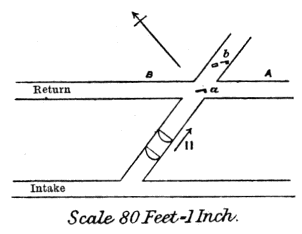 At (11) were two man-doors in a passage leading from the intake to the return. These doors were, with bricks and a quantity of coal dust, blown to the return. At (a) was a door crook, and at (b) a door crook and bricks. In the direction A, the dust was deposited on the sides of things opposite to the direction of the blast; in the direction B, the dust was on the sides of things in the direction of the blast.
With one exception, to be noted hereafter, in all observed cases, force had been exerted on the stoppings from the intake and haulage roads to the return or working face. Many of the stoppings were stowed with stones on the return side and were not blown out but were pushed over next the top; others, of a lighter nature and not stowed behind, were blown out and to the-return.
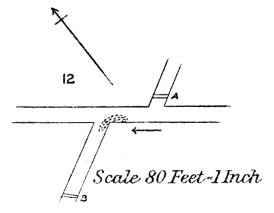 Near (12) a phenomenon was observed that appeared to indicate force coming on to the intake from the side, and also force having a direction in-bye; the stoppings on the left side going in-bye were set close to the intake as at A; on the right side they were set back some yards, as at B, and the space between them and the intake used as a deposit hole for dust and rubbish. This dust and rubbish was, in some cases, strewn in-bye, as shown. There could be no doubt that the force of the explosion travelled out-bye past these points, as shown by arrow. Air would be forced into these places against the stoppings, and the recoil would appear to have brought out some dust and rubbish, and from the direction in which it was strewn, the air would appear to have reversed.
(13) A set of empty coal tubs was standing here and they afforded unmistakable evidence of having been traversed by a force passing outbye. These tubs were connected by a main-and-tail rope with the haulage engine near the shaft; the tail, rope prevented the tubs being forced to the shaft, and the upper parts of the tubs furthest from the shaft and those first struck by the explosion, were broken off from the trains or lower parts and carried some yards in the direction of the shaft, leaving the lower parts in connection with the tail rope. A compressed air receiver stood near these tubs. The air pipe from its in-bye end was broken right across close to the receiver. The flat ends of the air receiver were dusty, and there was most dust on the outbye end, or end opposite to the direction of the blast. At (14) and (15) props supporting tail rope sheaves were broken and bent to the shaft.
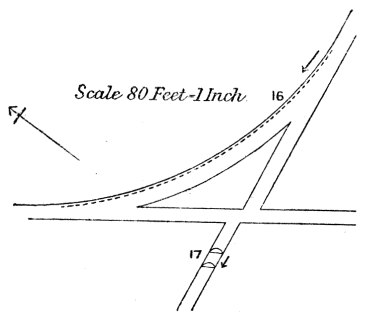 (16) Here was a curve in the main haulage road, on one side of which had been skating deals, shown by dotted line, against which the tub sides pressed while passing round the curve. These deals were blown out-bye. The horse road into the Lawson's district left the engine plane here. Doors at (17) on this road were blown towards the face, and some timber was displaced, causing a fall of stone. The explosion had not passed far up this road. At (18) were two regulating doors in an abandoned way, known as the Barmston way. These doors were blown down, as shown by arrow.
(19) A brick arch air crossing stood here, and was blown out. It will be observed that the return air crosses the intake at two points nearer the shaft. Both these crossings were natural crossings, and were not affected by the explosion.
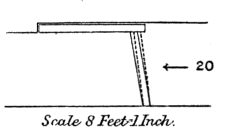 (20) Here a prop under a running balk, or balk set parallel to the side of road, showed out-bye force.
(21) A brick arch air crossing stood here, and was blown out, and coal dust was blown towards the return.
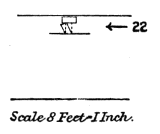 (22) Short props, or punch props, set under one end of balks, and resting on ledges in the stone, were forced out-bye.
(23) A brick arch air crossing here was blown out. The main haulage road was, from (16), passing in-bye, much blocked with fallen stone as far as (32). The rapper handle, near the Middle North way end, was found 29 yards out-bye from the place Where it was fixed; but this may have been caused by force applied to the rapper wire at some distance from it.
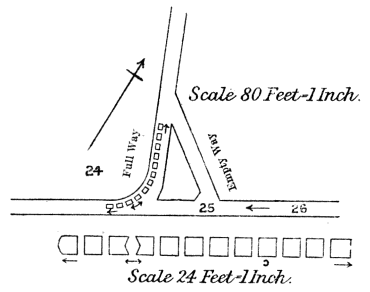 (24) The Middle North horse road left the main road here.
A set of eleven full tubs and an empty water tub stood here, as shown in sketch, and afforded indications of having been struck by a force passing out - bye and into the Middle North. Commencing nearest the shaft :— The out-bye end of 1st tub was bent out-bye. The 2nd tub was not damaged. The 3rd tub was in such a position that its in-bye end was exposed to a force coming from in-bye on the main road; this end was forced out-bye.
The out-bye end of the 4th tub was slightly bent in-bye, as though a division of force had taken place between it and the 3rd tub. The 5th, 6th, 7th, and 8th tubs were not damaged. The 9th tub was an empty water tub, the iron frame round the top and part of the woodwork were torn off, and were found lying on the 7th tub. The position of this detached portion indicated force passing out-bye from the Middle North, but the way in which it was bent indicated force passing into the Middle North. It had apparently been moved before being observed. The road into the Middle North lay past these tubs, and the detached portion of the water tub, if lying on the road, may have been carried back by workmen and put to one side. The 10th and 11th tubs were not damaged. The 12th tub had the top part of its in - bye end blown in-bye and into the Middle North. Past these tubs, and going into the Middle North, was a heavy fall of stone, which extended into the stables occupying the side of the Middle North haulage road. The explosion did not pass these stables. On the main haulage road, at (25), some sacks of hay were observed. These sacks were, before the explosion, in the empty way of the Middle North, and appeared to have been moved in the reverse direction to that of the explosion.
(26) Here a set of 30 full tubs afforded unmistakable evidence of force having passed over them, as shown by arrow, and from in-bye to out-bye. There were some falls of stone on these tubs, but the marks of force were not such as could have been caused by stone falling on them. This set of tubs extended past the Middle North empty way.
From B to C, Plan 1, on the main haulage road, was not examined, owing to this portion being barred off by stoppings put in after the explosion to isolate a fire.
A road, connecting the Middle North and Low North haulage roads, and parallel to the main road, was made use of to pass the closed part. This road was called the travelling way. There had been no great force exerted on the travelling way. Some chocks were disarranged. A door next the Low North horse road, at (28), was blown as shown by arrow, and bricks from the door frame were scattered along the road. The door crooks were found 20 or 30 yards along the road.
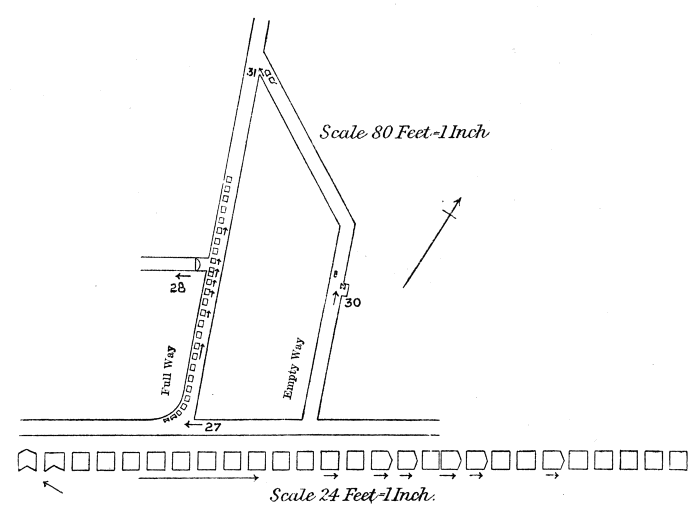
(27) At the Low North way end there was in the full way a set of 27 full tubs, the two first tubs standing nearly in the main road, the remainder extending up the full way. Beginning with the tubs nearest the shaft :— The first two tubs were forced against the side of road and had their sides bent, as shown by arrow. The 3rd, 4th, 5th, 6th, 7th, 8th, 9th, 10th, 11th, and 12th tubs were not damaged, but the chains connecting them were taut, as though the 1st and 2nd tubs, having been blown off the rails and jammed against the side, had prevented movement further than the chains would allow. Some stone had fallen on the 1st and 2nd tubs, but the damage done to them was not such as would be likely to be caused by stone falling on them. The 13th tub had the top part of the in-bye end blown in-bye, or up the Low North way. The 14th tub was not damaged. The in-bye ends of the 15th and 16th tubs were bent in-bye. The 17th tub was tilted up against the 18th tub thus :—

The in-bye ends of the 18th and 19th tubs were bent in-bye. The 20th and 21st tubs were not damaged. The in-bye end of the 22nd tub was bent in-bye. The remainder of the tubs were not damaged. These tubs extended past the travelling way, the door of which, as already mentioned, was blown, as shown by arrow. At (29) were two doors before the explosion. These doors were blown towards the face of the Low North way, and were buried under a large fall of roof, which almost blocked the road. A short distance beyond this fall was the working face of the Low North way, and no further damage was observed.





 Contains public sector information licensed under the

