


|

|

|

|
|
 |
||||
 |
 |
|||
West Stanley Colliery Explosion.
 On the 19th April, 1882, an explosion occurred, about 1 a.m., at West Stanley Colliery, in the County of Durham, causing the death of 13 persons and 18 horses and ponies.
The explosion was confined to workings in the Busty Seam, lying at a depth of 280 yards at the shafts. In addition to the Busty Seam, there were worked, at 78 yards, the Shield Row Seam; at 186 yards, the Low Main Seam; and at 194 yards, the Hutton Seam. The workings in these seams were not affected by the explosion.
The downcast shaft is 12 feet in diameter ; coal was raised in it from the Busty and Hutton Seams. This shaft was wet. The upcast shaft, 14 feet to the west of the downcast, is 10 feet in diameter; coal was raised in it from the Low Main and Shield Row Seams.
The Busty Seam lies nearly flat, and is of the following section :—
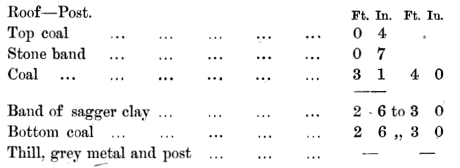
Only the upper 4 feet were worked.
From the downcast shaft, haulage roads extended north and south the explosion did not extend to the north of the shaft. A short distance south of the shaft a road passed to rite west into the principal district of the colliery.
The haulage was all performed by horses and ponies. About 150 tons of coal a day were raised from the Busty Seam.
A Guibal fan, 30 feet in diameter and 10 feet wide, placed at the top of the upcast shaft, exhausted the air from the mine. The quantity of air circulating in the Busty Seam was 27,600 cubic feet per minute. It was distributed as follows :—
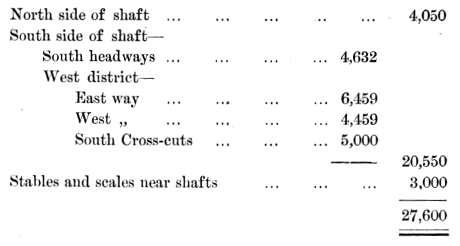
There were 8,596 yards of intake air way, and 2,619 yards of return air way ; the average sectional area of the intakes was 32 square feet and of the returns 86 square feet.
The explosion took place when the pit was occupied by a shift of repairers and stonemen.
Clanny safety lamps were used. Gunpowder was used to a limited extent in working the coal, and for stone work.
The Busty Seam at West Stanley was a fiery seam. The coal was dry and very dusty. There was much dust in the workings, as well as on the roads over which the coal was led to the shaft.
The workmen had, under the 30th General Rule of the Mines Act, last examined the mine in the preceding November, when their report was satisfactory. There had been nothing observed by the officials in their examination of the mine, the day before the explosion, to lead them to suppose an explosion possible.
The explosion extended over all the workings, except those to the north of the shaft.
Entry was soon effected into the mine after the explosion. No fires were caused by the explosion; and, as the extent of the workings was small, the pit was rapidly explored, and the bodies of the victims were all recovered on the day of the explosion.
At the bottom of the downcast shaft (1) the cage was blown out of the guides, and the guides were broken. The explosion had not crossed the shaft; some small disturbance on the north side being due to the explosion on the other side. Thus, near the shaft on the north side, some tubs were moved, but not broken; a cabin door had one of its planks forced in to the cabin; an air crossing 90 yards from the shaft, formed of wood, was slightly raised. No timber was blown out here.
At (2), a wood air crossing was blown up. Iron slivers from this crossing were blown 10 yards out-bye. At (3), two quadrants and weights, from switches at a siding, were both blown 15 yards out-bye. At (4), timber in "hole and driving end" was blown out-bye. At (5), portions of doors appeared to have been blown in opposite directions. At (6), an unused man door, said to have been lying on the out-byeside of an air crossing before the explosion, was found lying on the in-byeside of it. At (7), bricks from a door setting, door stanchions, and door bands were blown eastward, or towards the face. At (8), a door was blown westward. At (9), tubs had been traversed by force passing inward. At (10), a kibble, or light tub, with its tram, was blown in-bye. Stoppings and doors were blown as shown by arrow heads on Plan 2. There were some heavy falls on the haulage roads, caused by timber being blown out. The evidences of flame were abundant. All the men who were killed were either burnt or slightly singed. Near the working faces, in the return air ways, and in the unused passages, much coked coal dust was observed. On the main haulage roads, where the force had been greatest, no coked dust was observed. Near the face of the South Crosscuts a tin water bottle stood upright, and was found to be about half full of water, and it was observed that the solder above the water had been melted by the heat.
There were on the plane of the explosion 18 persons, five of whom survived. The survivors were four men and a boy from the north side of the shaft. There were no fires on the plane of the explosion, and no naked lights, except, possibly, at the bottom of the downcast shaft. Each of the workmen had a safety lamp. Shots were to be fired in the face of both the South Cross-cuts to blast down a depression in the roof stone called a "roll."
The workmen on the plane of the explosion may all be included in two of the divisions already used — 1st, the survivors; 2nd, victims in the field of the explosion. The survivors, workmen on the north side of the shaft, had been under no alarm up to the moment of the explosion.
Of the victims five were at the bottom of the downcast shaft, which, in the ordinary course of their work, they were about to ascend. Two were in the South way, and were found near their place of work. The remainder of the victims comprised two shifters, or repairers, at the East fiat, who were found within a short distance of their place of work, and four stonemen, working at the face of the South Cross-cuts, also found a short distance from their working places. The position in which these men and their lamps were found will be more fully described.
As the indications (2), (3), and (4) clearly showed that the explosion had come out from the district to the west, the possible places where the explosion might have originated are limited to two — one being in the East way, where the two shifters were working at the face of the waggonway board; and the other in the South Cross-cuts, where four stonemen were engaged in blasting down stone at the face.
All these men were using Clanny safety lamps, which, after the explosion, were tested in a stationary mixture of lighting gas and air, and did not pass the flame.
The two shifters were found about 30 yards from the face of the board in which they were working. They were lying one over the other, beside a tub, against which they appeared to have fallen, while running out. One of their lamps was found about 6 yards from the face. The other lamp was about 4 feet from the face, under a stone which had fallen from the roof, the lamp being uninjured except that the poles were slightly bent. There was also a prop under the stone, which had probably been supporting it before it fell. The stone had fallen away at a trouble or dislocation of the strata, which crossed the board close to the face. It appeared to have fallen after the explosion, for although the lamp found under, it was buried in dust; the upper side of the stone was clean, and not dusted, as it would have been had it fallen prior to, or at the time of the explosion. The brattice was disarranged, and there was gas near the face. The board appeared to be uneasy and was heaving: it was approaching disturbed ground, intersected with troubles. The movement of the strata in the board continued for several days after the explosion, and the fall in the face extended up the leader of the trouble as far as could be seen. There was always gas in this cavity, and gas could be heard issuing from the floor near the face.
The bodies of the stonemen working in the South Cross-cuts were found at the places shown on Plan 3. The men had been engaged in blasting down a "roll" of stone, which had appeared in the face of both Crosscuts. Westgarth and Riley working at the face of the fore Cross-cut, and Hutchinson and Douglas at the face of the back Cross-cut.
Westgarth was found about 60 yards from the face of the fore Crosscut, lying on his face, clean, and so slightly burnt that the burning was not observed in the pit. He had evidently been overcome by the afterdamp, while running out. Riley was about 30 yards from the face, clean and unburnt, except that his hair was slightly singed. He also had been overcome by after-damp. The lamps of these men were found clean and uninjured, standing upright on the floor at the face of the fore Crosscut. Riley's lamp was locked. Westgarth's lamp was unlocked, but not open. A shot here was stemmed and ready to fire, a straw full of gunpowder projecting from it.
Douglas was found in the fore Cross-cut, black and burnt, between Riley and Westgarth. Hutchinson was found in the stenton, or passage between the Cross-cuts, black and burnt. Douglas's lamp was just within the stenton off the fore Cross-cut, about 15 yards from its owner. It was unlocked but not open, and was saturated with oil and covered with coal dust slightly coked. Hutchinson's lamp was in his hand; it was covered with oil and coal dust and some coked coal dust was on it. It was unlocked, but screwed together.
In the face of the back Cross-cut was lying the result of a shot or shots — stone shot down and not removed. On these stones there was a cracket or wooden stool. A pick was observed within a few yards of the face.
The canvas brattice in the fore Cross-cut was standing; and was charred to a cinder opposite the stenton, as if by a volume of flame coming out of the stenton. The brattice in both Cross-cuts was disarranged, and there was gas next the face, when first reached after the explosion.
Westgarth and Hutchinson were authorised to unlock their lamps for the firing of shots.
A consideration of these observations leads the writers to the conclusion that, at the time of the explosion, Westgarth and Riley had been in the face of the fore Cross-cut (where their lamps were found) preparing to fire a shot. Being in a cul de sac they would be preserved from the passage of the blast over them, and the appearance of their bodies and lamps, clean and almost unburnt, confirms this view. Douglas and Hutchinson would appear to have been in the stenton or passage between the Cross-cuts, where Douglas's lamp was found, and also Hutchinson himself with his lamp in his hand. The bodies and lamps of both these men had evidently been traversed by the blast, which would be the case if they were in the stenton. The positions assigned to Douglas and Hutchinson were such as they would naturally have taken while awaiting the explosion of a shot.
The finding of the cracket or stool on the stones blown down would appear to negative the idea that a shot was the cause of the explosion, but from a consideration of all the circumstances the writers conclude that it was. Many cases were observed in some of the other explosions where bodies, much heavier than this cracket, were blown in the direction opposite to that of the explosion; and it is possible that the stone on which it was lying was brought down by a previous shot.
It was difficult to reconcile the way in which the door at the East fiat (7) was blown, as well as all the stoppings along the east side of the North Cross-cut haulage road, with the supposition that the explosion began where the shifters were working. There was no means of ignition there save their lamps; and to conclude that the explosion began there, it is necessary to assume that there had been a sudden outburst of gas, which fired by impinging on the lamps with a velocity greater than they could withstand.
On the other hand, all the indications of the direction of the explosion (except the cracket) agree with the idea that it originated in the South Cross-cuts, and all the conditions necessary for its ignition were present there. The air in the back Cross-cut would contain a small proportion of fire-damp, as the place itself, and the workings through which the air had previously passed, were giving off gas somewhat freely; it is not necessary to suppose that it was present in such quantity as to be detected, and the fact that a lamp would have to be opened to fire a shot renders this very improbable. A mixture of fire-damp and air, where the proportion of fire-damp is too small to be detected on the flame of the lamp, is known to become inflammable when coal dust is also present. There was much coal dust in this place, and possibly some in the stemming of the shot.
In this explosion, all the roadways and open passages in the west and south districts appeared to have been filled with flame, with the exception of the return air road from the west district. In all these roads and passages there was much coal dust, but in the return air way from the west district there was a collection of water where it joined the workings. Connecting the west and south districts, there were, for a distance of about 250 yards, only two roads, an intake and a return. They were both nearly straight and of about equal area. In extending from the west to the south district, the explosion had been confined to the intake air road. The water appeared to have arrested it in the return.
The explosion was arrested at the downcast shaft. The shaft was wet, and consequently the roads for some distance, on each side of it, were damp and free from dust.





 Contains public sector information licensed under the

