


|

|

|

|
|
 |
||||
 |
 |
|||
Tudhoe Colliery Explosion.
 On the 18th April, 1882, at about 1.15 a.m., an explosion resulting in the loss of 37 lives took place at Tudhoe Colliery, in the County of Durham. Seventy horses and ponies were also killed. One person who descended after the explosion lost his life by after-damp.
The explosion was entirely confined to workings in the Brockwell Seam, on one plane, which lies at the shafts, at a depth of 174 yards.
At a depth of 90 yards the Hutton, and at a depth of 134 yards the Busty Seams, were being worked from the same shafts, but these workings were not affected by the explosion, nor were any lives lost in them.
Three shafts were sunk to the Brockwell Seam. The East Pit, 12½ feet diameter, was a downcast shaft, and coal from the plane of the explosion was raised up it. The West Pit, 12½ feet diameter, was also a downcast shaft, and coal from the plane of the explosion was raised up it. These shafts were 58 yards apart. The Success Pit, 13 feet diameter, and situated 180 yards from the downcast shafts, was upcast for the whole colliery, and was used for no other purpose. The downcast shafts were wet.
The general inclination of the Brockwell Seam was to the N. E., dipping in that direction at the rate of about one inch per yard.
From the East Pit a haulage road extended in each direction to the north and south. That to the south was not affected by the explosion. To the right of the road, passing to the north from the East Pit, were three main branch roads, called the Shieldfield, Croxdale, and Coldstream ways. From the West Pit a haulage road, with several branches, extended in a westerly direction. Two engines near the pits, supplied with steam from the surface, hauled the coal from the various landings by means of main and tail ropes.
The ventilation of the whole colliery was caused by a Guibal fan, 40 feet in diameter, and 12 feet wide. It stood at the top of the upcast shaft and exhausted the air. The quantity of air passing through the mine amounted to 174,600 cubic feet per minute; of this quantity 85,000 cubic feet was from the Brockwell. It was distributed as follows :—
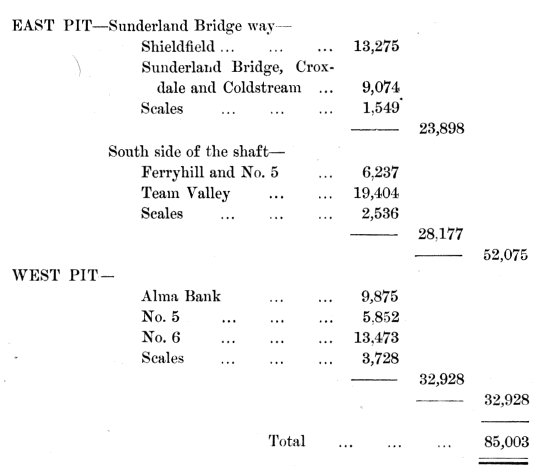
The main intake and haulage road of the East Pit extended north for a distance of 2,035 yards, and that of the West Pit 2,024 yards to the west. These, with branch intake and haulage roads, return air ways, and working faces, made up a total length of roadways in use in the district of the explosion of more than 22,000 yards.
The sectional area of the East Pit main intake was 42 square feet, and of the West Pit main intake 49 square feet. The branch intakes were smaller in sectional area.
The return air ways varied in sectional area from 21 to 314 square feet. The whole of the air from any district was seldom confined to one return air road.
The greater part of the working faces were occupied by three shifts of hewers, the last or night shift returning to the surface about midnight.
It was during the interval between the night shift and early morning, or fore shift of hewers, that the explosion took place. The men in the pit at the time of the explosion were chiefly repairers and stonemen.
More than 1,000 tons of coal per day were raised from the plane of the explosion.
The Brockwell Seam is 3 feet 6 inches thick at Tudhoe Colliery.
The Davy safety lamp was principally used, but some Clanny and Stephenson lamps were in use.
Gunpowder was used in the coal in the whole or first working, but not in the pillar workings. It was used in stone work also.
The Brockwell Seam at Tudhoe did not produce much gas. Firedamp was seen occasionally near the goaf edge.
The coal was generally dry and dusty, and the greater part of the engine haulage roads were dry.
The workmen of the colliery had, under the 30th General Rule of the Coal Mines Act, examined the districts affected by the explosion on April 6th, 7th, 11th, 12th, and 13th, and their report was satisfactory.
The officials of the colliery knew of no unusual source of danger. Within two hours of the explosion a shift of deputy overmen had come out of the pit from the various districts, and they stated that everything was in its usual state when they left the pit. The master-shifter, the officer in charge of the pit at the time of the explosion, survived, and stated that his examinations of the mine had revealed nothing to lead him to suspect an explosion possible.
Entry was soon effected into the mine after the explosion by the East Pit shaft, which was not much damaged. No fires had been caused by the explosion, and no unusual difficulties were encountered. The pit was rapidly explored, and the last body was brought to the surface four days after that on which the explosion occurred.
It was found that the explosion had reached the downcast shafts and the engine-landings in the Sunderland Bridge way of the East Pit, and in the West way of the West Pit, and had extended for some distance into all the branch ways. The landings mentioned are about 2,500 yards apart by the route traversed by the explosion — that is, along the main intake air ways.
The circumstances of this explosion were not so fully investigated by the writers as those in the other cases were. The explosion at West Stanley occurred the night after that at Tudhoe, and diverted attention from the explorations at the latter place. From this and other reasons the indications observed were comparatively few.
(1) Considerable damage was done to the timber in the East and West Pit shafts. Passing from the East Pit along the Sunderland Bridge haulage road, at the junction of the travelling way to the West Pit (2), a brick wall was blown southward. The timber on the Sunderland Bridge road was displaced from the East Pit as far as the second air crossing (3). Beyond this point, up to the Shieldfield way end, the timber was not disturbed. Here the disturbance recommenced and continued up to the landing in the Sunderland Bridge way. Within the Shieldfield haulage road a chest, at (4), was blown in-bye, and, at (5), tubs had been traversed by force passing in-bye. The air vessel of a pump had been forced in-bye near these tubs. The explosion ceased at the landing in the Shieldfield way. It had passed up the Croxdale and Coldstream haulage roads some distance.





 Contains public sector information licensed under the

