


|

|

|

|
|
 |
||||
 |
 |
|||
Trimdon Grange Colliery Explosion.
 On the 16th February, 1882, at about 2.30 p.m., an explosion took place at Trimdon Grange Colliery, in the County of Durham. It caused the death of 68 men and boys and 11 horses and ponies in that colliery, and the death of 6 persons in the workings of the East Hetton Colliery adjoining. Two of the latter — Mr. H. C. Schier, manager, and T. Blenkinsopp, master wasteman — descended after the explosion, and were killed by after-damp while endeavouring to rescue the workmen.
The explosion was entirely confined to workings in the Harvey Seam, on one plane, which, at the shafts, lay at a depth of 286 yards.
The Low Main Seam was being worked at a depth of 194 yards, but was unaffected by the explosion.
The downcast shaft, 12 feet in diameter, was sunk a few yards below the Harvey Seam, and coal was raised from it up this shaft by two cages running in wire rope guides. This shaft was wet. The upcast shaft lay 40 yards to the east of the downcast, and was sunk to the Low Main Seam only; it was 13 feet 9 inches diameter. A staple, 10 feet in diameter and 92 yards deep, sunk from the Low Main to the Harvey Seam, near the upcast shaft, was the upcast from the Harvey Seam workings.
The general inclination of the Harvey Seam was to the N.E., the dip in that direction being about 2 inches to the yard.
From the downcast shaft haulage roads extended to the north and south. The explosion did not affect the districts to the south of the shaft. To the west of the haulage road passing northward, were three principal districts — the Headways, the Cross-cut, and the Pit Narrow Board districts.
The haulage from the landings (shown on plans) was effected by an engine near the shafts working main and tail ropes.
The ventilation of the colliery was caused by a furnace in the Harvey Seam-at the bottom of the upcast staple. This furnace was fed with return air from the plane of the explosion. A furnaceman was in attendance at the time of the explosion, and there was no reason to suppose that the fires were not in their ordinary state.
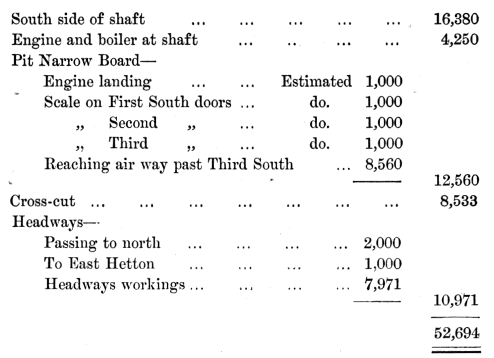
The quantity of air circulating in the Harvey Seam amounted, when measured eight days before the explosion, to 52,694 cubic feet per minute. It was distributed as follows :—
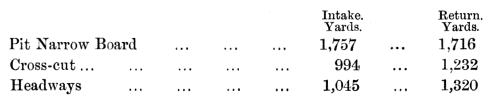
The lengths of the intakes and return were :—
The sectional area of the intakes was about 48 square feet, and of the returns about 36 square feet.
The explosion took place during full work; the working faces were occupied by hewers, and all the persons ordinarily employed in the leading of the coal to the shaft were in the mine.
About 400 tons of coal per day were raised from the Harvey Seam.
The Harvey Seam here is 3 feet 8 inches thick.
The Davy safety lamp was used by those workmen employed on the in-byeside of the caution boards.
Powder was used in the coal on the day of the explosion, and generally it was so used to a limited extent, and also for stone work.
The Harvey Seam at Trimdon Grange was moderately fiery. Near some points at the goaf edges gas was seen regularly ; but these points were in the return air ways.
The coal was dry and dusty, and the roadways were dry, except at some points.
The barometer was low at the time of the explosion, and the minimum temperature was below freezing point some time during the day of the explosion. The following observations were taken at the colliery some time during the morning of the 15th and 16th :—

At Durham University Observatory, on February 16th, the maximum temperature was 52.8°. F., and the minimum 29.0°. F.
The workmen had not made a complete examination of the Harvey Seam for a year and a half before the explosion. A special examination of the Headways district was made on the 24th of August, 1881, after some of the workmen had seen some gas near the goaf. When this examination was made no gas was found.
The officials of the colliery, from their examination of the mine on the day preceding, and on the day of the explosion, had discovered no unusual source of danger.
The damage done to the downcast shaft being small (partly owing to the absence of timber in it, wire rope guides being used) and no fires being caused by the explosion, the exploration of the workings, and recovery of the bodies of the victims, was rapidly effected; no special difficulties were encountered. The last body was brought out within three days of the explosion.
It was found that the explosion had extended to the downcast shaft, and to the working face in the Pit Narrow Board and Headways districts.
The most distant parts affected by the explosion were 2,800 yards apart by the route traversed by the explosion; this route being along the main intake and haulage roads. No damage was done in the return air ways, except at points where doors, stoppings, or air crossways were blown into them from the intakes. Near the face of the workings and in the return air ways adjacent, at both extremities, there was coked coal dust on the timber. On the intake air roads, where the greatest damage was done, no coked dust was observed, but men and horses who had been on these roads at the time of the explosion were all burnt.
The timber at the bottom of the downcast shaft (1) was blown out, and the wire rope guides disarranged. Near the shaft two pairs of separation doors were blown from the intake to the upcast staple and furnace. Some force had passed over the furnace, blowing the bridge to the staple.
On the south side of the shaft some force had been exerted, but this exhibition of force did not extend far, and was due to the explosion on the north side.
The roof stone at Trimdon Grange was generally good, and fewer falls of stone were observed than otherwise would have been the case.
Passing from the downcast shaft down the Pit Narrow Board or main intake and haulage road, it was observed that the timber was all displaced. Three air crossings were destroyed, being blown from the intake to the return, and three pairs of doors were blown in the same direction; but no indication of direction of force along the main road itself was seen until the engine landing (2) was reached. Here, about 20 yards south of the landing, there were some indications of force out-bye, or to the south some light articles, including "bait tins," or provision cases, were found nearer the shaft than the place where they were usually kept. Here also a rapper lever was found 11 yards nearer the shaft than the place where it had been fixed; this might, however, have been caused by some weight falling on the wire further out.
A set of full tubs stood within the landing. The tub nearest the shaft was broken, as if by force passing northward, the top only was broken ; the coal was piled up, and the corner pieces forced northward.
At the First South way end (3) part of the door frame, one of the door bands, and bricks from the door setting, were blown towards the face. The trapper boy who attended the door was found nearer the face than where the door had stood ; he was enveloped in a canvas sheet, which hung on the in-byeside of the wood door, as if he had been blown into it.
A few bricks were found as though they had been blown outward from the door, and opposite the way end, some debris, consisting of dust and pieces of wood and coal, was blown against the side of the way, or northward. At (4), in the First South way, the clothing of the putters was found 30 yards nearer the face than the place where they were in the habit of leaving it on commencing work. The stoppings on each side of the First South way were blown to right and left.
At the Second South way end (5) the door stanchions, and one of the door bands, were observed 20 yards nearer the face than where the door had stood. Tools and nails, which had been in a chest standing on the out-byeside of the door, were found scattered in the direction of the face, or in-bye. Here, as at the First South way end, there also appeared to have been some force outward, the remains of the chest, with other debris, were blown against the wall side, opposite the way end. At (6), on the Second South haulage road, putters' clothing was found 14 yards nearer the face than the place where they were in the habit of leaving it. The stoppings on each side of this road were blown to right and left.
The main haulage road between the Second and Third South ways was undisturbed; the timber was standing, and a driver with a horse and set of tubs on this part of the road were uninjured and unburnt. The horse and driver had been killed by after-damp.
At the Third South way end (7) the door was shattered, but not displaced; some bricks from the door setting and part of the door frame were blown outward. The explosion did not appear to have traversed the Third South haulage road. No damage was observed, except that the stoppings on each side of the road had been blown out, and they were not blown to right and left as in the First and Second South ways, but all to the right or north-west.
From the engine landing at (2) the stoppings, as far as the Second South way end (5), were all forced or blown inward, that is, from the intake ; those which were not stowed were found scattered along towards the return, as shown by arrows. On the in-byeside of the Second South way end the stoppings were blown outward on to the main road.
Along the working face of the First, Second, and Third South ways the force, as established by observations made on tubs, etc., had passed in the direction shown by arrows at (8) (8), etc.
Returning to the junction of the Headways and Cross-cut haulage road with the Pit Narrow Board, and passing along the former, it was observed that the first two stoppings on the right side of the road were blown on to the road (9). At (10), a bell sheave for guiding the haulage rope was observed forced in-bye. At the junction of the Headways and Cross-cut haulage roads a wagonwayman's chest and tools were blown in-bye (11).
Beyond the junction in the Cross-cut haulage road, the first two stoppings on each side and a pair of doors were blown to the return, as shown by arrows, but no further disturbance was observed on this road. No timber was displaced, and no explosion had passed along it.





 Contains public sector information licensed under the

