


|

|

|

|
|
 |
||||
 |
 |
|||
Seaham Colliery Explosion.
 An explosion occurred at Seaham Colliery, in the County of Durham, on the 8th September, 1880, at 2.20 a.m., causing the death of 164 men and boys and 181 horses and ponies.
The explosion was confined to workings on what is practically one horizontal plane, which at the shafts lay at a depth of 510 yards. The Hutton and Maudlin Seams were worked on this level, the latter seam being thrown down by a dislocation near the shafts to about the level of the former. The Main Coal Seam had also been approached through this trouble, but at the time of the explosion no workings were being prosecuted in it. Extensive workings were in operation at levels both above and below that on which the explosion occurred: in the Main Coal Seam at 438 yards at the shafts, and in the Hutton Seam at 564 yards on the low side of the trouble already referred to. The explosion was confined to the middle level, and no workmen above or below lost their lives.
There are two shafts at Seaham Colliery. The downcast shaft, 14 feet in diameter, is sunk to the Busty Seam at 600 yards, and is divided into two equal parts by a 3-inch wood brattice. At one side of the brattice coal was drawn from the level of the explosion, and at the other side from the deeper level at 564 yards. This shaft was naturally dry, but water was drawn for a few hours nightly from the lowest level, causing some temporary dampness on one side of the brattice. The upcast shaft, 14 feet in diameter, lies about 150 yards west of the downcast, and is sunk to the level of the explosion, and used for raising coal from that level. Several staples, sunk between the three levels in the vicinity of the shafts, supplement their action.
The general inclination of the measures is moderate, the full rise being nearly due west, about 1 inch to the yard.
The colliery was worked, as most Durham collieries are, by two shifts of hewers during the day time, and a shift of repairers and stonemen, with a few hewers, at night. Had the explosion occurred during the time coal was being raised the loss of life would have been much greater.
About 1,500 tons of coal was raised daily from the workings on the plane of the explosion.
The Clanny safety lamp was principally used by the workmen. Some Davy and Stephenson lamps were used.
Gunpowder was not used for blasting the coal, but it was used in stone work, a written authority to fire shots being given by the manager.
Both the Hutton and Maudlin Seams produce fire-damp in considerable quantity. Blowers were sometimes met with in the working faces, more particularly when near dislocations. In the whole or first working gas issued from the coal and was sometimes seen on the lamp. In the broken or second working it was occasionally found near the goaf edge, and at several points in the return air ways fire-damp was given off from old goaves, especially when the barometer was low. They are both very dry scams and produce much coal dust.
The ventilating power of the colliery, consisting of two furnaces and several boiler fires, was on the plane of the explosion. The smoke and heated air ascended two staples to the Main Coal Seam, and passed thence to the upcast shaft, Both the furnaces and some of the boiler fires were fed with return air from the plane of the explosion. So far as is known the furnaces and boiler fires were in their normal condition; furnacemen were in attendance at each furnace and the boiler fires were damped. The total amount of air ventilating the workings affected by the explosion was 184,000 cubic feet per minute. The water-gauge near the downcast shaft was 2.1 inches.
The workings on the plane of the explosion were divided into three principal districts — No. 1 Pit, Hutton Seam; No. 3 Pit, Hutton Seam; and the Maudlin. These districts were approached by three main intake and haulage roads, separating near the downcast shaft. The coal was drawn to the shafts from the landings, marked on plans, by engines, main and tail ropes being used.
The following statement gives the length of air roads and the quantities of air, etc., in these districts :—
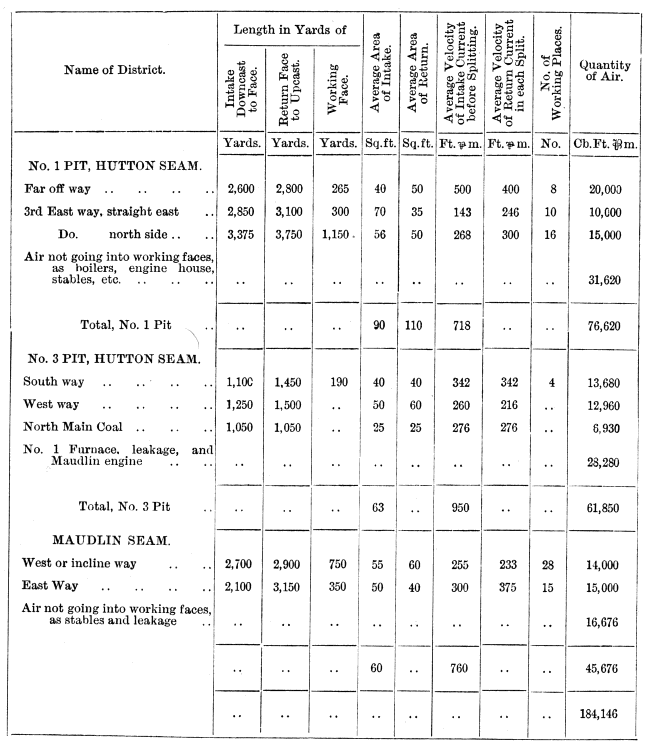
There was nothing unusual in the meteorological conditions at the time of the explosion, as the following observations taken at Seaham Harbour, about a mile from the colliery, will show :—

From 9 p.m. on the 7th to 9 p.m. on the 8th the maximum and minimum thermometrical readings were 62 deg. F. and 47 deg. F.
The workmen had examined the colliery under the 30th General Rule of the Coal Mines Act two months before the explosion, and found all satisfactory. No unusual source of danger was known to exist, and the examination of the whole colliery by the officials on the day preceding the disaster had pointed to everything being in its normal condition; nothing had alarmed any of the workmen who left the pit before the explosion, nor any who were down and survived it.
When the explosion took place a loud report was heard on the surface, and clouds of dust were ejected from the shafts, but no flame was seen. Owing to damage done to the shafts it was more than 12 hours before a descent could be effected, and then the usual scene of destruction was witnessed by the explorers; doors and air crossings destroyed; tubs broken to pieces and hurled one over another, and everything movable displaced; timber blown out and heavy falls from the roof in consequence, and the bodies of men and horses, in many cases terribly mutilated. Several fires were found burning near the shafts, and these had to be extinguished under circumstances of great danger before the exploration of the mine could be continued. The recovery of the bodies was carried on with unremitting labour, but owing to the numerous difficulties only 136 had been removed by the 1st October, when it was discovered that a fire was burning near the stables in the East way of the Maudlin Seam at a distance of 1,300 yards from the shaft. It was then decided by the mining engineers in charge of the operations to seal off this part of the mine for some time. It was re-opened in June of the following year, and the exploration continued under great difficulties, owing to the workings being full of fire-damp, and the uncertainty of the fire being quite extinguished. Use was made in these operations of Fleuss's patent lamp and breathing apparatus for penetrating dangerous gases; by means of them the explorers were enabled to advance before the air to ascertain if there was any sign of fire, and the lamps were of great service owing to the excellent light which they gave. The last of the bodies was not recovered until exactly a year after the explosion.
The explosion was found to have extended over roads of an aggregate length of about 7,500 yards, the greatest distance between the extreme points reached being about 3,800 yards. It had not extended quite to the face of any district, and was entirely confined to haulage and intake air roads.
The following observations were made of indications of the force and direction of the explosion. The figures refer to Plan 2, where arrows show the direction of the force exerted.
The timber in the downcast shaft (1) was much damaged for about 80 yards above the plane of the explosion. Access to the mine by this shaft was not available until nine days afterwards. Iron lattice fencing at each side of the shaft, and at right angles to the line of the road crossing it, was bulged towards the centre of the shaft from both sides. A disc of sheet iron, forming a guard over a sheave fixed at one side of the shaft, was bent outward from No. 1 Pit. Twelve yards north of the shaft stood a wooden tank, the south end of which was broken and forced into the tank and towards the shaft.





 Contains public sector information licensed under the

