


|

|

|

|
|
 |
||||
 |
 |
|||
Introduction (cont.).
 Coal dust in mines may be roughly divided into two classes :—
1st. — The dust on the floor, which will be spoken of as bottom dust.
2nd. — The dust on the sides, top, and timber, which will be spoken of as upper dust.
On dry haulage roads, where dry and dusty coal is led, and more particularly where it is led by engine power, coal dust is shaken out and flies as a cloud along the tops of the tubs, which are almost invariably passing against currents of air on the intakes. The air passes through tubs that have holes in them. The dust is carried away with the air from the tubs and the heavier particles fall to the bottom or lodge nearest the bottom. The lighter particles form a deposit on the upper parts of the roads as well as on the floor.
Coal dust sometimes exhibits the property of sticking to timber, stone, and coal, something like soot hanging in a chimney; that is, a deposit once formed, it grows, particles already deposited appearing to entangle other particles. Coal dust does not adhere to coal surfaces, which are often bright and smooth, so readily as to timber or stone; and to rough stone it adheres, more than to a natural parting in the stone. This hanging dust is sometimes spoken of by miners as soot.
The deposits of the upper dust appear to exist in greatest quantity for about 3 feet in height above the tops of the tabs. The tubs stand about 3 feet high, so that in a haulage road 6 feet high the upper 3 feet contains the most upper dust. In cases where the road is, say, 10 feet high, it is observed that from the floor to the tops of the tubs there is not much dust; for 3 feet above the tops of the tubs there is much dust, and the remaining distance is often comparatively free from dust.
Upper dust is by no means confined to deposits resting on horizontal surfaces, such as the upper sides of timbers, ledges, etc.; it has been observed two inches deep on vertical surfaces, and on the under side of timber and stone next the roof. It has heaped up on all fiat surfaces. All this dust is swept off during an explosion, and the appearance of a pit as regards dust, after an explosion, is no guide to its position before.
The upper parts of stone drifts, in which there is no timber, and arched lengths of haulage roads are sometimes lined one or two inches thick with coal dust.
In a stone drift to be mentioned, at Usworth, the conditions appear to have been very favourable for the deposition of upper dust. The drift was of about 40 square feet area, and 26,700 cubic feet of air passed down it per minute. Allowing 6 square feet as the area of the ends of the tubs, which were drawn up it laden with dry and dusty coal, at a speed of about 6 miles per hour, it results that the air moving in-bye would pass over the tubs at a velocity of 834 feet per minute, and as the tubs moved out-bye at a speed of 526 feet per minute, it would be equal to a velocity of 1,360 feet per minute. These conditions would ensure dust being blown out of and from the tops of the tubs, which, being carried back, would form a deposit of upper dust on the sides and top.
It might be thought that such a velocity of air would sweep away dust, but this is not so; the writers have frequently observed dust deposits on the upper parts of roads where the air passing in-bye and the tubs passing out-bye had greater velocities than those mentioned.
The high velocity of the air, within the limits likely to exist in the ordinary circumstances of a colliery, is more likely to cause deposits of upper dust than a low velocity; the eddies caused by the passage of a train of tubs against a large current of air ensures a consider able quantity of coal dust being carried against the upper parts of the road, where some of it sticks.
The writers have, years ago, frequently ridden out on an engine set of laden tubs at a colliery in the County of Durham, and in doing so it was necessary to cover the head with a handkerchief as a protection from the cloud of dust flying back.
In addition to dust from the top of the tubs a quantity of dust and small coal is shaken out of the bottom and sides of imperfect tubs.
The dust collecting on the floor of the haulage roads in dusty pits has frequently to be removed, otherwise the road would become blocked; this removal of dust has no reference to upper dust, which is not interfered with.
Mr. Galloway has stated01 that 1 lb. of dust to 160 cubic feet of air is necessary in order to form an inflammable mixture. Assuming 40 square feet area, then 1 lb. of dust is required for each length of 4 feet, or lb. for each foot. On dry and dusty haulage roads a quantity of dust in excess of this often exists as upper dust only, not considering bottom dust, and this over long lengths of road.
On the horse roads the quantity of upper dust is usually much less than on the engine planes. The tubs move at a lower speed against smaller currents of air, and the quantity of coal led over individual horse roads is less in quantity than that passing to the shafts on the engine planes, the horse roads being feeders to the engine plane. A considerable quantity of bottom dust exists on the floors of the horse roads, often greater in quantity than on engine planes. This bottom dust is, however, often much mixed with stone dust ground up by the horses feet from the bottom stone of the seam; horse dung and other impurities are mixed with it, and although it may contain a large quantity of coal dust, the latter cannot be collected separately.
The working places and the roads over which putters pass with single tubs are comparatively free from upper dust, and the quantity of coal dust is less generally, than on the horse roads and engine planes.
The dust in the air is considerable at the face of the working places, and, unless the coal is moist, there is frequently much dust on the floor.
The return air roads are, in most collieries in the North of England, free from coal dust. The work done on these roads is more in connection with stone than coal, such as forming pillars of stone and removing fallen stone; so that the coal dust left in them as working places soon becomes so mixed with stone dust as to lose its specific character. The timber supporting the roof in abandoned workings is usually withdrawn, and the roof stone falls and covers the dust left in them as working places, and, no fresh supply being available, these passages are often comparatively free from coal dust.
In some beds of coal, however, where top coal is left, which afterwards falls, or where the coal is of a specially tender character and the sides of the passages constantly fall over, the whole of the return air roads and old workings contain coal dust.
Coal dust in mines is often referred to as constantly present in the air. This is not so, except to a limited extent. The velocity of the air is rarely sufficient to carry dust any considerable distance. Near the shafts, where the velocity of the air is at its maximum, and where dust from the screens on the surface descends the pit, it is probable that the finest particles are carried some short distance along the air ways.
When dust is largely present in the air it is due to some disturbing cause other than the ordinary movement of the air. The rapid passage of tubs against the air current raises a cloud of dust from them; the passage of men and horses stirs up the bottom dust; the hewer at the working face raises about him a thin cloud of dust; the concussion of a shot, or wave of air caused by a heavy fall of stone, fills the air with dust; but in the absence of some such cause the dust is quiescent, and after its disturbance by any cause it soon settles down again.
Coal dust is not carried from the working face into the return air ways.
The coal dust collecting on the higher parts of the haulage roads appears to undergo some change and becomes more readily combustible than fresh coal dust.
Thus the writers have found that upper dust collected from dry collieries in the North of England has the property of burning en masse, that is if flame is applied to it so as to heat a small portion to redness, combustion gradually spreads itself through the mass, no flame being visible; ordinary coal dust has not this property.
Upper dust would appear to have undergone some chemical or physical change.
It is possible that absorption of oxygen from the air may have taken place.
Upper dust has a dull brownish cast and is not so distinctly and brightly black as fresh coal dust or screeny dust. It forms a very friable coke, the particles under the action of heat do not fuse and adhere readily. This fact may have some bearing on the absence of deposits of coked dust on the haulage roads after explosions ; the writers have noticed that deposits of dust on such roads after explosions have some coherence, and this may be due to the dust being really a friable coke.
The greatest amount and extent of violence was always observed on those roads likely, before the explosion, to contain most upper dust.
The inflammable nature of dust on roadways of collieries is well known and has been the cause of several fires. The dust has been ignited by a shot or by the "snot" from a lamp being thrown amongst it. In some collieries nothing but safety lamps are allowed to be used on the haulage roads, in order to prevent the ignition of the dust.
There is much difference in coal seams as to their capacity for producing dust. Until the coal is dry no judgment can be formed as to this. A tender coal produces more dust than a hard coal. Coal worked from the pillar workings is, as a rule, drier than coal from the whole workings, and is more tender owing to the crushing of the pillars.
Some coal seams are filled in with deposits of white spar — all the cleats contain vertical sheets of spar; when this is present the coal seldom produces much dust. Thus the steam coal of Northumberland is characterised by this spar and is not dusty.
All coal seams are divided into sections by horizontal partings and a dull black substance, which soils the fingers, accompanies these partings: this is called "dant," and sometimes "mother of coal;" a large quantity of the dust blown from the tubs will be "dant." It is possible that an examination of this substance might reveal some facts bearing on the subject of explosions.
Deep mines being warmer than shallow mines, coal dust accumulates in them. Fire-damp is also more common in deep than in shallow mines, owing to the superincumbent strata preventing its escape to the surface.
Coal dust and fire-damp thus accompany each other, but for different reasons.
It is possible, however, that strata charged with fire-damp at high pressure will not contain moisture that might, in the absence of firedamp, have been present in quantity sufficient to cause dampness.
Fire-damp does not increase in quantity with the depth, but may be said to be an approximately constant quantity after a certain depth is reached, and this depth coincides roughly with the depth at which the temperature of the strata is such as to cause dryness.
Examples, however, are not wanting of deep and fiery mines where water is present in such quantity as to prevent any accumulation of dust, and also of mines of depth sufficient to cause dryness, but yet so free from fire-damp as to be worked with naked lights.
In order to arrive at a conclusion as to the origin of the explosions and their extent, the writers noted the following :—
Parts traversed by force, and the direction in which the force had passed.
Parts traversed by flame.
Position and occupation of the workmen on the plane and district of explosion, and the position of all lights and fires.
Plans 2 show the parts of the collieries over which the explosion had passed with violence and flame. Arrows show the places where evidences of force were observed and the direction of the force. The letter F in red shows where signs of fire or burning were observed.
The positions in which the bodies of the workmen were found are shown by dots on Plans 1.
The solid stone and coal bounding the roads is rarely affected by the force of the explosion. A judgment as to the force exerted and its direction may be formed by an examination of timbering, tubs, doors, stoppings, and air crossings; rails, machinery, and boilers, supports and sheaves for ropes and wires ; workmen’s lamps and tools, shaft timbering and cages, men and horses, dust, hay, and other light material.
In consequence of the timber put in to support the roof being blown out, falls of stone are very general in pits after explosions ; these falls are caused by the stone resting on the timber being deprived of support. Where no timber had been required the roads were not affected by falls of stone after the explosion. In some instances the falls were so extensive that they could not be passed over, and where the fallen stone was soft and in small pieces, the main intake was completely closed, even to the passage of air. The timber under these falls as well as other things being covered up, indications as to the direction of force were lost.
With regard to falls of stone an important point is noticed ; where timber is blown out and some stone falls at once and during the explosion and other stone falls some time after and may continue falling for days, the stone falling at the time of explosion can be known by the fact of its being blackened with dust then filling the air. The place from which the stone fell can also be known by this blackening. Stone falling after the dust has subsided is in the newly exposed surfaces clean, as also is the p]ace from which it fell. Thus, in a pit after an explosion, we find stone with three characteristics as regards dust :—
1. — Stone exposed before the explosion and usually blackened with the remains of an old coating of dust.
2. — Stone exposed during the explosion and coated thinly with a fresh coating of dust.
3. — Stone exposed after the explosion and clean as regards dust.
Important reasoning can often be based upon observations of this nature.
Timbering sometimes affords good indications as to force and direction, but this is most so when part of it only is blown out. One of the commonest forms of timbering is two props and a balk across them. When one prop is blown out and the balk forced from its original position on its supported end, a good indication is afforded as to direction of force.
A form of timbering on haulage roads, called the hole and driving end, is often a good indication. A force F would blow the balk down, a force F1 would not move it.
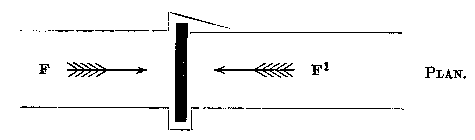
Tubs give very good indications both as to direction and amount of force. Full tubs are more broken near the top and above the level of the coal in them. Empty tubs are often completely smashed, but afford undoubted indications as to direction of force.
Stoppings when stowed are not generally moved, except near the top. Unstowed stoppings of brick or stone, unless very thick, are easily moved, and afford good indications as to direction of force, but not so good as to the amount. A 9-inch brick stopping is sometimes blown down by heavy gusts of air caused by an extensive fall of stone in the ordinary working of a pit; they are not erected to withstand lateral pressure.
Doors, like stoppings, afford indications as to direction of force, but not as to amount of force. Doors are blown out by a force that will not move timber, break up tubs, or injure men.
Machinery affords grounds for a judgment as to the violence of force, but perhaps not so good as to its direction. The parts are broken but often not moved far.
Supports for hauling ropes and rapper wires afford indications of the passage of force and its direction, but as force may be transmitted by the ropes or rapper wires from distant points, indications connected with these supports must be cautiously examined, and all sources of transmitted force eliminated as far as possible before coming to any conclusion.
Workmen’s tools and lamps afford some indication as to the passage of force or the reverse.
Damage to shaft timbering usually occurs at the limit of an explosion, but the varying extent of this damage appears to show that the explosion in some cases continues up the shaft.
The deposit of dust on timber and other things affords an indication as to direction, which, the writers think, is usually misinterpreted. With ordinary coal dust, coked dust, generally spoken of as charring, may be included.
This matter was more fully investigated at Usworth than at any of the other explosions. At Whitehaven there was no dust.
As stated in the description of force and flame at Usworth, observations were made in more than twenty instances. The direction of the blast was, in most of these cases, not a matter of any doubt whatever. It appears from these observations that dust, either as dust or as coke, is generally deposited on the sides of the props, etc., opposite to the direction of the blast. The deposition will probably take place during a reverse current instantly succeeding the explosion, and other reasons for supposing the existence of this reversed current are given.
Plans 2 show the parts of the collieries over which flame has passed. The evidences as to the passage of flame are :—
| Burning of men and horses. |
| Coking of dust. |
| Burning of timber, hay, brattice cloth, etc. |
| Fires discovered after the explosion. |
| Evidence of survivors. |
The burning of men and horses is more apparent by the frizzled state of the hair than by anything else, so far as an ordinary observer is concerned. The bodies of men, in the field of an explosion in dusty pits, are always blackened, and the extent of the burning they have been subjected to is a matter on which a medical man only can speak with any degree of confidence.
The coking of the dust is an indication often wanting over long lines, where great force and flame have passed. It is more noticed at the working faces than on the haulage roads. It was not observed at the shaft limit of an explosion. A chemical and microscopical examination of dust on haulage roads, in the absence of coking, affords reasons for asserting the passage of flame.
Timber, hay, brattice cloth, and other substances readily inflamed, are found burnt after an explosion, or burning when near the limit of an explosion, or where fresh air is directly afterward available to support combustion. Where the explosion has passed over long lengths of road, the whole of the oxygen in the air will be consumed, and further combustion rendered impossible, unless fresh air returns at once to the inflamed bodies.
The position and occupation of the workmen on the plane, and in the district of the explosion, and the position of all lights and fires, is important, as the origin of the explosions must be referred to a light carried or used by a workman, a fire existing before the explosion, or the flame of a shot.
The cause of death should also be noted. Information on this head is usually supplied by medical men, but is sometimes unsatisfactory, as they are not aware of the conditions under which the bodies were found, nor of the sequence of events which preceded and followed the deaths.
An extensive explosion is accompanied by four conditions, any one of which could ultimately cause death :—
| Flame. |
| Force of the explosion. |
| Falls of stone and timber, caused by the force of the explosion. |
| After-damp. |
At the origin, and at the working faces, where the explosion extends to them, the victims are burnt, but their bodies are usually not mutilated, unless from special causes.
The distance they move is never, under these conditions, more than a few yards; and it would appear that after-damp is the immediate cause of death. Examples are noticed of persons who have been near the origin, or at the face limit, of an explosion, and who have escaped burning almost entirely, but yet have evidently succumbed within a few yards of the place where they had been before the explosion — after-damp having caused death in a very short time.
Persons near the shaft limit of an explosion, who have been subjected to both violence and burning, and who have not moved after the explosion, are sometimes found alive. They had escaped death by after-damp owing to fresh air returning at once to them. This would appear to show that burning or violence alone, or in conjunction, is not necessarily sufficient to cause immediate death ; and therefore, where a victim is much burnt, but who has evidently succumbed within a few yards of his working place, after-damp has probably been the immediate cause of death.
Where victims have been subjected to the full force and flame of the explosion at some distance from the shaft, they are found mutilated and burnt, and often buried under falls of stone, and have not moved further than the explosion might have blown them. It would be impossible to say whether violence or after-damp had been the immediate cause of death in such cases ; but it would be certain that after-damp alone would have caused nearly immediate death, even if they had escaped death by violence. The stone under which they were found may not have fallen until after death.
The victims outside the field of the explosion, and who escape both violence and burning, die from after-damp alone.
It would appear that the immediate cause of death is, in almost all cases, after-damp. Victims exposed to violence and burning would be, unless near the shaft, also so exposed to after-damp that the latter alone would cause almost immediate death.
Persons found alive near the downcast shaft, and who, owing to its proximity, have escaped death from after-damp, often die in a day or two from the effects of the violence and burning they have been subjected to.
There is another condition that may be the cause of death in some cases: the air in the field of an explosion is often so filled with dust as to cause suffocation ; thus the mouth of one of the victims of the Usworth explosion was observed by the doctor to be full of coal dust.
The report by a doctor as to the injuries and burning of each victim of an explosion is very necessary; important conclusions can sometimes be drawn from the character of the injuries.
The relation between workmen and their lights must be discussed. Ordinary workmen using a safety lamp and working in a limited area, such as hewers, stonemen, shifters, etc., always hang their safety lamps within a short distance of their place of work, on an average from 3 to 6 feet distant. They sometimes have a nail attached to the ring of their lamp, which they knock into a prop or any timber near. The hewers are generally provided with a lamp stand on which they hang their lamps, and sometimes the lamp is placed on the floor. Workmen whose work necessitates constant motion, such as officials, putters, drivers, etc., carry their safety lamps with them, when at rest hanging the lamp by a nail or setting it on the floor. A miner using a safety lamp or any description of light is rarely any considerable distance from it ; he carefully guards it and seizes it on the first symptom of alarm.
In dusty collieries, after extensive explosions, the following relation between workmen and their lamps is observed :—
| a |
When the workman has been traversed by great force and flame the lamp is usually found blown down and injured, and not far from the owner.
| |
| b |
Where the workman has been traversed by flame, but no great force, the lamp is found hanging where it was before the explosion, and the workman a few yards from it, unless he has been in motion at the time of the explosion, or has retired from his place of work to fire a shot, in which cases the lamp is either with him or at the point to which he has retired, usually upset and covered with oil.
| |
| c |
Where the workman has been out of the field of the explosion, but sufficiently near it to extinguish his lamp, in this case the lamp is found hanging at the place of work and the workman some distance from it, having passed out in the dark until he perished from after-damp.
| |
| d |
Where the workman has been traversed by no flame and no force or any gust of air sufficient to extinguish his lamp, in this case the workman and lamp will be found together at the point where he has perished from after-damp, and some distance from his place of work. The lamp may be found hung up or standing on the floor, the oil in some instances being all consumed, the lamp having continued burning after the death of its owner.
|
The relation between workmen and those parts of their dress they take off when at work is similar to the relation between them and their lamps.
In fire-damp explosions, without any coal dust being brought into play, the relations discussed are different. The persons at the point of origin frequently escape alive, with burns only, and the movement observed to have been made by all the victims, is far greater than in the case of victims in the field of an explosion in dusty pits.
The task of examining a colliery after explosions, such as those to be described, is most laborious and sometimes dangerous. To have the best chance of drawing correct conclusions from such an examination, it is essential that it made when the mine is first explored, as it is necessary to move many things during the work of restoring the ventilation and recovering the bodies, and this is done with very little observation by the workmen, The whole of the work has to be done by the dim light of the safety lamp, and as operations are carried on continuously by night and day, the same observer cannot always be present.
It is necessary to use considerable caution in drawing conclusions from the indications observed as to the direction in which the explosion has passed. In some cases the most careful examination showed that force had been exerted in opposite directions over the same length of road. In several cases light bodies were moved several yards in what was evidently the contrary direction to that of the explosion.
01 "Transactions of Royal Society," Vol. XXIV.





 Contains public sector information licensed under the

