


|

|

|

|
|
 |
 |
|||
Plate X.
The Ruddle Pit.
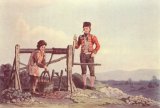
The mineral called Ruddle, or Raddle, is obtained near Micklebring, a hamlet in the parish of Braithwell, near Doncaster. A shaft is sunk of about twenty-three feet in depth, and five in diameter, which passes through strata of limestone and gritstone, and immediately under this last the ruddle is imbedded universally in clay, which is three feet thick above and below the vein. It lies nearly horizontal, and is generally about nine inches in thickness. The miner in working sits down and uses a short sharp axe, similar to that of the lead miner. He excavates to the distance of about four yards from the centre of the shaft; but, as the clay cannot be easily supported, as soon as he has reached this distance, a new shaft is sunk near to the other. The ruddle is carried to a mill, where it is ground to a powder; then mixed with water and ground afresh, and afterwards let off into a reservoir, where the ruddle subsides, and the water is evaporated. It is afterwards cut into small squares, packed up in casks, and sent to Hull and London, whence it is exported. The price about £5 per ton. We understand ruddle is also found near Bristol, very near the surface, which injures the more expensive preparation of it here. This substance is used for the coarser purposes of painting, such as carts and waggons, and also by carpenters for marking their timber, &c.
The man in an old regimental jacket, and the boy, as here represented, were employed at the pit where the drawing was made, and harmonize well with their occupation.





 Contains public sector information licensed under the

