


|

|

|

|
|
 |
 |
|||
Plate IX.
Woman making Oat Cakes.
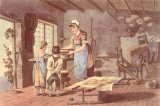
This species of bread is provincially termed Haver Cake, which must undoubtedly be a corruption of the German haber, or hafer, and not derived, according to Johnson, from the Latin avena. With perhaps the exception of some parts of Lancashire, it is almost exclusively made in the West Riding of Yorkshire, and constitutes the principal food of the labouring classes in that district. It is a very thin cake, composed of oatmeal and water only, and by no means unpalatable, particularly while it is new. The mixture is made of a proper consistence in a large bowl, and measured out for each cake by a ladle. As the price of an oat cake is invariably one penny, the size of the ladle of course depends upon the rate of meal in the market. The process of making these cakes will be readily understood by referring to the annexed Plate. Some dry meal is sifted upon a flat board, and a ladle-full of the mixture poured over it. The cake is formed and brought to a proper size and thickness by a circular horizontal movement of the board, as here represented. It is then laid upon what is termed the Backstone, or hot hearth, to bake, which does not require many seconds of time, and afterwards placed upon a cloth to cool. An inverted chair, as seen in the Plate, frequently serves this purpose. The cakes are then hung upon a frame, called a Bread Creel, suspended from the ceiling of almost every cottage in the district. The people in the neighbourhood of Huddersfield are fond of what they term Browiss, which is oat cake sopped in broth or gravy. This bread gives name to the 33d regiment of foot, well known as the Haver-cake Lads, which was raised in and near Halifax, and now belongs to the gallant Lord Wellington. This however will be an interesting and appropriate subject for a future Plate.





 Contains public sector information licensed under the

