


|

|

|

|
|
 |
||||
 |

|
 |
||
all the more recent speculations in the Iron trade have been failures, and very disastrous ones in our districts. There is one case in our neighbourhood now (1857) of very extensive works, on which £400,000 have been lost, and I hear that notice has been given to all the men that the works will stop. These works have been in operation for 30 years."
Mr. Menelaus, one of the chief agents of the Dowlais Iron Co., said he had had considerable experience in mining operations, and that the Dowlais Iron Co., was the largest Iron concern in South Wales. "Is of opinion that no manufacturing concerns in England, for the last few years, pay so small a return for the capital invested as Welsh Ironworks." "Can you state what amount of capital has been invested by the Dowlais Iron Co. in placing their concern in a position to be carried on ?" "I would say, roughly speaking, that the present value of the plant, the value of the works, and the capital invested in the concern, is pretty nearly a million of money (£1,000,000 sterling)." "Is it a profitable investment at present ?" "At present we are making no profits; that is, taking Iron at the present price. I say advisedly, that the Welsh Ironworks, having regard to the amount of capital invested, is unremunerative; in fact, we are giving away our property." "But it always has happened during the last fifty years, has it not, that you have had periods of great losses, and then periods of enormous gains ?" "The conditions are different. Sir John Guest had a lease of the Dowlais property for something like £100 a year; a portion of it was sublet, and that brought in £5,000 a year. We are now paying, as royalty, £20,000 a year."
H W. Schneider, M.P., is a very large proprietor of Iron mines. "Park Mine is the name of my largest mine, situated in the Low Furness district, in the parish of Dalton, Lancashire. I began that mine nearly 20 years ago, and for the first 10 or 12 years we raised nothing, spending a very large sum of money; I almost abandoned it in despair; it is a very peculiar class of mining; there are no veins, properly so called; there is nothing to lead you to it except general inference, and a knowledge of the country, consequently we work very much in the (lark for a great length of time, until we hit upon the ore." "Is it hematite ?" "Yes; the Park Mine having been worked by me for 10 or 12 years without finding ore to make it worth working, I was on the point of abandoning it, when by a lucky hit (I can call it nothing else), we discovered a deposit of ore of an immense size, and from it, within the last seven years, we have been gradually increasing the quantity raised from 10,000 tons, the first year, to about 150,000 tons this year (1857). I have spent £3,500 in trials this year; and though my Iron mines were profitless for many years, they are at this moment in a flourishing condition."
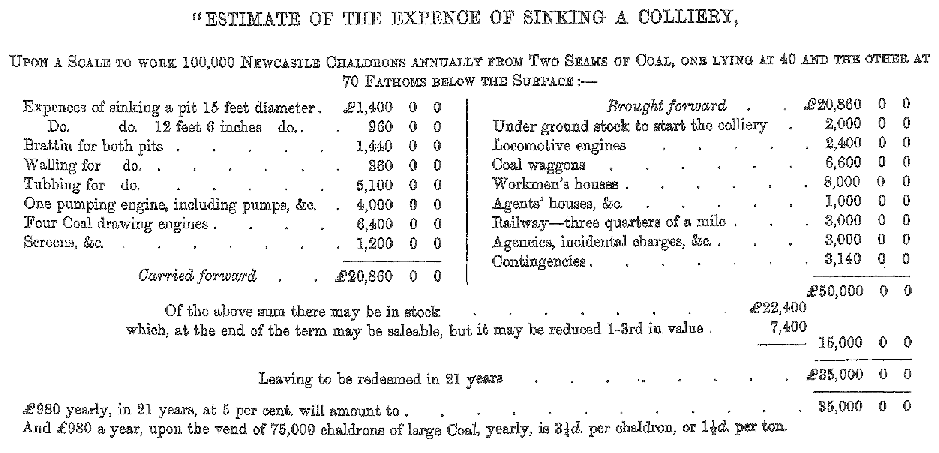
Mr. Thos. Wood, Durham, has been manager of collieries in the North, and frequently values collieries; has had nearly 100 valuations through his hands. On the question as to the amount of capital required to raise 100,000 chaldrons of Coal (each chaldron 53 cwt.), Mr Wood said — "That depends on so many circumstances not taken into consideration in putting the question, the depth of the shaft to be sunk, the quantity of water to be contended with, and whether the party had to make a private railway; unless these points were given, I could not say; but I can state an instance which has come under my own observation within a short period, where I have made an estimate to sink a colliery to work 100,000 chaldrons. It is a private colliery. I will state the depth and size of the pits, and sort of material to go through; there are two seams of Coal, the depth of one would be about 70 fathoms, to which I propose to sink a pit 15 feet in diameter, and divide it into three. The depth of the second seam would be 9 or 10 fathoms less, about 60 fathoms, on which I propose to sink another pit 12 feet 6 inches diameter, and to be divided into two. The result of the whole is, with an allowance for contingencies of £3,140, the cost would be £50,000. In corroboration of this, I have proposed to give security to undertake and complete it for the money. The stock, such as engines, waggons, locomotive engines, and so on, forms about £20,000 of this £50,000; the other part consists of houses, the sinking the shafts which would be lost at the time these pits would be exhausted. I have not estimated what profit could be made as to this colliery; this is merely the cost of sinking the colliery, distinguishing that part which would be lost entirely from that part which would be kept up. At the end of the lease about £25,000 would remain in stock, but that depends on some circumstances which are necessary to be named. It might happen from dikes and other interruptions, this colliery could not, perhaps, be worked 20 years or 10 years; it might happen it could be worked 30 years; taking it for 25 years, it would then become necessary to redeem that part entirely lost at the end of the time." Mr. Wood then handed in the following


Please Note: These web pages retain the original pagination from the publication




 Contains public sector information licensed under the

