


|

|

|

|
|
 |
 |
 |
||
II. Conditions Prevailing At The No. 3 Mine On The Day Of The Explosion And For Some Time Prior Thereto.
With a view to determining the point of origin of the explosion, it is of great importance that as detailed information as possible should be forthcoming as to the state of the No. 3 Pit on the day of the explosion, but as all but two of the persons employed in the mine at the time of the explosion were killed, one must reason largely as to the probable conditions from those prevalent for some time preceding the disaster.
(a) The climatic conditions prevalent at the mine on the day of the explosion and prior there to. — As indicating the climatic conditions prevalent at the time of the explosion, I have obtained the following record of observations made on that day

These point to the fact that the atmosphere was moist and the pressure fairly high-conditions which are not favourable to an explosion of gas or coal dust.
In respect to the comparative humidity of the outer atmosphere with that of the mine, I should draw attention to the remarkable fact that the mine appeared to absorb moisture. Usually the air at the face of coal mines contains more moisture than when entering the mine. Readings taken on January 9th, 1911, showed that whereas the degree of humidity of the outer atmosphere was 934 at the face of No. 3 jig, in the North Plodder it was only 82, or 114 less. The actual readings, taken by Mr. Roscamp, H.M. Inspector of Mines, were as follows
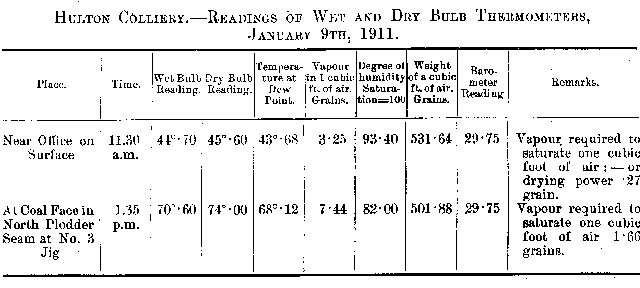
It would have been of interest to have had comparative observations taken before the explosion.


A copy of this report was kindly donated by
West Cumbria Mines Research.




 Contains public sector information licensed under the

