


|

|

|

|
|
 |
 |
 |
||
III. — Condition Of The Workings Of No. 13 Level Prior To The Explosion.
Reference has already been made in general terms in Section I of this report to the methods of working and ventilating the Penclawdd seam at Wernbwll Colliery. It may not be out of place, in view of the divergence of opinion as to the cause of the explosion, to discuss at some length the condition of the workings in the No. 13 level of the Main West District.
At the time of the explosion the face of the level had reached a point about 135 yards inbye from the slant, and topholes had been driven, as is usual, to the next higher level, No. 12. As will be seen from Plan 2, there were 7 topholes off No. 13 level. Five of them were finished and two others were in course of being driven. No. 1, the one nearest the face of the level was about 10 yards up, and No. 2, the next one outbye was about 27 yards up from the level. In addition, a crossing from the latter was being driven level course to meet the former.
The course of the main ventilating current is shown in blue and red on Plan 1. The intake air came down the slant and along No. 13 level, up No. 2 tophole, where a brattice sheet at the crossing caused it to ventilate the face of that tophole, through the crossing to No. 3 tophole up which it passed to No. 12 level, whence after ventilating the working places in that level it passed to the auxiliary fan in No. 11 level and thence to the main return.
Except to a small extent, due to the natural conditions, the main ventilating current could not serve in the ventilation of the workings below No. 13 level. Any deleterious gases given off there, after being diluted by air from the compressed air supply, would join the main current at No. 13 and be carried along that level to No. 2 tophole and so to the main return airway. Similarly,, the main current did not serve in the ventilation of No. 13 level beyond the bottom of No. 2 tophole nor in the ventilation of No. 1 tophole. Any deleterious gases produced in the workings beyond No. 2 tophole depended entirely for their dilution on the air allowed to escape from the compressed air pipes.
No information is available as to the supply of air from the compressed air pipes, but apparently the quantity, whatever it was, had not prior to the explosion been found to be inadequate for the purpose of ventilating the levels and topholes. Firedamp, in fact, had never been detected in these workings.
Reference has already been made in Section I of this Report to the question of coal dust and to the fact that stone dusting had been considered unnecessary on account of the natural conditions. In No. 13 level, from the slant to No. 4 tophole, the roadway was wet, especially underfoot; from there onwards it became drier until near No. 3 tophole, the amount of moisture present was almost negligible. Where moisture was present in quantity, it was due to water percolating down the topholes from the level above. The topholes themselves, until holed, were quite dry.
Generally, the conditions in No. 13 level were quite normal, and there was nothing to call for special note except in one respect, viz. : the physical character of the coal. The normal Penclawdd seam in the Wernbwll Slant is in two bands or layers, each about 2 feet 3 inches thick, with a dirt parting of from 1 to 2 inches between them. The coal substance appears to be nearly all vitrain, i.e. it has a brilliant, black lustre and breaks with a curved fracture. Streaks of hard, dull greyish material (durain) are conspicuous only by their absence.
When No. 13 level had advanced a distance of about 40 or 50 yards from the slant the physical characteristics of the seam changed, and its thickness became irregular. Along the deepside of the level, instead of the normal thickness of 4 feet 6 inches, there was little more than 1 foot of coal; whereas, to the rise the thickness increased — at the face of No. 2 tophole the seam was upwards of 6 feet thick.
Throughout this disturbed area the seam had undergone marked changes. The brilliant lustre was lost as well as all traces of foliation so common to coal seams in general; and no indications of the dirt parting in the middle of the seam remained. The coal in situ was tough and lifeless. In pieces in the hand, the pressure of the fingers sufficed to squeeze it to fine powder. Fractured surfaces had a dull brownish colour and exhibited a very finely granulated texture. The appearance of the altered coal leads one to conclude that the seam, after having been very finely disintegrated, had been subjected to considerable movement and afterwards became more or less resolidified in the position in which it now exists.
This "altered" coal was unusually tender and friable; there can be no doubt that, in working it, larger quantities of coal dust, and probably a finer coal dust, were produced than in working the normal seam. In that respect there was additional risk of a coal dust explosion.
With a view to determine to what extent, if any, the chemical properties of the coal had been changed, samples of the normal and abnormal seam were submitted to analysis with the following result :—
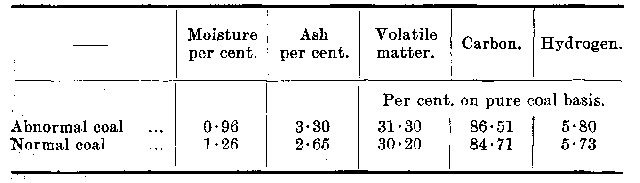
These figures do not appear to indicate any material change in the chemical composition of the coal.


A copy of this report was kindly donated by
West Cumbria Mines Research.




 Contains public sector information licensed under the

