


|

|

|

|
|
 |
 |
 |
||
II. — Conditions In The Black Vein Before The Explosion.
The Black Vein was first opened out at Milfraen Pit in 1926, on the longwall stall road system but subsequently a mixture of longwall conveyor and stalls was resorted to. It was the latter method of winning the seam that was being practised when the explosion occurred. A section of the seam is as follows :—
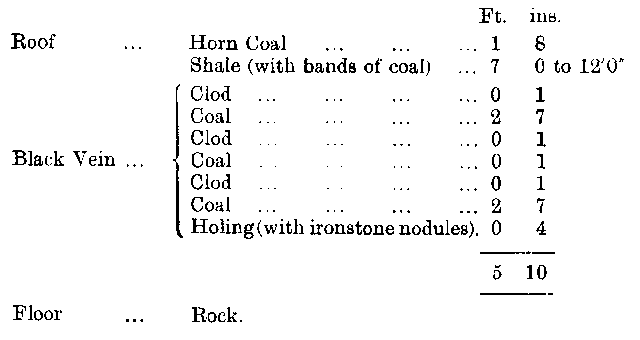
On 10th July there were in operation two conveyors known as B and C conveyors, and 17 stall roads. The C conveyor face was 80 yards long and was operated by a jigging conveyor driven by an electric motor which dumped the coal into trains at the face of the main dip of the district. On the East side of the main dip there were at work a series of stall roads, ten in number, outbye of which was situated the B conveyor face sixty yards in length and operated by an electrically-driven jigging conveyor which dumped the coal into trains on the B level. Between the B conveyor face and the return airway there were five stalls, the latter range of working places being known as "Mapstone's". The haulage of coal from these four ranges of work was effected by haulage gear situated on the main dip of the district which hauled the journeys on to a parting close by, whence they were conveyed by another haulage gear, situated further outbye, to the shaft siding.
Plan No. 2 shows the system of ventilation. According to the record kept in accordance with the requirements of Section 29 (2) of the Coal Mines Act, 1911, the ventilating current when measured on the 11th June, 1929, near the mouth of Kay's Slope, amounted to 13,579 cubic feet per minute. After passing round two districts in Kay's Slope and through a series of inclined air shafts to the Winch Heading, the air current entered the Milfraen workings via the roadways known as the Siskol Heading and the Buller road. It will be seen, on reference to Plan 2, that there were three airlocks between the intake and return. That between the Winch Heading and the return airway consisted of one door (in poor condition) and two brattice sheets; a second, of two doors and one brattice sheet, and the third, on the road known as the Crosscut, of one door (in poor condition) and one brattice sheet.
The result of this state of affairs was that whilst the air entering the Winch Heading amounted to 12,896 cubic feet per minute, the amount entering the actual workings was calculated to be 7,683 cubic feet per minute, the calculation being based upon measurements taken outbye of the airlock on the road known as the Crosscut. Had such a volume of air actually been entering the Milfraen workings, there would have been an ample supply for all purposes. The state of the workings prior to the disaster however was such as to preclude the possibility of this body of air passing through the district by any route, for (1) the airway known as the Buller road was much constricted in area; (2) the C conveyor face had fallen leaving only a passage of sufficient size for a man to crawl through; (3) the B conveyor face had also fallen in such a manner as only to leave a space of approximately eight or nine inches between the top of the fall and the roof; and (4) there were three sheets or brattices in position on the main dip.
The night shift fireman, Jehu Morgan, stated in evidence that the condition of the Buller road on the morning of the explosion as found by him during his second inspection of the shift, and during the inspection required to be carried out by Section 64 (1) of the Coal Mines Act, 1911, before the commencement of work in the day shift — the shift during which the explosion occurred — was such that he had to crawl through on his knees. He also stated that he did not feel disposed to get over the fall on C conveyor face because there were several ragged slabs there and there was not sufficient room for him to get through safely, though the ventilation was passing over.
The fireman of the afternoon shift of the day before the explosion, Edward Hobbs, describing his inspections during that shift, stated that it was not safe to pass over the fall on C conveyor face.
With regard to the fall on B conveyor face, Jehu Morgan stated that on the morning of the 10th July it was about eight to nine yards in length and there was only a space of about eight to nine inches between the top of the fall and the Horn coal above.
On referring to Plan No. 2, it will be observed that the brattice sheets were arranged with the intention of causing the available air to pass around the faces. It was stated in evidence that these sheets were fairly tight sheets; consequently, if this be true, and the evidence of Jehu Morgan, the night fireman, be accepted that the ventilation was passing over the fall on C conveyor face, then the fall on B conveyor face acted as a regulator and prevented any appreciable quantity of ventilation passing through the district. In spite of this, however, when Morgan made his final examination of the district before going off shift, he reported everything as in proper order for the oncoming shift, stating definitely in evidence that after having examined it with his flame safety lamp, the cavity existing between the upper side of the fall on B conveyor face and Mapstone's level — see cross section on C.D. Plan 3 — was clear of gas and that there was no feeder of gas present. The fall in the B face was of so formidable a character that the management had decided to leave it, and head out in the coal in front of it. Towards this end, the Hopkinson electric coal cutting machine together with its attendants was permitted by the fireman to work on beyond its allotted time, and actually did continue to work, although latterly not under load, right up to, and twenty minutes beyond, the time of the explosion, when the current was cut off.
Section 29 (1) of the Coal Mines Act, 1911, requires that "An adequate amount of ventilation shall be constantly produced in every mine to dilute and render harmless inflammable and noxious gases to such an extent that all shafts, roads, levels, stables, and workings of the mine shall be in a fit state for working and passing therein, and . . . "
It is clear that this important provision was not being complied with on the morning of the 10th July, because had it been, no untoward event could have followed. As showing the unsatisfactory state of affairs, the evidence of Arthur Henry Holder, who was employed in Mapstone's at the time of the explosion, is of importance. On being asked if he noticed that the normal ventilation was reduced, he replied :— "I estimate it at one third the normal quantity."
The state of affairs revealed by this answer was the result of the cumulative effect of a series of falls which occurred in the district during the week end prior to the explosion. On the 8th July, the position was such as to necessitate the presence of the Manager, Mr. Lewison, during the whole of that night and throughout the following day.
In view of the requirements of Section 36 (3), Coal Mines Act, 1911, with regard to the provision of two ways of egress to the surface from every part of the mine, not more than nine persons should have been in the workings on the 10th July, as the second means of egress viz.; via the C conveyor face, was already, according to the fireman Morgan, not travellable.
With regard to the illumination of the workings, and the means available for testing the state of the air, whilst all the men carried electric safety lamps, the firemen carried, in addition to an electric lamp, an approved flame safety lamp, of the Davis Derby type. The man in charge of the electrical coal cutting machine was apparently supposed to be provided with a flame safety lamp on all occasions, but unfortunately at the time of the explosion he was not so equipped and therefore was not in a position to comply with the requirements of General Regulation 132 (v).
The timbering of the working faces appeared to be satisfactory, but the packing of the goaf, it was evident, was of an haphazard order. The evidence of the firemen and other officials went to show that it was difficult satisfactorily to stow the waste where conveyors were in operation owing to the difficulty of providing sufficient stowing material, and the inconvenience of handling it.
The Black Vein does not belie its sinister reputation as a fiery seam even so near to the outcrop as it is at Milfraen, for gas is occasionally found and had been found on two occasions during the current year, it being necessary on one occasion for the overman, Daniels, to withdraw the men from, curiously enough, B face. Fortunately, as already stated, the workings are generally damp and in some places wet.


A copy of this report was kindly donated by
West Cumbria Mines Research.




 Contains public sector information licensed under the

