


|

|

|

|
|
 |
 |
 |
||
I. — General.
The Milfraen Shaft, owned by the Blaenavon Company, Limited, is situated three miles north west of Blaenavon, in the County of Monmouthshire, and is sunk to the Old Coal Seam near its outcrop at the north eastern extremity of the Coalfield. It is 242 yards in depth, and is the upcast for workings developed from it in the Black Vein — the only seam being worked at present — as well as for the workings reached by way of Kay's Slope, situated about one mile away, where the Black Vein also is the only seam being worked. Plan No. 1 is a general plan of these workings. Kay's Slope forms the intake airway for both sets of workings.
The Black Vein at Milfraen lies at a depth of approximately 182 yards below the surface, and is reached by means of cross measures drifts from the level of the Old Coal Seam which lies approximately 60 yards below the Black Vein. The coal is bituminous and a proximate analysis of it is at follows :—
| Per Cent. | |
| Fixed Carbon | 64.62 |
| Volatile Matter | 27.31 |
| Ash | 6.26 |
| Water | 1.81 |
| Sulphur | 1.57 |
Supervision. — The supervision of the Colliery was carried out by the following officials :—
| Mr. J. H. Lones, General Manager of the Blaenavon Co. |
| Mr. F. Kemp Cartwright, Agent. |
| Mr. W. Lewison, Certificated Manager. |
| Mr. H. Daniel, Overman, and three firemen. |
Mr. Lones is the General Manager of the Blaenavon Company which owns, besides a group of collieries, a steel works the greater part of which has been idle for a number of years. Mr. Lones does not possess a Colliery Manager's Certificate and takes, I presume, no active part in the technical management of the collieries, but exercises general supervision over their financial affairs. Mr. Kemp Cartwright is the Agent and, as such, pays periodical visits to the underground workings, his last visit to the Black Vein workings at Milfraen, prior to the explosion, being on the 5th July. Mr. Lewison is the Manager of the Kay's Slope and Milfraen Pit which constitute one mine under the Coal Mines Act, 1911, and the Garn Slope; all work the Black Vein Seam. Mr. Daniel's duties are confined to the supervision, during the morning shift, of the workings in the Milfraen Pit, whilst of the three firemen employed, each was responsible for one of the three shifts worked. The total number of persons employed in all shifts under Mr. Lewison's supervision is 1,189, of which 113 are employed at the surface. Of this number, 176 only are engaged at the Milfraen Pit, 35 of these being engaged at the surface.
The output of this group of mines is 10,150 tons per week of which 1,150 tons is raised at Milfraen during two daily drawing shifts, a third being a repairing and machine coal cutting shift the times of the shifts being morning 7 a.m. to 3 p.m., afternoon 3.30 p.m. to 11.30 p.m. and night 11.30 p.m. to 7.30 a.m. The inspection required by Section 64 (1) of the Coal Mines Act, 1911, to be made within two hours of commencing work in any shift was made and reported upon by the fireman of the preceding shift. The station required by Section 63 of the Coal Mines Act, 1911, to be fixed for the purpose of inspection before the commencement of work in a shift, was fixed at a point 150 yards inbye from the pit bottom, on the cross measures drift leading from the Old Coal Seam up to the Black Vein. By reference to Plan No. 1 it will be seen that the district assigned to the firemen was in point of size a reasonable one, and such that ample time was available for thorough examination of the district. No officials other than the firemen were appointed for the afternoon and night shifts.
Ventilation. — The ventilation of the workings was produced by means of a Schiele (double inlet) Fan placed near the top of Milfraen Pit, capable of producing 75,000 cubic feet of air per minute with a 3 inch water gauge. At the time of the explosion this fan was running at 120 revolutions per minute and producing 36,000 cubic feet of air per minute with a 1 inch water gauge. Means are provided, in accordance with the requirements of Section 31 (3) of the Coal Mines Act, 1911, for the reversal of the air current. The pit head frame at the upcast (Milfraen) Pit was enclosed by a wood casing in which sliding doors were operated by the movement of the cages in their ascent and descent of the pit.
Electricity. — Electric current is supplied to Milfraen Colliery through a sub-station at bank where the source of supply, at 11,000 volts A.C., is transformed down to 3,000 volts A.C. This pressure is again transformed, at a sub-station underground, to 500 volts by means of two 100 K.V.A. transformers and at this pressure it is used in various parts of the workings to drive a pump, haulage gears, coal cutting machines and face conveyors. A detailed plan of the electrical plant, showing the position and size of the apparatus, is attached to this Report, (Plan No. 4).
Safety Lamps. — The workings from Kay's Slope were illuminated by naked lights, but from a point marked L.S. in the return from these workings (see Plan No. 2) open lights were prohibited. The workings from Milfraen Pit were consequently illuminated by locked safety lamps of approved pattern, namely, the Oldham Electric, and Davis (Derby) flame types. All the lamps in use in the Milfraen Black Vein workings at the time of the explosion were accounted for and subsequently submitted for- examination by Capt. C. B. Platt, Superintending Testing Officer at the Mines Department Testing Station, and his report disposes of the possibility of any of them having contributed to or caused the explosion. Capt. Platt's report is given in Appendix IV to this report. No flame type safety lamps, excepting those carried by the fireman and overman of the district; were present in the Black Vein on the morning of the explosion.
Haulage. — The main and subsidiary haulages were operated through gears driven, by electric motors, there being two such haulages in Milfraen. The position of these motors is shown on Plan No. 4. As they had no bearing on the explosion, I shall not refer to them again.
Signalling Apparatus. — The movements of the trams on the haulage roads were controlled by a system of bare wire electric signals, the bells in connection with which were of the Davisafest approved type. Each circuit consisted of one bell, the energising medium being produced by six quart size Leclanche cells. Neither the bells nor the signal wires fall under suspicion as having in any way contributed to the disaster and may therefore be dismissed from further consideration.
Shotfiring. — There was no shotfiring in, the Black Vein, the conditions being such as to render it unnecessary.
Coal Dust. — The roadways were generally naturally damp, and stone dusting was unnecessary to dilute the comparatively small quantity of combustible dust produced during the working of the coal. The conditions were, in fact, such as to fall within the second proviso contained in Clause 4 of the General Regulations dated 30th July, 1920 (as amended 20th November 1924), as to precautions against coal dust, and samples of dust taken by the management during the month of May and within three months of the date of the explosion showed in every case under 30 per cent, of combustible matter. In any case the effects of the explosion of firedamp were in no way extended through the agency of coal dust.
Searching. — The searching for matches or smoking materials was carried out at this mine in an haphazard and negligent manner. No regular system, or any system approved by the Inspector of the Division, was in force. The provisions of Section 35 (2), Coal Mines Act, 1911, were thus contravened.
After the explosion, two cigarette ends were found in the coat pockets of deceased workmen. This unsatisfactory state of affairs, however, had no connection with the cause of the explosion, but it shows carelessness and indifference to the requirements of the Coal Mines Act on the part of the Manager of the mine.
The provisions of Section 35 of the Coal Mines Act, 1911, are of importance, and should be strictly adhered to by all persons concerned. The requirements are simple, and quite easy to accomplish if only those responsible at the mine would take the trouble to formulate a system — if it is thought undesirable to search every person before he enters the mine — a selective system by which a moiety of the workmen are searched daily. Such a system, if of a reasonable character, would readily receive the assent of the Divisional Inspector in the manner provided for in sub-section 2. As far back as 1913, Sir William Atkinson, then Divisional Inspector in South Wales, sent a letter to, amongst others, the Blaenavon Company dealing with this question and I give a copy of this letter in Appendix V.
For the same reasons as he gives in his Report* upon the Marine Colliery Disaster, I concur with H.M. Chief Inspector of Mines that searching of workmen should take place at the surface.
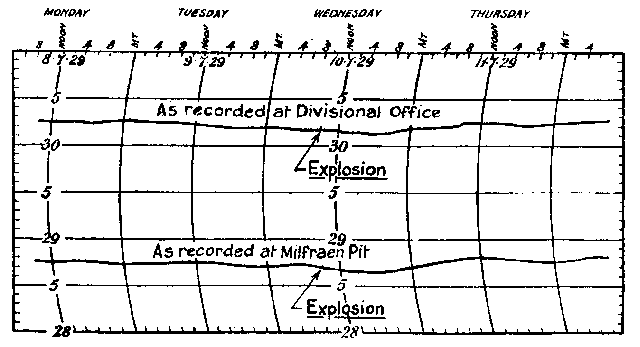
Barometer. — It will be seen from the subjoined Barogram taken at the office of H.M. Divisional Inspector of Mines at Cardiff, that the barometer had been steadily but slowly falling from midnight of the 8th July, when it stood at 30.5 inches, until 7 p.m. on the night of the 10th July, when it stood at 30.25 inches, after which a slow but steady rise is recorded. At the time of the explosion (8.80 a.m., July 10th) the reading was 30.35 inches. A reproduction is given of the barometer readings taken during the same period at the fan house at Milfraen Colliery which is situated eleven hundred feet above sea level, and about 1,050 feet above the level of the Divisional Inspector's Office at Cardiff.
* Explosion at Marine Colliery, Monmouthshire, Report by Sir Henry Walker, C.B.E., H.M. Chief Inspector of Mines. (Cmd. 3048).


A copy of this report was kindly donated by
West Cumbria Mines Research.




 Contains public sector information licensed under the

