


|

|

|

|
|
 |
 |
 |
||
4. Gas In The Low East, Top East, And Middle East Districts.
At this point it is necessary to examine more in detail the conditions which prevailed in the mine on the day before the workers by mutual arrangement started preparations for the erection of the stoppings, and also the subsequent conditions as disclosed in evidence and by the statutory reports made by the deputies of the colliery.
The results of the analysis of the air samples which were taken in the mine during the period from Sunday, 22nd, to Friday, 27th July, are given in Appendix II.
(a) Prior to the commencement of damming off operations.
On Sunday, the 22nd July, the Agent, the Manager, the Miners' representatives and H.M. Inspectors made an underground inspection of the mine to ascertain the conditions. On that occasion smoke was issuing from 21's into the back bord but was thought to be diminishing. The party proceeded up 95's crossgate and one or two got as far as the junction of 53's and 29's and found 3 and 3½ per cent. of firedamp. A pocket of gas estimated by Mr. Dunn to be about 4 per cent. was discovered in 95's crossgate 50 to 70 yards beyond the air door there, but although Mr. Herbert Smith returned to this point immediately he could not find this percentage. In explanation of this it was thought that there might have been a wave of gas brought down, possibly, by the opening and shutting of the door; and generally it was noticed in the course of this inspection that all the lamps in the party appeared to be showing a less percentage of gas in the air than the lamp carried by Mr. Dunn.
When this inspection was in progress the manager, accompanied by Mr. Hugh Ross, visited the West Section of the pit that, and the latter in his evidence stated while there was 2½ per cent. to 3 per cent. of firedamp at the coal face, the roadways were clear.
(b) Gases on the return side of the fire, during the damming off operations.
The operations at Stoppings D and C were carried on under considerable difficulties. Smoke and noxious gases were continually being given off. These conditions necessitated the conveyance of air to the site of the stopping by means of brattice cloth and air pipes. Even then the conditions became so dangerous from time to time that the workers became affected and had to be withdrawn from the stoppings, and men wearing rescue apparatus had now and again to be employed. It was only by constant attention to the ventilation and by working in relays that the work could be continued.
Mr. Hugh Ross, one of the two workmen's inspectors for the mine, and the holder of a Second Class Certificate under the Coal Mines Act, informed the Court that when he visited 21's on the 25th July, there was a good percentage of gas being given off, and a little bit of smoke coming out. On the following day he inspected 21's again. One of the workers seemed to be distressed by having inhaled carbon monoxide and Mr. Ross tested for firedamp and "found anything over 3 per cent." He made the suggestion that brattice cloth should be put up to Mr. Stoker, the overman, who replied that it would be put up and Mr. Ross told the workmen not to go inside till this had been done.
Mr. Alderman Dunn, the other workmen's inspector for the mine, inspected 5's return and 7's (Stopping D), on Thursday, 26th July. He was alarmed at the quantity of gas there. He examined with Mr. Willetts, the overman, the point at which it was proposed to put the stopping. In reply to Mr. Herbert Smith, Mr. Dunn said :—
"Then we had a discussion as to the quantity of gas, and I said 'Well, the first thing that has got to be done here is that the whole of this section, as far as I am concerned, must be properly stone-dusted and before any men work, as far as I am concerned, ventilation must be put in and that gas cleared out'. Then one of the men who was driving out, who was knocking out this old brick stopping came for a wedge, so I said 'There will be no wedges used as far as I am concerned.' He said 'Well, can we then, in the absence of a wedge, can we drive a ringer in with a hammer?' I said 'No, not so far as I am concerned.' Then a few yards further on was a man called Herbert Whittaker who was laying in some road. He was driving nails and dogs into the road. I said 'Stop that, we are going to have nothing of that until, first, this is stonedusted and, second, there is some ventilation, and this gas is cleared out."
In reply to Mr. Herbert Smith, Mr. Dunn said :—
Q. Or in other words, you withdrew the men ? — A. Those were the instructions that I gave.
Q. You had not the power, but you told the men? — A. I told both men and overman Willetts and deputy Lomas. In addition to that, after that, then Lomas the deputy, advanced along here with me on this crossgate — I think it. is old 78's — down to a point here, and on this return Lomas said: "For goodness sake sit down, Ted". I said: "What's the matter?" He said "If you don't sit down, something will happen to me — feel at my heart".
Q. Lomas said that ? — A. Lomas said that. I left him at a point there, after sitting down in this crossgate, and made an inspection of this 88's stall. That was the last I saw of him.
Q. There is no particular number where you say that happened, that you can give us for reference ? — A. Where Lomas said that?
Q. Yes ? — A. On 78's old crossgate.
Q. You sat down with him ? — A. I sat down with him, yes.
Q. On 78's old crossgate? — A. Yes. Well then, I came then to the pit bottom and at the No. 1 pit bottom I saw Mr. Pickering and Mr. Nicholson and Mr. Butler. I am sure of that. I had a discussion then with Mr. Pickering and Mr. Nicholson — Mr. Butler walked on — at No. 1 pit bottom, regarding the conditions of the top east return, and I understand since that both Mr. Butler, Mr. Pickering and Mr. Nicholson went there, and you have heard the result, how Mr. Nicholson was overcome and Mr. Butler was overcome with gas — probably something else — and had to retire out of the pit.
On Friday, the day before the explosions Mr. Ross went down the mine shortly after 7 a.m. He accompanied Mr. Gabbitas and they travelled up 5's return into 7's (stopping D). Mr. Ross found that gases were coming plentifully through this stopping but that there was a good current of air coming up 7's intake and diluting them. There were no men working. They told him the rescue men had been putting sand bags in the stopping. He then visited 21's. He got 2½ per cent. to 3½ per cent. of firedamp extending 10 yards back from the stopping. The men were not actually working then but they must have been working that morning. He complained about holes above the brattice cloth and the under-manager gave instructions to have them packed.
On the afternoon of Friday, 27th July, there was 4 per cent. of firedamp at Stopping D. The men were working in relays, and overman Hodges did not consider it necessary to withdraw them.
(c) Fire damp on the intake side of the fire, during damming off operations, from the 24th July to about 1 p.m. on the 27th July.
Stopping B was fairly close to the East Main Plane and consequently no difficulty with gas arose there.
As regards the points A1 and A2, the vicinity of the disaster, where stoppings were being erected in 53's crossgate and at 37's, the chemist's analyses, which in this area dealt only with 53's crossgate, showed 2.49 per cent. CH4 (Firedamp) present on the 24th July, 2.36 per cent. on the 25th, 3.19 per cent. on the 26th, and 2.31 per cent. on the 27th.
On and from the 23rd until 2.15 p.m. on the 27th the deputies' reports, made at specified times under Sections 64 and 65 of the Coal Mines Act, 1911, recorded (by lamp test) percentages of firedamp varying from 2 per cent. to 3½ per cent. as being present in the air current between 95's and the stoppings. Until the 27th July, no higher percentage than 3 per cent. was reported except on one occasion on 23rd July (between 12.15 p.m. and 2.15 p.m.) when 3½ per cent. was reported in the air current inbye. 37's on 53's crossgate.
These reports by the deputies, up to and including that for the period 4.45 a.m. to 6.45 a.m. on 27th July were all countersigned by both the manager and the under-manager. None of the subsequent reports made under these sections — which were in respect of the periods 12.15 p.m. to 2.15 p.m., 4 p.m. to 6 p.m. and 11 p.m. to midnight on 27th July, and 4.15 a.m. to 6.15 a.m. on 28th July, had been countersigned by either the under-manager or the manager up to the time of the explosion.
The manager, Mr. Aaron Butler, in respect of the 24 hours ending at 7 a.m. on the 25th July, made a special report to the agent (which was initialled also by the under-manager) of 2 per cent. firedamp, "conditions good" on 95's and 53's crossgate — 2½ per cent. on 53's level. Mr. Butler made a further special report for the 24 hours ending 7 a.m. on the 26th July, of 2 per cent. of firedamp from 95's to 37's, and 3 per cent. of firedamp from 37's to 22's on 53's.
The agent, Mr. Pickering, in his evidence stated that he was down the pit on the 23rd, 24th, 25th and 26th July, and the highest percentage of firedamp he found in this area (i.e., 53's and 37's) was 2 per cent.
The same area was inspected by Mr. Hugh Ross, one of the workmen's inspectors, on Wednesday, 25th July, and in his opinion the air was "fairly decent" at 53's and 37's. Mr. Alderman Dunn, the other workmen's inspector, on the same day made tests which showed 2 per cent. of gas "at the outside" along 53's, 32's and 41's. The latter are old gates beyond 22's, where the stopping in 53's was to be built. Mr. Ross visited 53's and 37's again on the following day (Thursday), and in 37's he thought he got about 3 per cent. gas where the men had started the stoppings. The 3 per cent. came back 3 or 4 yards. In 53's there was about 2 to 2½ per cent. right up in the roof. Mr. Ross again inspected these places early on Friday morning, 27th July, and at the stoppings A1 and A2 "it took him all his time" to get 2½ per cent. He could hear air whistling through the stopping at 37's.
Both Mr. Ross and Mr. Dunn appear to have been satisfied with the conditions as regards the presence of firedamp on the intake side of the fire area up to this time, i.e., Friday morning. In reply to Mr. McQuisten, Mr. Ross said that there really was not much sign of danger until 4 to 6 per cent. of firedamp was reported there. That was the first time that the real danger was apparent. His "fear always was the intake side." He "never was afraid of the return side."
(d) Firedamp on the intake side of the fire during the 20 hours preceding the explosion.
In the early afternoon of 27th July there appears to have been a considerable increase in the percentage of firedamp, and this condition — despite a temporary improvement — appears on the whole to have got worse up to the time of the explosion. This is shown in the following diagram, in which I have attempted to illustrate roughly the chief variations in the percentages of firedamp which were observed in the air current in 53's crossgate between 95's and 37's. The percentages are taken from the deputies statutory reports.
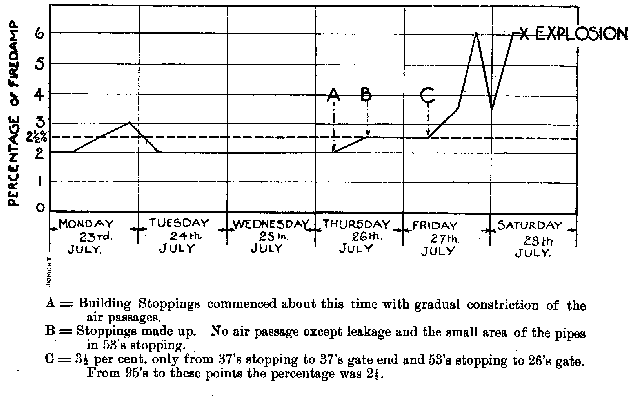
The period from the early afternoon of 27th July, when the percentage of firedamp increased considerably, up to the time of the explosion, comprised three deputies' shifts (two deputies to each shift) and I will consider each shift separately, the first two shifts briefly and the last in some detail.
27th July — 1 p.m. to 7 p.m.
The deputy in charge was Thomas Ernest Sturdy. He was assisted by another deputy, Thomas Thompson, and these deputies worked under the supervision and direction of Wm. Hodges, overman, who was assisted by another overman, George Outram.
The deputies made and signed jointly a report for the period 4 p.m. to 6 p.m. —
4 per cent. of CH4 in air current at 95's gate end (fenced off), 6 per cent. of CH4 in air current from 95's to 37's A1 and A2 Stoppings.
Sturdy also made a special report under the Spontaneous Combustion Regulations for the period 1 p m. to 7 p.m.
Steady increase of CH4 from 3½ per cent. to 6 per cent.
It was given in evidence that about 3.45 p.m. to 4 p.m. a slight "puff" or explosion occurred inside 37's stopping. Sturdy reported this occurrence by telephone to the Overman, Wm. Hodges, who, after asking the outgoing deputy Perrins to inform the under-manager, proceeded to the spot, accompanied by George Outram. The men, who had been temporarily sent back by the deputy, had by that time been allowed by the deputy to resume work.
Mr. Hodges and Mr. Outram made an inspection about 4.30 p.m. and found —
3 per cent. on 95's left face.
4 per cent. at 53's stopping in cavity drawn to complete pack.
3 per cent. in the general body of the air in "the whole length of 53's."
Mr. Hodges then left the district to report by telephone to the Manager, and he got permission from the Manager to take a scale off a door in 21's and to put a temporary cloth in 83's gate in order to improve the ventilation inbye. By 5 p.m., according to the deputy's evidence, the percentage of firedamp at the face of both stoppings had increased to 6 per cent. The overman, George Outram, estimated 5 per cent.; and, as it was "snap" time, the men were sent out until the conditions could be improved. Outram went back after the scale had been removed from the door in 21's level, and made a joint examination with Sturdy. They found that the percentage of gas at the stoppings had by then fallen to 4 per cent. This was about 6 p.m. and the men were thereupon re-admitted to work. Outram then left the district, after giving instructions to the deputies to put sheets on 83's and the old gates 7's and 24's.
About 6.45 p.m., when the outgoing and oncoming shifts were changing, a second "puff" occurred inside the stoppings.
Mr. Outram was subsequently informed by the deputy, Sturdy, of this second "puff," but the other Overman, Hodges, does not appear to have heard anything about it, although he did not leave the pit until about 10 p.m.
Mr. Hodges also, under examination, appeared to be doubtful whether at the end of this shift he knew of the terms of either of the two written reports made by the deputies. He appears, however, to have seen both the manager and undermanager when he came out of the pit, and to have informed them of the measures which the deputies had been directed to take with a view to improving the ventilation.
27th July — 7 p.m. until Midnight.
The deputies for this shift were George Whitehouse (in charge) and John Edward Leader. The overman supervising them was George Watkins. The two deputies signed jointly a report of a statutory inspection made between 11 p.m. and 12 midnight —
4 per cent. firedamp at 95's face (low side) fenced off.
3½ per cent. firedamp in 53's cross gate.
5 per cent. of firedamp in 37's face and stopping.
Deputy Whitehouse also made a special report under the Spontaneous Combustion Regulations for the period 6 p.m. on 27th July to 1 a.m. on 28th of July —
CH4 reduced on 53's cross gate to 3½ per cent.
The same deputy at the end of the shift sent a private note to the manager, in regard to the progress of the work, to which he added the words: "Nothing fresh to tell you as things are all right."
The overman of this shift, George Watkins, met both the off-going overmen, Wm. Hodges and George Outram, and was informed by them that there was more gas than they cared for, and that the deputies (Leader and Whitehouse) had been told "what preparation and what sheetings to make." Whitehouse gave it in evidence that, acting on these instructions from the overman of the previous shift, he put light sheets in the cross gates off 95's, assisted at the outset by the deputy of the previous shift, Sturdy, and that the ventilation improved somewhat subsequently.
Later Mr. Watkins met Leader on the main plane and was informed by him that these sheets had been put on and also that the door in 95's cross gate had been opened.* Mr. Watkins accordingly went with Leader to see what the effect of this work had been on the ventilation. This was about 10 p.m. On arriving at 53's and 37's (stoppings A1 and A2) he found no more than 2 per cent. of firedamp. He regarded this as satisfactory. He remarked to Leader "things are very nice" and Leader agreed. Watkins gave it in evidence that he then went to the men at the stoppings and conversed with them. He asked them how they were going on and they said they were all right. He enquired if there had been anything of a "puff" or anything of that description, and they said "no," and that they were quite comfortable. They did not tell him there had been a second "puff" about 6.45 p.m. when they were just going in to work.
* This door had evidently been closed by some unknown person, for it had been purposely left open previously to allow air to traverse direct up 95's cross gate.
From Midnight on 27th July to the time of the explosion (9.15 a.m., 28th July).
The deputy in charge was Horace Outram and the deputy assisting was Robert Bryden. Both these deputies were working in this district for the first time. The overman supervising them was Thomas Willetts. The deputies made and signed jointly a statutory report for the period 4.15 a.m. to 6.15 a.m.
4 per cent. of firedamp at 95's face (low side) fenced off.
6 per cent. of firedamp in air current from 95's to 37's and stoppings.
The deputy in charge, Horace Outram, also made a special report under the Spontaneous Combustion Regulations.
CH4 increased from 3½ per cent. to 6 per cent. on 53's crossgate.
These reports were qualified in evidence by both the deputies who signed them.
Outram knew the conditions which had been found and reported by the deputies of the previous shift, Leader and Whitehouse, for, in accordance with the usual practice throughout these operations, he initialled their report when he commenced his shift, to show that he had seen it and knew its contents. Outram, in evidence, stated that he checked this report by examining for himself before admitting his shift. He found 4 per cent. of firedamp 1 foot from the roof from 37's gate to the stopping; the percentage at the floor being 1½ per cent. In 53's there was 3½ per cent. of firedamp and on 95's face there was 1½ per cent. except on the right hand side (fenced off) where there was 4 per cent.
The overman, Thomas Willetts made an inspection of the same area very shortly afterwards, having seen the deputy's report of the previous shift, and having conferred with George Watkins, the overman of the previous shift. Willetts at 95's crossgate found 4 per cent. on the low side (fenced off) diluted to 2 per cent. along the face. At 53's stopping he found only 2 per cent. in the air current until he examined at the roof, where he found 2½ per cent. At this time there were no men at 53's stopping. There had been a change to a 6 hour shift for the men, and, as this was the first shift, they had not yet arrived. By the time he got to 37's stopping the men were at work there, and, before leaving that area at 2.30 a.m., he examined and found 3 per cent. at 37's. From his knowledge of the conditions existing during the previous shift, he considered that the conditions had improved considerably. and that this improvement had been effected by opening and fastening back the door in 95's crossgate, and erecting screens at each gate in that crossgate.
The conditions do not seem to have got substantially worse until after 5 a.m., when two small "puffs" with one minute interval between them occurred inside the stoppings. At the moment Horace Outram was at the base, "26's gate," and according to his evidence he did not hear the "puffs" or feel anything. Bryden, who was near the stopping, sent for him, and he immediately went forward, sent the men back to the base, and made an examination with Bryden. This examination revealed an increase of firedamp from 5 to 6 per cent. at 37's stopping where the men had been working, about 3½ to 4 per cent. in 37's gate, and 3½ per cent. at 53's stopping. Outram did not send the men back to work because he "found an accumulation of gas, an increase of gas due to those puffs," and when he had "finished making a thorough examination it was about 10 minutes to 6 in the morning and the men finished their shift at 6 o'clock," and he thought "it was not wise to send the men back to work for about 10 minutes" . . . He did not consider the conditions fit. This examination concluded at 5.50 a.m. and by this time there was 6 per cent. of firedamp in 53's crossgate "for 40 yards back" from each of the stoppings.
At 7 to 7.30 a.m., when George Perrins, the succeeding deputy, came on (Perrins was one of the victims of the disaster) he and Outram made a re-examination. In answer to Mr. Neal, Outram said that during that examination they did not find more than 4 per cent. and only 1½ per cent. at the top of 95's. This inspection with Perrins was a voluntary one on Outram's part; Arthur Bagley, who was Perrins' mate, was not there, and at the time Outram had not the slightest idea where Bagley was. He saw him afterwards, but says that he had no conversation with him. This point is somewhat important because Bagley, as will be found later, said he did converse with Outram and was told by him that he had telephoned to the under-manager.
Notwithstanding the fact that there was 4 per cent. of firedamp present, Perrins re-admitted the men while Outram was present. It was considered that the position was improving. On his way out Outram saw the under-manager at the pit bottom but did not report. He subsequently saw the manager on the surface.
The other deputy, Robert Bryden, confirmed Outram's evidence as to the finding of 6 per cent. of firedamp after the "puffs" which occurred about 5 a.m., but, as Outram had done before him, he qualified in evidence the report which both of them had signed. He stated that the 6 per cent. of firedamp in the air current which was entered in the report as extending from "95's to 37's A1 and A2 stoppings," in fact extended only 40 yards back from 53's stopping. According to Bryden's evidence, he and Outram left the pit together, and, although on their way he saw Bagley going in front down 95's crossgate, nothing was said to Bagley.
The joint inspection by Perrins and Horace Outram was the last made by anyone left to tell the tale. I now come to the evidence given by Arthur Bagley, deputy, who had been instructed to work under Perrins and do what he could to get material to Perrins as it was required. He related that he descended the pit at 6 a.m. and got into 95's pass-bye, approaching the top of that road about 6.30-6.40 and gave orders to two men to fill dirt. There he saw Horace Outram and Robert Bryden. He got within 10 or 11 yards of them (there were empty tubs there and the two men were beyond) and he heard one of them shout "Is that Arthur," to which he answered "Yes." The reply received was, "Bring yourself up here" to this he replied "Right-ho." One of the two deputies (name not mentioned) commenced to say something, and, while he was saying it, he, Bagley, pulled his lamp flame down, and, from what he saw in the lamp, concluded there was 6 per cent. about 5 feet 9 inches from the floor where the road was 10 or 11 feet high. On seeing this he said to Horace Outram and Bryden "What the hell are you doing here," Outram said "Nay, that's what I want to know." "Well," I said, "I can see sufficient; there is one here off." He accordingly went off into the haulage road.
In reply to Mr. Thomas Richards, Bagley admitted that he did not tell anyone that there was actually 6 per cent. He said it was not safe.
It seems that, after finding this firedamp in 95's pass-bye, Bagley went out on to the haulage road and into No. 11's, and found deputy J. W. Burke, who was doing up a brattice sheet in the East Main Plane below 83's road-end acting under the orders of the under-manager and Mr. Stoker (killed in the explosion). Bagley thereupon told Burke not to go along 95's level, as it was in an unsafe condition. He then went to the telephone and got Perrins. Questioned by Mr. Wynne, Bagley's recollection of this conversation was as follows :—
Q. Can you tell us what conversation you had with him? — A. Well, I said "Is that Perrins" and he said "Yes." I said "What is the condition of the ventilation at the stoppings" he said "it is bad." I said "Well I have been in 95's pass-bye and there is rather a large quantity of gas and if I were you I should withdraw the men."
Q. What did he say to that ? — A. He did not answer the question, Sir.
Q. He did not answer? — A. No.
Q. Did he ring off ? — A. I cannot say that he did ring off. By this time these two deputies previously referred to came to the telephone and I did not want them to go past without having a further conversation with them.
Q. Did you have any conversation with them then? — A. Yes, sir. I did.
Q. Can you tell us what passed between you ? — A. Well, I put the receiver back. I did not get any reply from Perrins because I thought really he would want time to consider.
By this time the two deputies, Horace Outram and Robert Bryden, arrived at the telephone, and Bagley stated that he asked them what it was like against the stoppings. Outram replied "Well it is the same as where you found it," and, in reply to a further question, said he had so acquainted the under-manager. It will be recollected that both Outram and Bryden deny that such a conversation took place.
After this Bagley went along the plane towards 21's road in search of an overman or the under-manager or some other official to tell them the condition in 95's. He saw no such official and consequently returned with brattice cloth to assist Burke in the erection of the screen previously referred to.
While they were putting up the screen, Perrins, the deputy, arrived, and said he had asked for sand and not got it, although he had told some of the haulage hands to get it. Bagley said his reply to this was "Well, you will have to go and tell them again, I don't consider it safe for me to go along there." To which Perrins replied "I think our safety depends on the speed we can get the stoppings on."
After Perrins had gone Mr. Stoker, the overman, came and enquired "What is it like along there Arthur ?" Bagley said his reply was "It is very bad, really it is not fit for a cat." Stoker then asked what he (Bagley) was doing and the latter informed him that he was "constructing this sheet to put more wind along." Stoker's reply was "That's right." After this Stoker left, and while Bagley and Burke were putting another sheet in 83's the explosion occurred. He saw the flash and was affected by the hot air. Burke was with him, but both escaped.
The last workman to come out of 95's alive on the fatal morning was John Arthur Watson, who was taking in supplies and materials to 53's and 37's stoppings. Before proceeding there he had to wait at 26's — this was about 6.30 — for the two deputies, George Perrins and Horace Outram, to make an examination. At this time he noticed that Horace Outram's lamp had gone out. After Watson had started on his usual job Perrins asked him to fill dirt on 95's. To this he objected and got a note from Perrins to leave the pit. He left Perrins' area and worked elsewhere. In reply to Mr. Herbert Smith he said the temperature of the place was pretty warm when he came out, and, in reply to Mr. Neal, he said that the ventilation, was very thick and heavy — different from what it was the day before.





 Contains public sector information licensed under the

