


|

|

|

|
|
 |
 |
 |
||
2. Narrative Of Events Leading Up To The Explosion.
(a) Operations to combat fire prior to the stopping of the colliery.
In order to make the narrative of the disaster as complete as possible it will be necessary, even at the expense of a little repetition in detail, to go as far back as the 26th April last, when gob-fire trouble first arose in the Low East District of the mine (see Plan II).*
On that date "gob-stink" was reported as having been detected in 60's airway in the Low East District and in order to deal with it — to prevent possibility of development of stink and fire — it was arranged to build dirt packs at the entrance to 60's stall and at the end of the airway leading to 21's level. When this had been done, the manager thought they had control of the trouble. Meanwhile, owing to this occurrence, certain alterations were made in the ventilation, whereby the long ventilating current passing along the faces of the Middle East, Low East and Top East Districts (see Plan I) was, by reason of the closing of an airway at 60's, shortened to the extent that, instead of passing on to the Top East district, it was short circuited down 60's crossgate into 29's slant and so back to the upcast pit bottom. This alteration, agreed to by the agent and manager, necessitated the Top East District being ventilated by a separate volume of air entering from 7's by the North East intake and passing along the faces into 21's where, in company with the air passing out of the Low East, it travelled to the upcast shaft.
On the 7th May, notwithstanding previous efforts, gob-stink was discovered about 80 yards further outbye at 52's on the one side and on the other at 102's in the neighbourhood of the end of 21's level. Further packing was resorted to, 102's was "gobbed up solid" and in 52's airway 8 feet of sand was placed between two 14 inch brick walls.
After this no disturbing report on the conditions appears to have been made until the 17th or 18th of the same month, when the manager received at one o'clock in the morning a report that smoke had been found issuing out of the left hand bank in 60's. He went to the pit straight away, and, giving instructions for a dirt and sand pack to be put on the left side in 60's to dam back the smoke, superintended the work for about 5 hours; when, owing to the effects of breathing noxious fumes, he and an overman named Nathan Gill became so seriously gassed as to require assistance in getting out of the mine. As a result of this, the manager was in the doctors' hands and unable to return to his duties until the 23rd May — after an absence of 5 or 6 days. Additional packing was meanwhile done, and the place sealed off under the superintendence of the agent, Mr. Pickering. While this work was in progress it was arranged for the air to be coursed or short circuited along old 25's gate and thence into 60's crossgate.
On the 20th May (Sunday), smoke being again discovered issuing from the left hand pack side opposite the East Gate in 60's crossgate, some more sand was rammed in that particular place, and for the time being this stopped the issue of smoke. At this time there was 2 per cent. of firedamp present in 60's crossgate and it had increased to 3½ per cent. by the time the agent left the mine at 4 p.m. It was now recognised that all the work that had been done had not finally extinguished the fire, and Mr. Jackson, the General Manager, and Mr. Joseph Humble, the Consulting Engineer, were sent for. This was at 6.30 p.m., and after a 4 hours discussion it was decided that nothing could be done until they could go down the mine the following morning.
Accordingly an inspection was made on Monday the 21st May by Mr. Jackson, Mr. Pickering, Mr. Humble and others, who descended the pit about 10.30 a.m. On visiting 60's crossgate they found evidence of a certain amount of heat on the left hand pack of 60's crossgate — between 60's scouring and the last right hand gate, which is 25's. The firedamp percentage, found to be 3½ the previous day, had been reduced to just under 2: but gobstink was still evident in 21's right hand bank as it had been the previous day. After this inspection had been made and a subsequent conference held, it was considered that, if the packs and stoppings were thoroughly and strongly made, that would he enough to stifle the fire.
A further conference, attended by the Miners' Representatives, was held on the 22nd May, when the general situation was discussed. Another underground inspection was also made. Smoke was again issuing at the same place in 60's crossgate and men were endeavouring to stem it off by ramming sand into the crevices; though this operation proved difficult, as the sand dried quickly and dribbled out. Some heat had also been located during the night at a right hand gate pack in the same crossgate. Sand had been applied there also. It being the agent's opinion that the work of stowing up the crossgate should proceed with all speed, he gave instructions accordingly. The men engaged at this operation were working in relays; the air was very warm and the percentage of firedamp present was 2 per cent.
On the following day, i.e., the 23rd May, the manager returned to duty, and an inspection was made by him accompanied by the agent and also by Alderman E. Dunn and Mr. Hugh Ross, the Miners' Representatives. On this occasion they found the blocking up of the old crossgate in 21's completed and presenting the appearance of a satisfactory job, while in 21's bank they found the sand packing commenced there making good progress. As there was still evidence of gob-stink just outbye of old 102's, it was arranged to raise up 21's road to bury the packs, and also, if possible, to bury a break out of which gob-stink was issuing. 60's crossgate was then inspected. It was found that the road had been stowed up back to 25's gate, and it was arranged to stow up as much of 25's face gate as possible. The conditions were considered to be favourable, and this work was continued during the 24th, 25th, 26th, and Sunday the 27th May.
On the 28th May, however, the manager found definite evidence of fire in 60's crossgate, the ground being hot on the left hand side of that gate. He discovered on pulling out some bricks that the "bottoms" — meaning the bottom coal which was not worked — and also part of an old wooden chock were on fire. He dug out a tub load of bottoms, really ashes, and, after pulling some of the burning timber out, quenched the burning material with water. He filled the hollow made by the removal of the ashes with sand, and, as these operations seemed to arrest the fire for the time being, the work of gobbing up the roadways was continued. On fire being found in the bottom coal, it was also decided to dig a trench in it further outbye to arrest extension of the trouble in that direction. Accordingly a trench was dug and filled up again with sand behind an 18 inch brick wall. The digging of this trench disclosed for the first time that the bottom coal was of abnormal thickness, viz., 2 feet 6 inches. On the completion of this trench the management continued drawing off (i.e., removing timber and allowing the roof to collapse) and gobbing up roads. By this process they still hoped they had succeeded in arresting the fire.
Notwithstanding these efforts, which had continued throughout June and were still in progress, on the 2nd July fire was again discovered to have broken out in the right hand or outbye side of 25's old gate, close to the face. A worker named John Proctor and the overman, Nathan Gill, by travelling a circuitous route to avoid the smoke which the former had previously discovered and reported to the overman, found "about a yard circle of fire burning round a clog" (chock). To this they applied buckets of stone dust. Leaving this operation to be repeated by Proctor and another worker, Nathan Gill retired to change his clothes which he described as having become "wringing wet" ; because, on hearing of the fire, he had not waited to get into his working clothes. During his temporary absence, while one of the men was emptying a bucket of stone dust on to the fire, something went off or exploded with a report, and the force of it blew him out of the hole. They carried on, however, until there was another report, and they then decided that the place was not safe. It should be mentioned here that the hole referred to was really a confined airway left in 25's during the gobbing operations then in hand, the hole being 3 feet high and about 2 feet or half a yard wide, just large enough for a man to crawl through, until orders were given for the airway to be "gobbed up" entirely. During Gill's absence a deputy, Sturdy, arrived, and after going up to the fire soon came down again. On his return, Gill was surprised to find that notwithstanding what had been done, the "fire had considerably increased to a matter of 12 to 14 yards in length, and chocks on the left hand side in 25's gate were burning considerably." These chocks were formed of old broken timber and had been put in to support the roof, which had proved in the course of working to be very bad. Gill, finding the further application of stone dust to be useless in checking the fire, ordered the men to pack up the airway in 25's in order to stop the air current reaching the fire. He sent at once for Mr. Butler, who arrived quickly followed by Mr. Pickering. This operation of closing 25's airway was continued, and by the manager's and agent's orders another pack on the opposite side of the fire was built in 60's crossgate.
These packing operations, including the packing on 52's gate side, continued for several days. Just when it was thought this work was a decided success, smoke commenced to issue out of a "slip" 20 feet above the pack on the left hand side (looking towards the coal face). After an unsuccessful attempt to stop the smoke by sealing up the slip by throwing sand into the opening, stoppings were erected to effect this purpose in 52's gate; and while these were being erected an air pipe 18 inches to 23 inches diameter was built in to allow ventilation for men to work. Following this, another trench a yard wide was cut in the bottom coal up the centre of 52's gate and filled with sand. At this point the coal was found to be 2 feet 9 inches thick, and, when exposed in the trench, its temperature was found to be normal. While the work was continuing on the 13th July the manager reported a heavy weighting of the roof in 52's. This weight had fractured the air pipe in the stopping and smoke was again issuing through the pipe in such a volume as to make it impossible to work. However, they succeeded in stopping up the pipe. Trenching in the bottom coal was then continued and preparations were made for another stopping at the entrance of 52's gate. While this was progressing a tremendous fall of roof occurred there. Owing to the foulness of the air some of the men became unconscious — the manager among the number — and had to be helped out to fresh air. These men were obviously suffering from carbon monoxide poisoning. Work was thereupon suspended — the men being withdrawn — and 60's crossgate fenced off.
As the agent considered it "of exceedingly great importance" that 60's crossgate should be stopped off outbye of 52's junction, stoppings were erected there by men wearing rescue apparatus. This operation was completed at 4 a.m. on Monday the 16th July, and sealed that side of the fire area. Meanwhile, on the 14th or 15th July, further attempts were made more securely to seal the area on the intake side, and a dry brick stopping was commenced at 44's gate for this purpose. When this stopping was nearly completed a tremendous leakage of air was discovered going over the top into the gob fire area. Nathan Gill, the overman, who was in charge of the work, at once built up this opening, and arranged for dirt and sand packs to be placed against the stopping.
By the 16th July, when 7 yards of packing and brick walls had been put in 44's gate and some 10 yards along the face side, an explosion of firedamp took place in the region built off and blew off the upper part of each of the stoppings. The men engaged at the packs at once withdrew and reported the occurrence to the overman Gill. At 10 the same night Gill visited the stopping, and finding "the place was absolutely clear, fit for anyone to work in," he set the men at work to build a brick stopping to strengthen everything that had already been put in; but, finding he had not sufficient material, he proceeded to the pit bottom to order more. When he was there a telephone message reported that another explosion had taken place in his absence. After receiving full particulars of the position following the second explosion, and realising the seriousness of the situation (for he regarded the sealing-off process at that particular time as hopeless), he left the mine to consult the manager. As a result of this second explosion the whole of the men were withdrawn from the mine in the early hours of the 17th July by order of the agent and manager. This meant the stopping of the colliery — coal getting was discontinued — and thereafter all operations, when resumed, were solely for the purpose of fighting the fire.
* In 1921 and 1922 there had been two fires and heatings in the West and North West Districts. Those were dealt with either by digging out the heated material or by the erection of stoppings.
(b) Operations to combat fire subsequent to the stopping of the colliery.
No work was resumed until midnight on the 22nd July. Gill duly talked the seriousness of the situation over with the manager, and said at the time that, as there was a swilley in the affected area, the best thing they could do was to flood the fire out with water. The manager agreed, and by arrangement Gill went down the mine on the morning of the 17th July under orders to get down what pipes he could on to the seat of the fire for this purpose. Meanwhile the manager's instructions to proceed with the idea of flooding the swilley with water were countermanded by weight of opinion as the result of a conference of Mining Engineers which will be referred to at a later stage of this Report.
On 18th July, during explorations following the withdrawal of the men, definite indications of a third explosion were found in the faces outbye of the stoppings in 44's. Later, the effects of a fourth explosion were felt at 21's level by a party of explorers, including the under-manager, Mr. Gabbitas, who, on their way out of the pit, saw the doors in the slit at the end of that level opened by a reversal of the air current. This place was about 700 yards from the site of the stoppings built in 60's crossgate and 44's gate and bank. After an inspection on the 17th July it had been arranged to make an endeavour to strengthen the stoppings on 44's gate and face, but, having regard to these subsequent explosions, this plan was not carried out.
On the 18th July it was arranged to reduce the water gauge by slowing the fan. The gauge was accordingly reduced from 4.5 to 2.5 at 430 on that date and later in the same day to 1.5. On the 20th and 21st July underground inspections were made by Mr. Jackson, the Managing Director, and other officials. After a consultation, it was decided to put a regulator in 9's back herd, so that the speed of the ventilating fan could be increased again without producing a corresponding quantity of air in the fire affected area, while at the same time the volume of air would be increased in the North West District, where inspection had revealed a considerable quantity of firedamp. It was also decided to adopt a recommendation put forward by Mr. W. H. Chambers, viz., to apply inert gas to the affected area and for that purpose to enclose the whole of that area by the erection of stoppings in 53's crossgate and 37's face, also in 21's road and 7's return — top East return. This inert gas was to be forced through pipes built in one of the stoppings for that purpose.
On the 22nd July an inspection was made of the East side and of the North West District of the mine by the miners' representatives, the Colliery Officials and H.M. Inspectors of Mines. The party divided in the pit — one party going East and the other North West. After this inspection a conference of the parties who had made it was held, and it was agreed that the men should go down the pit, or be asked to go down the pit, immediately after the conference had finished, to commence work on 53's crossgate to prepare it for the stopping. It was estimated that 50 men a shift would be wanted to carry on all the work.
Further reference to this conference and to the condition of the pit as it was found on the 22nd July will be made later, but it should be stated now that Mr. Herbert Smith had a meeting of his men the following day (Monday), at which the men were told about the conditions prevailing in the pit the previous day, and, in order to obtain the required number of men to resume operations, the following notice was posted up at the colliery and circulated amongst the men :—
We have to-day examined the Maltby Main Colliery and have arranged after careful examination to advise at once getting ready to stop off the affected area, namely the Low East and 53's Slant, and we ask you to attend work to-night at 12 midnight as we are satisfied you will work in as little danger as possible."
(Signed) Edward Dunn,
Hugh Ross,
At midnight on the 22nd July, within a very short time of the issuing of this notice, 46 men — apart from officials — had turned up to work, and, as shown by the following table, their number gradually increased up to and including Saturday morning (the day of the disaster) when 122 workers were employed on the work of erecting stoppings and of getting in material to the various points where the work was proceeding. It was made clear at the Inquiry that no person whatever was employed in the mine to do any other work than that rendered necessary by the decision to seal up the affected area.
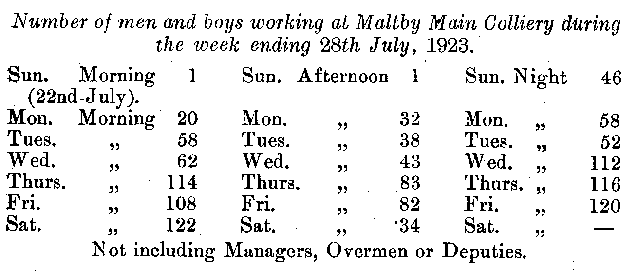
After preliminary operations, the actual building of the stoppings at the appointed places commenced on Wednesday afternoon the 25th July.
For the guidance of the officials engaged in the operations the following instructions were issued to them by Mr. Basil H. Pickering, the agent of the colliery. The reference marks given in these instructions will be found on Plans I. and II. :—
"A decision has now been arrived at in regard to the procedure to be adopted to deal with the gob fire, and the following information is for the guidance of all concerned.
"In general principle it has been decided to isolate the area from the face end of 53's crossgate to the top of old 7's, by the erection of stoppings, and then to pump inert gas into the area with the object of quenching the fire that is burning.
"A gas engine will be installed at the pit top, and the inert gas will be conducted down No. 2 shaft, along the East Plane and will be taken from the bottom of 83's crossgate up 95's level and injected under pressure through the stopping at the end of 53's crossgate. Arrangements are now in hand in regard to this, and it is hoped that the engine will be installed by about the end of this month.
"In the meantime the following work is to be tackled :—
"Stoppings are to be erected as shewn on the attached plan, at points 'A.1' 'A.2' 'B' 'C' and 'D.' Stopping 'A.1' is to be carried from a point shown just inbye old 19's level on 53's crossgate to 53's crossgate end, and stopping 'A.2' is to be packed out along the face.
"Before commencing stopping 'A.1' it is intended to draw off to as great an extent as possible 53's crossgate outbye the point where the stopping starts, and to cause as many heavy falls as possible. Two 2-inch pipes will be laid through the whole length of stopping 'A.1' for the purpose of carrying the inert gas. One 8-inch steel pipe will also be laid throughout the whole length for the purpose of carrying ventilation into the affected area, as at present. In addition one ½-inch pipe will be laid through the stopping in order that samples of gases from the other side of the stopping may be taken.
"Stopping 'B' is to be carried, if possible, from a point just inbye old 9's back bord back to the East Plane and is to be constructed of solid packing. A ½-inch pipe is also to be laid through this stopping for the purpose of analysing the gases.
"Stopping 'D.' A 6 or 8 feet pack is to be commenced in the Top East Intake, at a point just inbye the first bend in the Intake off old 7's. An air space is to be left over this, and then the existing stopping between 5's and 7's is to be knocked out. The pack already formed in the intake is to be made up, and then a solid pack brought back to 7's road from this point. A ½-inch pipe is to be laid through this stopping for the purpose of analysis of gases.
"The work on stoppings 'A.1' 'A.2' 'B' and 'D' as detailed above, is to proceed simultaneously on three shifts. and an overman or senior deputy is to be in charge of each stopping, and will be held responsible for the work being carried out in a proper manner. Each official detailed to be in charge of the above mentioned stoppings will render a report to the manager as to the situation at the end of each shift.
"It is hoped to start this work either Sunday night, the 22nd July or Monday the 23rd July. At a time to be indicated later, men equipped with rescue apparatus will be sent into 21's level, and will, firstly, draw the road off at the junction of 29's slant with 21's and will then step back and draw off this road at two or three points, in order to cause as heavy falls as possible. After this has been done work on stopping 'C' will be commenced, and it is hoped to ventilate this so that the work may be proceeded with in the ordinary way, and without rescue apparatus being required.
"Stopping 'C' will consist of 50 yards at least of solid packing, and a ½-inch pipe will also be laid through this for the purpose of the analysis of gases behind it.
"It must be understood that these instructions must be rigidly adhered to as the whole success of the undertaking depends upon the work being carried out in a systematic and thorough manner.
(Signed) Basil H. Pickering.
22/7/23.
Since these instructions were drafted it has been thought desirable to commence the erection of, stopping 'A.1' further outbye, and should things remain as they are to-day when preparations for the erection of the stopping are completed, it is proposed to start it close up to the fall which has taken place in the junction of 53's crossgate with 29's road.
(Signed) B.H.P.
23/7/23."
The work of erecting the stoppings was carried on simultaneously, first of all by 3 shifts of workmen, and later by 4 shifts of 6 hours in the 24.
As shown by Plans I and II, operations were being carried out not only at 53's crossgate and 37's stall marked A1 and A2 on the plan, but also at three other points, i.e., at B (entrance to old 19's crossgate) C (21's haulage level) and D (off 7's intake).
On the morning of the 28th July a fresh shift of men, consisting of 122 workmen in addition to the officials, descended the pit about 6 to 6.30. While work at the stoppings was proceeding a violent explosion occurred in the neighbourhood of A1 and A2 stoppings. The violence of the explosion not only killed 27 unfortunate men who were working in the vicinity but so blocked the approaches that only one body could be recovered, that of Original Renshaw, which was found in 95's crossgate about 130 yards from the East Main Plane. Gallant and repeated efforts were made to reach the bodies of the remaining victims, but owing to heavy falls of roof and the presence of noxious gases, this was impossible, and it was recognised, in view of these conditions and the violence and burning to which Renshaw's body had been subjected, that no person could possibly be alive beyond the point at which it had been found. Moreover it was thought probable that another explosion might take place from a further accumulation of gas in the presence of the fire, and consequently that it would be foolish to endanger the lives of other persons in an attempt to recover the dead. As a matter of fact other explosions did occur in the same vicinity; and a few days later it was mutually agreed by the Owners, the Miners' Representatives and H.M. Inspectors of Mines that the safest method of recovery was completely to seal off the East side of the pit by erecting very substantial stoppings in the main roadways, and by injecting inert gas through one of the stoppings into the East Main Plane, so to reduce the oxygen content of the air as to kill the fire.
These stoppings were safely built by the united efforts of the workers under the superintendence of the Officials, Miners' Representatives and H.M. Inspectors.





 Contains public sector information licensed under the

