


|

|

|

|
|
 |
 |
 |
||
1. Description Of The Colliery And Method Of Working.
The Maltby Main Colliery is situated in South Yorkshire, 1 1/8 miles east of the village of Maltby. The two shafts of the mine are sunk to the Barnsley Bed, the only seam at present worked, at a depth from the surface of 820 yards. A general plan of the workings in this seam (Plan I) and a plan showing in detail the scene of the explosion (Plan II) are appended to this Report.
Both shafts are 20 feet in diameter. The output from the Colliery prior to the explosion was between 14,500 and 16,000 tons per week. Coal was only being wound up one shaft, the downcast (No. 1); the upcast (No. 2) Pit Bottom was in process of being equipped for coal winding.
The average section of the Barnsley Bed in the District where the explosion occurred is as follows :—
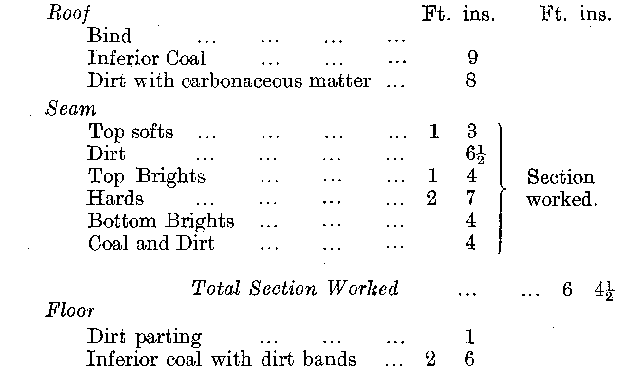
This 2 feet 6 inches of inferior coal below the seam was discovered during damming-off operations in the fire area, and will be referred to later on.
A section of the seam at the shaft, and of the strata immediately above and below the Barnsley Bed is given below :—
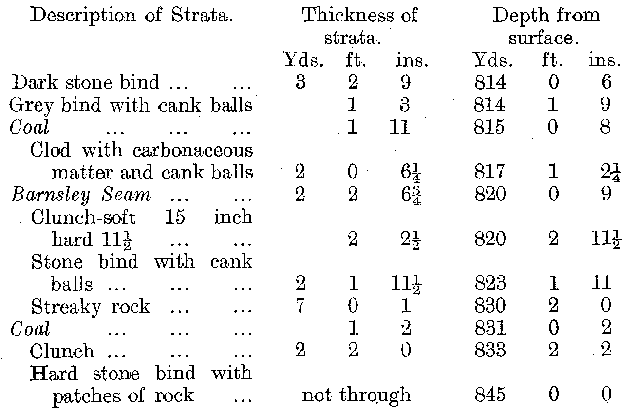
The seam is naturally a gaseous one, and is inclined to be subject to sudden eruptions of gas.
At this mine the seam was not considered to be particularly liable to spontaneous combustion; only four gob fires, previously to the fire dealt with in this Report, having occurred since the pit first reached coal in 1911.
The general direction and rate of dip of the seam is to the East at about one in twenty. The workings are divided into S districts, i.e., the Low East District, Middle East Left District, Middle East Right, South East, South West, West, North West, and Top East. The system of working practised is the "Longwall advancing" system; the distance between the gate roads being usually 40 yards. Packs are built on either side of the gate roads to a width of 3 yards; crossgate packs being 4 yards wide. Every 6 yards a gob pack is built and made 6 feet wide. Eighty-five per cent. of the coal is won by hand, the remainder being worked by compressed air driven coal cutting machines.
Explosives. — No shots whatever are allowed to be fired in the mine.
Haulage. — The haulage is of the "endless," "main" and "main and tail" systems.
The East and West Main Endless Ropes are actuated by electrically-driven haulage engines, situated close to the intake pit bottom. The remaining haulages are compressed air driven main and tail, and main rope engines, and 19 ponies were in use.
Ventilation. — The ventilating current is produced by a Capel fan 12ft. 6in. in diameter, making 177 revolutions per minute. This fan is driven by a steam engine. An electrically-driven standby fan is also held in readiness.
The ventilation book gives the following particulars of air measurements recorded on 13th July, 1923 :—
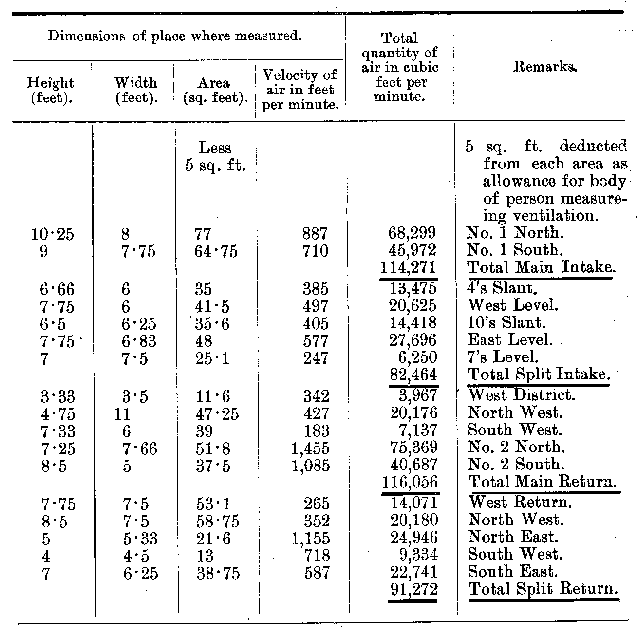
There is no record of the quantity of air that was actually finding its way at the time of the explosion into the areas affected by the explosion but it was a recognised fact that a large current of air was still passing along the East Main plane — the bulk of which was making its way to the South East District by the coal face at No. 11's stall and by leakage along several branch roads en route.
On reference to the foregoing figures it will be noted that, a fortnight before the explosion, with the fan running at 177 revolutions per minute, the quantity of air in the East intake was 27,696 cubic feet per minute for 370 persons employed in the South East District on the one side and in the Middle East and Low East on the other; while a volume of 6,250 cubic feet per minute was entering No. 7's level for the Top East alone, where 38 persons were employed.
Safety Lamps.
No naked lights are allowed in the mine. There is an installation of 2,223 Oldham electric lamps, and 250 "Marsic" double gauze oil lamps by Messrs. John Davis & Son (Derby), Limited. All the lamps are fitted with magnetic locks. An electric lamp was issued to each workman, and in the normal course of working each stall was supplied with a flame safety lamp in addition. The station for re-lighting the flame lamps was on the surface.
Management.
The Colliery is under the general control of the Managing Director, Mr. W. B. M. Jackson, the Agent being Mr. B. H. Pickering, the Manager Mr. A. Butler, and the Under-Manager Mr. M. Gabbitas. There are two Overmen on each shift, one being on the West side of the Pit and the other on the East. Two of these hold Second-class Certificates of Competency. In addition there is a staff of 35 deputies.
Persons Employed and Organisation of Shifts.
Prior to the explosion a total of 2,689 persons was employed; 2,214 underground, and 475 on the surface.
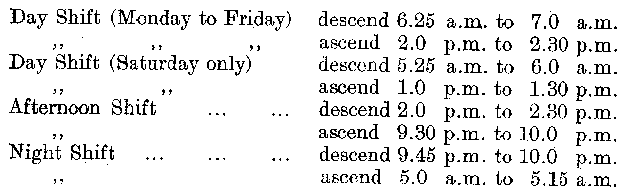
The mine was worked by three shifts of workmen and the times of descent and ascent were as follows :—
The Deputies were also arranged in three shifts; their hours of work being as follows :—

The total number of workmen below ground in the mine on the morning of the 28th July was 122; these were employed on the building of stoppings and work incidental to it.
Inspections before and during work.
In the normal course of work, the morning shift deputy descended the mine at 6.30 a.m. and allotted to their work such of his men as remained in the pit bottom at the time of his descent. He made the inspection prior to the commencement of work on the afternoon shift between 12.15 p.m. and 2.15 p.m., and after this inspection set the afternoon men off to their places in conjunction with the afternoon deputy, who descended at 2.30 p.m. The afternoon deputy made his inspection of the district before the commencement of work on the night shift, between 8 pm. and 10 p.m., and the night shift men were allotted their duties by this deputy. The night deputy descended at 10.30 p.m., made the inspection for the morning shift between 4.45 a.m. and 6.30 a.m., and allotted the early arrivals of the morning shift to their duties.
Precautions against Coal Dust.
Stone dusting had been extensively carried out at this colliery. and for some time prior to the date of the explosion 24 tubs of stone dust per week had been found to be sufficient to keep the roadways in compliance with the requirements of the regulations as to precautions against coal dust.
The stone dust used consists of Dinnington bind, ground by a stone crusher on the surface.





 Contains public sector information licensed under the

