


|

|

|

|
|
 |
 |
 |
||
VII. — Air Sampling And Its Results
(a) Systematic samples collected 20th — 25th July
(33) From midday on Wednesday, 20th July, systematic sampling was established at points marked 1, 2, 3 and 4, on the plan. Sampling at point No. 1 was stopped after 2.30 a.m. the next morning. These air samples were taken by rescue brigade men who had been trained not to operate the relief valves on their breathing apparatus when there was any possibility that such action might vitiate the samples. Bladders were inflated by taking increments systematically over the cross section of the roadway so that a representative sample of the "general body" of the atmosphere was obtained. The results of the analyses of these samples are shown on the three graphs. At first samples were taken every two hours and the results of analyses gave no cause for concern until the early hours of Thursday, 21st July, when 0.0013 per cent. of carbon monoxide was found in a sample from No. 3 Point, i.e., in the right-hand return from No. 4 East. From that time on until the explosion it was only on rare occasions that "NIL" or even "trace" results were obtained from this airway. It is true that the percentages were never anything but small but their presence at all should, I think, have led those responsible to look more closely into the matter. When the percentages of carbon monoxide and the oxygen deficiencies are as small as these were, it is really doubtful if a reliable and truly indicative figure can be obtained when the "ratio" is worked out. I do feel, however, that they were "straws in the wind" and that they should have been followed up, not only by sampling at shorter intervals, but by attempts to obtain other samples taken at different points in the cross-section of the roads and at points nearer to the site of the January fire. It is contended that this carbon monoxide was a constituent of the gases left in the wastes after the fire and explosion in January but I cannot altogether accept this. A glance at the graphs shows that the shapes of the "curves" for methane and carbon dioxide are substantially similar, i.e., that when one is high the other is high and when one is lower the other is lower. The shape of the carbon monoxide curves are however quite different, clearly indicating that this gas was not a "residual". Moreover, it has been calculated that the total volume of atmosphere enclosed within the seals was something between 1 and 2 million cubic feet. As already noted, some 40 million cubic feet of firedamp were drained from the area during the time the seals were in position so that in effect the "bottle" must have been "washed out" about 20 times and the likelihood of any residual carbon monoxide remaining at the time of re-opening is indeed remote.
(34) The Kilsyth Coking Coal is not regarded as being subject to spontaneous heating so I am convinced that fresh air was coming into contact with carbonaceous matter which was at such a temperature that oxidation was taking place. Once oxidation starts the temperature rises causing in its turn an increase in the rate of oxidation and, unless the flow of air is sufficiently great to carry away the heat thus generated, open combustion eventually results. Something of this nature was, I think, happening on either or both banks of No. 4 East face — probably on or near the edge of the waste. Apart from the members of the party who cleared a passage for the air over the fall on the left bank, no one had examined or even travelled the face, and fresh air had had access to it for several days.
(35) It was said that No. 4 sampling point was chosen because it was readily accessible to men wearing breathing apparatus. While this is a valid consideration, the site was open to considerable objection on the ground that very heavy leakage of fresh air was taking place at No. 4 East Air Crossing, thus diluting the atmosphere in the return and rendering the detection and measurement of carbon monoxide much more difficult. Under prevailing circumstances, and indeed in any case where firedamp is being cleared from an area after a fire has been smothered by sealing off, it should be recognised that nothing should be allowed to stand in the way of collecting the most informative samples of the atmosphere. Had samples been collected from the Left-hand Return of No. 4 East it is not altogether improbable that a much more definite picture of the state of affairs on the Left Bank of the face would have been obtained. As it was, the "traces" and small percentages of carbon monoxide which were found should have excited more interest and curiosity. In this particular road only a very small amount of air was circulating and high percentages of firedamp were present. The road rose gently towards the face and the face itself rose gently from the intake up to the left-hand corner.
(36) Observations by the Area Ventilation Engineer wearing breathing apparatus made as late as Monday morning (the day of the explosion) in No. 4 East Left-hand Return showed that the atmosphere in the upper part of the road was stagnant; while there was a flow, estimated to lie between 500 and 1,000 cubic feet per minute, along the floor of the road. It is a pity that spot samples were not taken entirely from this moving current instead of from the general body of the air. They might well have been much more informative.
(b) Additional Samples in No. 4 East District, 22nd July
(37) As already explained, special samples were collected from No. 4 East District on 22nd July.
(38) Shortly after midday half-a-dozen samples were taken spaced out at intervals along the right-hand return; about 3 p.m. three were taken similarly in No. 4 East Intake and about 7 p.m. three (one at the face, one midway and one at the outbye end) were collected from the left-hand return. The results of the analyses are set out in the table below:—
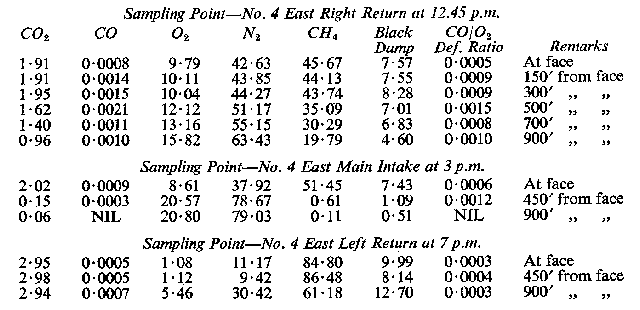
It will be noted that all except one contained carbon monoxide in measurable quantity.
(c) General Comments on Sampling Procedure
(39) The samples, other than those drawn off from the methane drainage pipe, were collected in bladders which were inflated by a hand-operated syringe. At the chosen places increments were collected from different points carefully distributed over the cross-section of the roadway, a squeeze of the bulb being given at each point. This ensured that a representative sample of the general body was obtained. The samples were collected by rescue men wearing Proto self-contained breathing apparatus, who had been trained not to use their relief valves while taking them.
(40) It was known that the atmosphere in the left-hand return of No. 4 East contained a high percentage of firedamp and that only a small quantity of air was circulating. The flow of air was confined to the lower part of the cross-section of the roadway. Had samples been taken entirely from this moving air current it is possible that much more informative results would have been obtained. Those increments taken from the upper parts of the road, being mostly stagnant methane, had not passed over the site of the fire and merely served to dilute the increments of atmosphere which had. The net result was to reduce the percentage of carbon monoxide in the sample and to render its measurement a more difficult matter for the chemist. The same applied to samples taken in the right-hand return, particularly in the earlier stages. As the quantity of air passing increased, so of course, did the dilution by fresh air, but samples taken from near the floor might have been easier from the chemist's point of view.
(41) In view of the amounts of carbon monoxide which were found it is a pity that attempts were not made to discover their origin by sampling further inbye, even to the extent of going on to the face for them.
(42) Analysis was carried out on a Graham Lawrence apparatus which enabled the carbon monoxide content to be determined to within 0.0002 per cent. I am satisfied that the results of the analyses were made available as soon as possible.


A copy of this report was kindly donated by
West Cumbria Mines Research.




 Contains public sector information licensed under the

