


 |

|

|

|
|
 |
 |
|||
Volume 5 (V), 1856-1857, published 1857
Various kinds of leather were tried, including hippopotamus and buffalo hides, even caoutchoue, made to the full size of the side leathers, and also for bucket and clack falls, without entire success. Metallic packing was also used, with partial success, the scouring of the sand through every material was a serious object. Even the bucket shells as well as bucket doors were wormed through in a most curious manner, similar to the action of the marine (teredo navalis) worm on ships' bottoms.
Having secured a similar timber ring in the other pits at the top of the sand, concentric oak cribs were then laid, backed by sheet piling 10½ feet in length, made of Norway battens, Memel deals, and rock elm 4½ inches thick, shod and hooped with iron. These were driven by a number of hand pile drivers, and the cribs drifted down with them to guide their course. The irregular structure of the sand caused a great deal of trouble; some parts being very soft and loose, whilst others were as hard as adamant, so that great difficulty was experienced in keeping the piles in line. We also found it necessary to keep a quantity of whins (gorse) and straw ready to stem the loose sand and gullets.
It was now deemed expedient to suspend the sinking at the west or new pit, and by heaving the sets up clear of the sand in the bottom, and keeping them pumping pure water, enable us to push forward the other two shafts with all the available strength. Success crowned this more, and on the 12th August the east pit, and on the 14th the middle pit, were safely got through the sand, with ample space to maintain their respective diameters intact.
Considerable difficulty was, however, yet experienced in getting a satisfactory foundation for the wedging cribs in both these pits, from the soft and spongy nature of the red and blue metal underlying the sand. At a distance of nine feet in the one pit we encountered a bed of hard black metal, and in this laid the crib, and the tubbing set on and closed to the last batch, put in above the sand, leaving a part of the plug holes running, to relieve the pressure in the other pit. In the east pit, after several courses of tubbing had been set on, the tubbing was found to have flattened on two sides, forming an elipse instead of a circle. These two sides not admitting the tubbing so as to maintain the full size of the shaft, we had to remove it, and were thus again exposed to the action of our old enemy. To add to our misfortune, the V bob, or middle set, burst near to the bottom, and had to be replaced before we could proceed.
After these two pits were tubbed through the sand, the sinking of the west or new pit was resumed, and continued through the sand, which was more rapidly accomplished, and on the 25th January, 1842, a double metal wedging crib was laid at seventeen feet below the sand, and on the 29th the tubbing was closed.
On the 5th February, the wedging of this tubbing being completed, the water was plugged off, and all the troubles and difficulties of this business seemed to be at an end. Next day, however, an explosion took place from the air pressure behind, which ruptured the tubbing at the top of the sand to such an extent that fourteen courses had to be reset. To prevent a recurrence of this casualty we put in several two-inch brass taps, and took pipes up into the standing set cistern. A borehole was also put down from the north engine staple into the sand, which gave a vent to any air or gas that might accumulate.
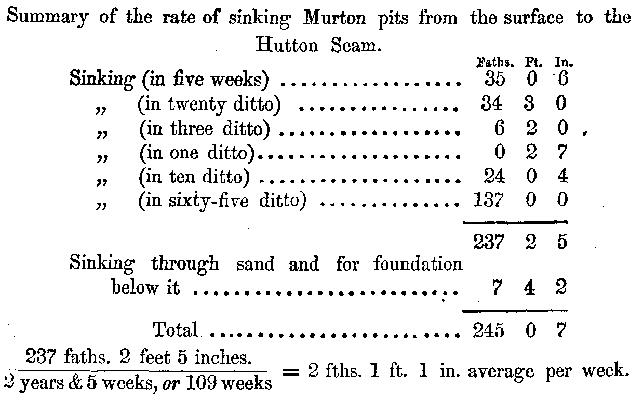
The whole of the three shafts were now completed to a depth of eighty-three fathoms from the surface, and rendered perfectly dry. The ordinary sinking being resumed, no further or unusual difficulty was met with, and they were all carried down in safety to the Hutton seam in April, 1843, at the depth of 248 fathoms from the surface. The engine pit being continued down to the depth of 252½ fathoms for sump and standage.
This pit contains:—
| 106 | fathoms of | walling. | |
| 62 | ,, | metal tubbing. | |
| 80 | ,, | naked rock. | |
| Total | 248 |
After the middle pit reached the Hutton seam, and before any brattice or slides had been put in, an acoustic phenomenon was observed. The distinctness with which you could hear the voices of the men, even in a whisper, between top and bottom (nearly 1,500 feet) was remarkable This was, however, destroyed as soon as the first fittings were put in, after which, became quite inaudible ordinary sounds.
It struck me that a tube of either lead or gutta percha might be advantageously employed for communication between top and bottom, instead of the ordinary signal ropes, which, in addition to being very expensive, were often getting out of order, and I felt desirous to investigate this phenomenon. I entered into an agreement with a party to try the experiment, with the arrangement that if he failed he was to bear one-half of the expense. This was acted upon, and the experiment tested at various distances. The sound became less distinct as we proceeded, and at the depth of little more than thirty fathoms it was too indistinct to be of service, and the experiment abandoned.

In order to prove whether the feeders of water, met with in the course of sinking through the sand, had any connection with those passed through in the limestone, the several batches of tubbing were occasionally tapped, and invariably found full, and under, apparently, the original pressure.
I think I cannot do better than put on record a statement of the engine power, and schedule of the various appliances collected upon this plant, every one of which was most fully employed.
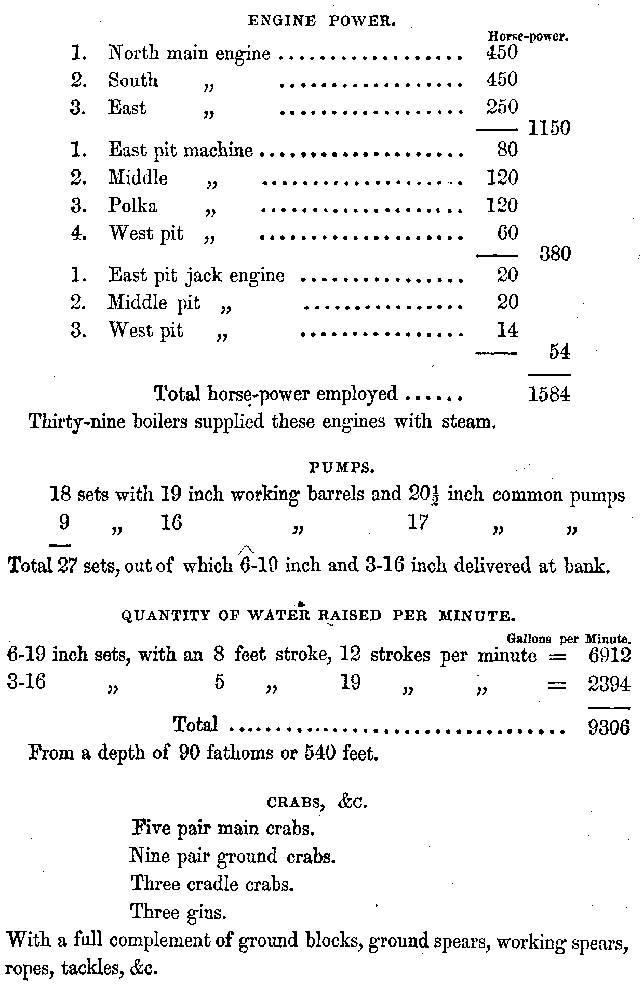
The array of powers and materials here collected and appointed, is, I believe, without parallel in the annals of mining.
The slow process of crab work, occasioned in a great measure by the flitting of the rope on the main capstan, suggested, subsequently, to my mind, the idea of dispensing with this old fashioned mode for something more in keeping with the present day, by which greater speed could be obtained, coupled with the lessened employment of manual as well as horse labour. I sketched out a piece of mechanism for multiplying the power on a large metal drum, and attached the whole to a small steam engine. The success of this has been beyond my expectation, and the ease, certainty, and expedition, with which it does its work is highly satisfactory. This engine is erected on the Dudley sinking pit, Cramlington Colliery, and may be seen at work daily. By referring to the accompanying drawing, the application will be more clearly seen.
In this instance I have also attached, to the same engine, another pair of drums, for drawing the sinking stones, &c., so that its time is kept fully employed. It is easily thrown out of gear and applied to either work.
I would recommend this steam crab to any person having a winning of any magnitude in hand. Its services would have been invaluable at Murton, where there would have been full employment for several of them.





 Contains public sector information licensed under the

