


 |

|

|

|
|
 |
 |
|||
Volume 5 (V), 1856-1857, published 1857
A few extracts from my diary at this period will probably give a better and more faithful view of the operations than any abridged information drawn from them.
1839. 9th August. — The sinkers got into the middle pit for sixteen hours. Lowered the set 10 inches and took off limestone sides for scale. The two machines (middle and west) kept the feeder at 11 strokes per minute. The west machine (commenced pumping 2nd August, 1839) having a 5 ½ feet stroke for all the three sets of 16-inch pumps attached to it. The middle machine had also a 5-feet 8-inch stroke in the pit, and these machines were going sixteen strokes each whilst the men were in the bottom.
3rd September. — The east machine was going twelve strokes per minute (4½-feet strokes equal to 456 gallons per minute) exclusively, with water passing through the 1½-inch borehole, whilst the pressure of water in the other pit showed a column of eighteen fathoms.
9th September. — The low set of the middle machine having got choked with sand, it was hove up to the level of the standing set and hung upon the ground spears, but the water was never again drawn down to the bucket-door until the 5th May, 1840, when the east main engine started work.
26th November. — Got the water down in the east pit and put a plug in the borehole which enabled us to get the two 19-inch twin standing sets for the main engine in dry.
1840. 4th March. — Started the new twenty-horse machine (Hawthorne's) in the East Pit for drawing stones, &c.
29th April. — Started the east main engine.
4th May. — Resumed sinking in the East Pit, and drilled two additional holes down to the sand (7-feet) to draw off more water for the main engine. — Sunk 4½-feet the first week.
5th May. — Got the water in the Middle Pit down to the bucket-door of the choked set; this set having been hung for eight months on the ground ropes and spears.
22nd May. — The sand broke away from the bottom of the East Pit through a thin stratum of soft blue metal, the sinkers having great difficulty to save themselves. The rapidity with which the water came off, accompanied by a mass of loose sand was so great that the two V bobs, or standing sets of the main engine, were instantly choked, and held the engine fast, whilst the column of water rose twenty fathoms up the shaft in a very short time. An auxiliary 19-inch set of pumps was hung in the fore pit and attached to the main engine after having loosed off both the two V bobs and low sets.
1st June. — Got new set started, and on 4th inst. lowered the water down to the bucket-door of the standing sets, when we found the working barrels and all below one solid mass of sand, as were also the delivery drifts heading to the high set.
The feeders were found at this time to amount to 3285 gallons per minute, as will be shewn by the subjoined table of the powers and rates of going of the respective engines.
| Working | Length of | Rate per | Gallon. | |
| Barrel. | Stroke. | minute. | per min. | |
| In. | Ft. | |||
| East Main Engine (one set disabled) | 19 | 8 | 11 | 1056 |
| East Machine | 16 | 4 | 20 | 682 |
| Middle do | 16 | 4½ | 19 | 729 |
| West do | 16 | 5 1/3 | 18 | 818 |
| 22 | 68 | 3285 | ||
| The other 19-in, set of this engine would have added | 1056 | |||
| Gross Pumping Power | 4341 | |||
16th June. — The sinkers got again into the bottom of the Middle Pit, and commenced filling away the cast-up sand which was 4 fathoms above the bottom when they last left off.
It was now clearly ascertained that the present engine and pumping power, although unprecedently extensive, was insufficient to combat with the difficulties with any apparent chance of success.
Under this state of things the advice of other mining engineers of eminence was sought, and Messrs. Wood and Johnson were appointed to confer with me on the most advisable course to pursue.
26th June. — All the engines were stopped.
On referring to the plan of the works at this period it will be observed that the area of both pits was sufficiently occupied with pumps, ground spears, &c., to render it unadvisable, if not impossible, to place any additional sets in them. Hence, if more pumps and machinery were required, more pit room would also be required to accommodate them.
A proposition was then made and submitted to Messrs. Wood and Johnson to sink another shaft of larger diameter, and place upon it two pumping engines, capable of delivering at bank two sets of pumps, each from a depth of 90 or 100 fathoms. This was approved of, and no time lost in putting it into execution. This shaft became afterwards invaluable as a general upcast shaft to the colliery.
As this additional engine power would only be required for a time, they were erected on substantial rough ashlar work, so constructed that the weight of the beam pillar was made to add solidity to the cylinder pillar, and thus both simplify and economise the building. These stone pillars were completed in three weeks, and whilst the sinkers were at work in the bottom.
These twin engines, manufactured by Messrs. Hawks & Co., were of 450-horse power each, high pressure, and supplied with steam from eighteen cylindrical boilers, placed in a most formidable line, and flanked by two chimneys of eighty feet in height each. I would here remark that an unnecessary waste of material often takes place in the erection of chimneys. These, although eighty feet in height, were built with only 15-inch work at the bottom, and 10-inch at the top, and never showed any symptoms of insufficiency.
A horizontal machine of 60-horse power was erected, to draw the sinking stones; and another of 14-horse power to do the jack work, &c.
The ground was broken for this pit on the 7th July, 1840, the diameter set off being 18¼ feet, to allow for walling inside; this, with nine sinkers in the bottom, in a shift, was a formidable looking shaft. Probably no pit in the whole annals of sinking ever went more rapidly down until stopped by the feeder of water. I give, as a sample, the weekly rate: —
| 1st week, (only four days) | 4½ | fathoms. |
| 2nd week | 6 | do. |
| 3rd week | 7 | do. |
| 4th week | 7 | do. |
| 5th week | 8 | do. |
| 6th week | 5 | do. |
| 37½ | do. | |
| 7th week | 2½ | do. |
| (being stopped by erecting the shear-legs.) | ||
| Total | 40 | fathoms. |
| Average one fathom per day. | ||
By the end of January, 1841, this shaft was sunk, walled, tubbed, and bratticed to the depth of seventy-three fathoms; being divided into three parts, two for the pumps and one for the sinkers.
The two new pumping engines were set to work in February and March, 1841. Every appliance being completed, and the water standing in the pit was drawn down and the sinking resumed.
On the 16th April a borehole was put down from the bottom of the new pit into the sand, then within four feet, to lay the water on to the new engines. Immediately afterwards the bottom of the shaft blew up from the pressure, and the water rose to the same level as it was in the other pits, and thenceforward continued to rise and fall regularly with them, showing a free communication between them all.
9th May, 1841. — The whole of the limestone being taken off in the east pit, and that shaft belled out from fourteen feet, the finished size to 21½ feet in diameter, the first course of oak cribbing (consisting of three cribs backed with 1½ inch deals, and five feet in height), was placed, and hung from the limestone by eleven iron rods, twelve feet in length, fastened into the solid stone above.
This shaft was now fairly launched into the sand. The difficulties and delays to the advanced progress may be judged of by the following extract.
From the 16th April to the 10th May, inclusive, the sinkers have been 176 hours 20 minutes in the bottom,
| 176 | = 7 1/3 hours per day. |
| 24 |
The number of buckets changed during the same time has been 378, and 38 clacks.
| 416 | = 17 1/3 average per day. |
| 24 |
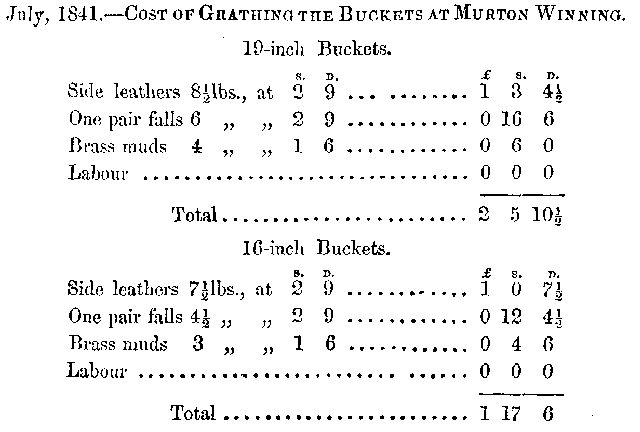
The consumption of coals for the engines, &c., amounted to 1,000 chaldrons per fortnight whilst all the engines were employed.





 Contains public sector information licensed under the

