


|

|

|

|
|
 |
 |
|||
5. — Accident, And Rescue Of Some Of The Miners.
A little after 6 a.m. on Monday, the 10th of May, the morning shift, consisting of thirty-five men, entered the shaft and began their descent down the ladders. Shortly afterwards several men came to the surface in an exhausted condition, saying that the mine was full of some foul gas, which so deprived them of their strength that they could scarcely climb the ladders. These facts were at once reported to Captain Kewley; after sending to Laxey for assistance, he immediately descended the shaft with the object of ascertaining the true state of affairs, and of rescuing the men below, who were stated to be more or less overcome by the noxious gases. He met a few men almost dead-beat, trying to make their way up, and between the 45 and the 60-fathoms level he came upon others, still alive, but quite unconscious.
With the object, of improving the atmosphere of the mine, he had holes punched in the pipes conveying compressed air to the boring machines, and this gave some relief.
If one tries to imagine the exact condition of affairs in a shaft such as has been described, it is evident that the task of the rescuers was no easy one. Persons unaccustomed to mining can best understand the state of the case by picturing the shaft as a rectangular well, having a ladderway in the middle (Plate II). The unfortunate men had to be dragged up from platform to platform with the aid of ropes, through the "manholes," which measure only 22 inches by 19 inches, whilst the rescuers themselves were breathing a poisonous atmosphere, and beginning to feel its paralyzing effects.
I have mentioned that ore and waste rock are drawn up the shaft in a bucket (kibble) ; but in cases of severe accidents, a special receptacle is used in its place for conveying the injured persons to the surface. It is a rectangular box six feet long, and just deep enough and broad enough to take a man. This was called into requisition a little later, and, with the aid of volunteers who had come from Laxey mine, three of the survivors were successively put into it and dragged up the shaft by the winding engine.
The work of rescue proceeded under great difficulties until five o'clock in the afternoon, when James Kneale, the last survivor, was brought to the surface.
By this time the rescuers themselves were thoroughly exhausted, and barely able to climb the ladders. Captain Kewley, whose pluck has in no way suffered from his sixty-five summers, had gone down no less than ten times, risking his own life again and again, in the hope of bringing succour to his men.
Dr. Miller, of Laxey, on hearing of the disaster, immediately proceeded to the mine and gave medical aid to the sufferers, several of whom were still unconscious on reaching the surface.
Fortunately for all concerned, my assistant, Mr. Williams, was still in the island ; and, upon receiving notice of the disaster through the foresight of Mr. Samuel Harris, High Bailiff of Douglas, he hastened to the mine, which he reached about six in the evening. In the hope of finding further survivors underground and being able to save them, he at once organized another rescue party with Captain Kewley, and descended the shaft to the 74-fathoms level, passing three dead bodies. Mr. Williams and a miner named Frederick Christian then made their way nearly to the 100-fathoms level, passing other dead bodies, some of which impeded their progress. The obstruction of the manhole just above the 100-fathoms level by three bodies was so great, that they decided to proceed no further; and it is fortunate that they did so, for on commencing their ascent, they found that their strength was failing them, and that they had a difficulty in climbing the ladders. In time they reached the 60-fathoms level, and rejoined Captain Kewley and the rest of the rescuing party, who had commenced the ascent and were complaining of weakness and of inability to climb. It was then that Mr. Williams applied a remedy, in a fashion hitherto untried in mining accidents, as far as I am aware.
On hearing at Douglas that the accident was probably due to foul gases, Mr. Williams tried to procure some cylinders of compressed oxygen. As none could be obtained, he thought that possibly he could effect his purpose by generating the health-giving gas on the spot, and he bought about a pound and a-half of potassium chlorate. This he carried with him down the mine, and made use of it while he and the rest of the rescue party were waiting to commence their ascent from the 60-fathoms level. He set light to a heap of newspapers on the floor of the level, and kept throwing the potassium chlorate, little by little, on to the fire. On leaning over it and inhaling the fumes, the party experienced decided relief, and to some extent regained their strength. I imagine that the deflagration of a portion of the chlorate furnished heat enough to cause another portion to give off its oxygen; but, be the explanation what it may, I am assured by Mr. Williams and Captain Kewley that the improvised remedy was unquestionably of service in enabling the rescue party to reach the surface. By this time they had been forced to the conclusion that no one remained below alive.
Before going underground, Mr. Williams had telegraphed a brief notice of the disaster to me; but, unfortunately, I was engaged officially at Newhaven, and the telegram did not reach inc till after the last train had left for London, I was consequently obliged to defer my departure until the following morning, and then it was impossible for me to reach Liverpool in time to catch the mail steamer leaving that port for Douglas. I was unable to start from Liverpool until the morning of the 12th.
6. — Recovery Of The Dead Bodies.
Early on the following morning the work of recovery was continued, under the superintendence of Mr. Williams, as Captain Kewley was suffering from the effects of the poisonous atmosphere in the mine on the previous day, besides having ample work to do in superintending the disposal of the bodies as they were sent up to the surface. The working parties had further the aid and advice of Captain W. H. Kitto, the manager of Foxdale Mine, and my friend Mr. H. Wynne-Finch, who happened to be staying with him when the news of the disaster arrived ; they at once proceeded to Snaefell, descended the mine, and threw themselves into the work energetically.
Early in the afternoon, Mr. Williams was so exhausted by his exertions, that he became unconscious for a few minutes. and had to be sent up to the surface in the "box." By this time ten bodies had been recovered, making, with the three brought up on the previous day, thirteen in all. Work was then suspended for the day. About six o'clock in the evening, a party of volunteers from Foxdale Mine, summoned by telegram from Captain Kitto, reached Snaefell, and would have descended at once if they had not been told that their services would not be required until the following day.
My other assistant, Mr. Jones, who had started from Chester as soon as he received telegraphic instructions from me, reached Laxey in the evening.
On the Wednesday morning a party of volunteers, headed by Mr. Williams and Mr. Jones, descended the mine, and recovered five more bodies, which were found on different platforms near the 115-fathoms level, some above and some below.
By this time, they had descended as far as the platform immediately above the 130-fathoms level (C D, Plate III.) One of the miners kneeling upon this platform put his candle through the "manhole" in order to look for the last body, when he found that it was at once extinguished. Knowing the importance of ascertaining the exact nature of the poisonous gas, Mr. Williams sent a note to the surface asking to have some bottles, filled with water, and well corked, sent down to him for the purpose of securing samples for analysis. When the bottles arrived, he stood upon the second rung of the ladder below the platform, and, keeping his head well up, he held one of them under the platform, allowed the water to run out, and recorked it. A second sample was obtained in a like manner, but while he was emptying the water from a third bottle, he suddenly, and without any warning, became unconscious. There is no doubt that he inhaled a big whiff of gas which came through the "manhole" when disturbed by the operation of taking samples. The effect was instantaneous, but it must be recollected that his blood was already affected by having been down the mine for some hours. As he knew that he was running some risk, he had wisely taken the precaution to put a rope round him before beginning his dangerous task, and it is most fortunate that he did so, for otherwise it is almost certain that he would have lost his life. Mr. Jones and some miners who were holding the rope dragged him up from platform to platform, for a total distance of 80 feet, still in an unconscious state ; and their work was not accomplished without difficulty, for they were feeling the effects of the poisonous atmosphere, and had only just strength enough to lift their living burden. On reaching the 115-fathoms level, Mr. Jones held his colleague's mouth to a hole punched in an air pipe, through which a strong current was issuing, and worked his arms backwards and forwards in the manner recommended for the apparently drowned, and before long he was rewarded by seeing signs of life. Mr. Williams was then at once sent up in the "box," and on arrival at the surface he was brought round by Dr. Miller, who injected ether subcutaneously.
Mr. Jones managed with difficulty to climb to the top with the rest of the party. There is no doubt that by his presence of mind, under very trying circumstances, he saved Mr. Williams' life.
Undeterred by Mr. Williams' narrow escape from death, Captain Kitto descended the mine in the afternoon with Mr. Wynne-Finch and a party of volunteers from Foxdale. with the object of endeavouring to recover the last body, leaving his assistant, Captain Lean, to direct matters at the surface if necessary. They penetrated as far as the platform which Mr. Williams had reached when he took his sample, and reported that they saw a body upon the landing some 10 feet below it. While one of the men was punching the air pipe, in order to improve the ventilation, Mr. Wynne-Finch became unconscious, and was sent to the surface in the "box."
Captain Kitto and his men then ascended the ladders, all feeling more or less the effects of the poisonous atmosphere which they had been breathing.
Travelling by the earliest possible steamer, I was not able to reach Douglas until the afternoon of the Wednesday (12th of May), and on proceeding at once to the mine I found Dr. Miller, who took me to see the eighteen corpses laid out in the carpenter's shop. He pointed out the signs of poisoning by carbonic oxide, telling me also that these had been more apparent on the Monday and Tuesday. I was also able to congratulate Mr. Williams upon his escape and hear from him and Mr. Jones some details concerning the condition of the mine. I then went to see my friend Mr. Wynne-Finch, who was lying down in his mining clothes still feeling bad. Later on he was brought down to the inn at Laxey and was put to bed with hot bottles. The next day he was sufficiently well to return to Foxdale.
As the men who had been underground were tired or exhausted, and as there was nothing to be gained by an immediate descent, I postponed my visit underground until the following day. I then considered it my duty to test the air very carefully for fear of risking any more lives. I had come to the conclusion from Mr. Williams' first telegram, and from newspaper accounts, which told me that the disaster was caused by fire or foul gas, that probably carbon monoxide was at the bottom of the mischief, and therefore in passing through Liverpool I had bought a supply of mice, with the object of employing them as indicators of the poison in case it should still be present.
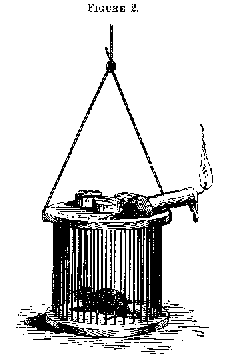
A mouse was put into an improvised receptacle made from the revolving part of its cage, and this was attached to the "clevis" or spring-hook of the winding rope, whilst a lantern and lighted candles were placed inside the kibble. By the aid of this testing apparatus it was easily ascertained without any risk that the air was not bad as far as the 115-fathoms level, and that it became poisonous and deadly at the 130. The mice showed precisely the same symptoms as human beings ; for, if not completely dead on arriving at the surface, they had lost all power in their legs, whilst pinkness in the snout recalled the pink lips of the dead bodies of the unfortunate miners. I then decided to descend the mine and learn by further personal examination the precise condition of affairs. Accompanied by Mr. Williams, Mr. Jones, Captain Kewley and several miners, I went down the ladderway as far as the 115-fathoms level, and on descending deeper took the precaution to test the air with a mouse and candle before going below each platform. By means of a string I lowered the cage, with the mouse inside and the candle affixed by a lump of clay, from one platform to the next, and left it for a couple of minutes before drawing it up. Testing carefully in this manner from stage to stage, we arrived all right at the bottom of the fourth ladder (A B Plate III.), but when, standing upon the platform at the foot of this ladder, I lowered the mouse to the fifth, I found that the light went out and that the little animal showed signs of much distress. The air was evidently worse than it had been on the previous day, for then a light would burn brightly on the platform, although it was extinguished below. On Thursday, the day of my visit, there was very bad air above the platform. One of the miners begged me to be allowed to go down with an air-hose in his mouth ; but of course I refused, saying that I was responsible and that no one should go down lower. We all climbed up again without difficulty; though, after an hour at the surface, I began to have a violent pain across the forehead which lasted some time.
In order to improve the ventilation of the mine, I had a fire lighted at the bottom of the wooden chimney, and I was glad to see that it created a good draught.
On the following day my tests made from the surface showed me that the level of the bad air in the mine had not gone down as I expected. I therefore concluded that some of the ventilating doors, which I had been told were shut, must be open. Captain Kewley offered to send down men to see, but I thought that it was better that I should go myself. Mr. Williams, Mr. Jones, and Captain Kewley came down with me to the 100 level, and we found two doors open. These I helped to shut, and we came up hoping to find a great improvement on the morrow.
On the Saturday morning, my tests with mice proved that things were much in the same condition ; and it then seemed to me probable that the door at the 130-fathoms level was open, allowing the air going down the main shaft to escape through this level to the succession of intermediate shafts which formed the upcast, without going to the lower levels at all. I was of opinion that this door should be closed if possible, and there was naturally a desire on all sides that the last body should be brought up.
Mr. Williams, Captain Kewley, Captain Reddicliffe, and I, with a party of miners, went down all right to the 115-fathoms level; and before descending any further I tested the air, by lowering a tame rat in a cage, from platform to platform. Leaving most of the miners at the 115, Mr. Williams, Captain Kewley, Captain Reddicliffe, I, and Henry Clague reached the 5th platform (C D, Plate III.) in safety, from whence, when I lowered my testing apparatus with its candle alight, I could see the body of the poor miner, lying in the position described by the Foxdale men. Just at the level of the body. the candle went out. I let the cage with the rat remain down five minutes by my watch, and when brought up it was not dead, though visibly affected. Captain Kewley and Clague said they would go down and get up the body. I had to tell them plainly that they should do no such thing. No doubt it looked easy, for the body was not more than 10 feet below us. I was firm in refusing permission, but said that I thought we might grapple for it easily and bring it up in a very few minutes. One of the men who was higher up came down with the grappling iron, and, in order to use it more conveniently, he pushed aside the short ladder leading from the platform C D, to the 130 level. Moving the ladder seems to have disturbed the body of gas, for almost immediately afterwards Captain Kewley said he was feeling ill, so I shouted "All up at once". We all climbed to the 115 level, where the "box" was in readiness. Captain Kewley was put into it, and we signalled to have him wound up. Those who had been as far down as the platform C D, were decidedly affected by the poisonous atmosphere, and as they felt they could climb no higher, they sat down in the 115 "lodge" or "plat," that is to say, the enlargement of the mouth of the level where it joins the shaft.
The miners who had remained at the 115-fathoms level, or had descended but little below it, started off by the ladders, and in time reached the top of the shaft in a somewhat exhausted condition. In the meanwhile the "box" in which Captain Kewley was being raised to the surface stuck in the shaft, owing to a link of the chain, by which it was attached to the winding rope, getting caught between two of the planks in a defective part of the wooden trough up which it was sliding. The "box" would go neither up nor down, and poor Captain Kewley was kept in this trying position for about an hour. At last his son went down with some men and set the "box" free, and another party came to the 115-fathoms level to rescue those who were unable to climb. The "box" was sent down to that level, and one after another we were brought to the surface. After this misadventure it was evident that it would be unwise to venture down the mine again until the ventilation had considerably improved.
I should mention that so little did I apprehend any difficulty, that I told my assistant, Mr. Jones, that he had better return to the mainland by the afternoon steamer and go on with his ordinary work. However, he heard of our mishap before the steamer started and returned in all haste in order to render assistance.
On Monday, the 17th, I had an interview with one of the directors at Douglas, and again at the mine; I had to tell him plainly that I considered that his Company was expecting too much from Government officials, and that, while we were ready to give advice and assistance, it was no part of our duty to superintend the recovery of the bodies nor to put the mine in order again. I told him that the mine seemed to require the services of some competent mining engineer, possessing more technical knowledge than Captain Kewley, though I knew the latter could not be surpassed in personal courage. Eventually, the directors secured the services of Mr. N. R. Griffith, of Wrexham, who advised the erection of a ventilating fan. All work underground was stopped until the fan could be procured and set to work.





 Contains public sector information licensed under the

