


|

|

|

|
|
 |
 |
|||
Llandudno,
22nd November 1897.
Sir,
In obedience to your instructions, I have the honour to make a Special Report upon the Underground Fire which took place at the Snaefell Mine, in the month of May last, by which 20 persons lost their lives.
I propose to treat the subject under the following headings :—
| 1. | Situation of the Mine and Ownership. |
| 2. | Nature of the Deposit worked. |
| 3. | Method of working. |
| 4. | State of the Mine previous to the accident. |
| 5. | Accident, and rescue of some of the miners. |
| 6. | Recovery of the dead bodies. |
| 7. | Further examinations of the Mine, and inquest. |
| 8. | Cause of the accident and remarks. |
| 9. | The mouse as an indicator of carbonic oxide. |
| 10. | Previous underground fires in other districts. |
| 11. | General Remarks and Recommendations. |
1. — Situation Of The Mine And Ownership.
The mine is situated on the south-eastern flank of the mountain from which it takes its name, and at a distance of about three-quarters of a mile from the summit. A rough cart-road connects it with the village of Laxey, from which it is distant about four miles. The top of the shaft is 908 feet above the sea level.
The property belongs to the Crown, but the mine has been leased to the Snaefell Mining Company, Limited, which has been in possession for many years. Mr. John Kewley is the resident agent at the mine, and Mr. Frank Reddicliffe visits it every month in his capacity of consulting engineer.
2. — Nature Of The Deposit Worked.
The deposit worked at the Snaefell Mine is a vein which has an approximately north and south strike, and an average dip to the east of about 15° from the vertical. Its width varies from 6 inches to 40 feet, and it consists of the following minerals, viz., galena. zinc blende, copper pyrites, some iron pyrites, pyrrhotine, pearl spar, and calc spar. The surrounding rocks (country) are generally composed of clay-slate, now known as the "Barrule Slate," and considered to be of Cambrian or Silurian age.
3. — Method Of Working.
As is shown by the sections (Plates I. and II.), the mine is worked by a main shaft, which follows the dip of the vein, and consequently participates in its various slight bends. The shaft is 171 fathoms deep measured along the dip. In most places the sides require to be supported by timber, which is arranged in the form of a series of rectangular frames, as depicted in Fig. 1.
Each frame consists of two long pieces of 8 ins, by 8 ins. timber (wall plates) A B, C D, supporting two end pieces A C, and B D. The space enclosed by this rectangular frame is divided into three compartments 1, 2, and 3. The first is for winding, the second contains the ladderway, whilst the third takes the pumping machinery, and the pipes which convey compressed air to rock drills. There may or may not be planks (lagging) around the outside of the frames; none are shown in the figure.
The winding compartment is lined with planks nailed to the successive frames, set at distances varying from 3 ft. 6 ins, to 6 ft. apart, or to the cross pieces (dividings or buntons) such as E F. The winding shaft may therefore be compared to a long box made of planks nailed to strong ribs. It will be noticed that the part G H I K has a thicker lining than the rest; the object of this is to provide for the wear and tear caused by the bucket (kibble), as it glides down or up what is practically a steeply inclined wooden trough.
The nature of the middle compartment will be best understood by referring to Plates II. and III., from which it will be seen that it is divided by horizontal platforms (sollars), 10 ft. to 50 ft. apart, and that these are connected by sloping ladders; N is a manhole in one of the platforms, giving access to the next ladder.
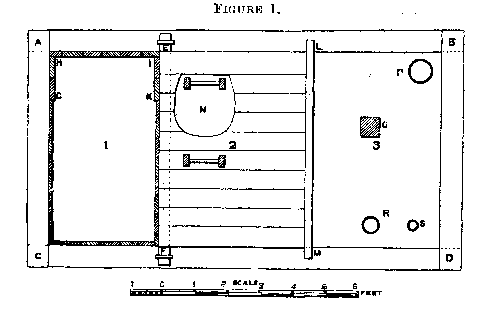
Whilst there is a close partition of planks between the winding compartment and the ladderway (Fig. 1), the latter is separated from the pumping compartment merely by cross-pieces such as L M, which serve to prevent a person standing upon the ladder platform from falling into the open space at the side. This space contains the main rod of the pumps O, the rising main P, and the two pipes R and S conveying compressed air.
At distances of 20 to 30 yards apart, horizontal tunnels (levels) have been driven out, and constitute the main roads of the mine (Plate I); here and there these levels are connected by intermediate shafts (winzes) which serve for ventilation and for accessory ladderways. Sometimes the roof and sides of these levels have to be supported by timber, whilst in other cases the rock is firm enough to stand for many years by itself.
The valuable portions of the vein are removed by the method known as "overhand stoping." The actual work of excavation, whether for driving levels or for "stoping" away the vein, is done partly by hand and partly with the aid of machine drills driven by compressed air.
The explosive used is solely gelatine dynamite.
The ore and any waste material not used for filling exhausted workings are conveyed in little waggons, pushed by hand, along tramroads in the levels, and are tipped on arriving at the shaft. Here the mineral is shovelled into a wooden bucket (kibble) in which it is slowly dragged up the shaft. The capacity of the kibble is 8½ cubic feet, and it holds about 7 to 8 cwt. of ordinary ore and 5 to 6 cwt. of waste rock.
The kibble takes 1½ minutes to travel from the bottom of the mine to the top, and allowing for the stoppages in loading and unloading, it makes about 12 journeys an hour, during which period the total weight of the material raised will be 4½ tons, if ordinary ore, and about 3½ tons if waste. These figures are quite enough to show that the method of winding is extremely old-fashioned, though it is the same as that which obtains at the adjacent and well-known Laxey mines.
The upper part of the mine is kept free from water by a drainage tunnel (adit), whilst the workings. which are all far below its level, are drained by means of force pumps and lifting pumps placed in the shaft, and worked from a main rod (O Fig. 1) set in motion by a water-wheel at the surface.
In the main the ventilation is natural; in other words, the miner has to depend upon natural currents of air set up by differences of pressure between that of the external atmosphere and that of the underground workings. In order to produce a greater difference in pressure than existed naturally, the end of the adit was connected, a few years ago, to a sloping wooden chimney, 136 feet in length, erected along the hillside ; this created a difference of level of 96 feet between the top of the main shaft and the point of exit of the air from the chimney. The air current was controlled by a door in each level, close to the shaft, and its tendency was generally down the main shaft to the bottom of the mine, and up through various winzes to the adit level and thence to the chimney. The natural current was supplemented by air escaping from the rock drills after it had done its work.
As will have been inferred from the description, the men have to descend and ascend the main shaft by a long line of ladders (Plates II and III). The time occupied in making the descent from the top to the bottom may be taken at about a quarter of an hour for a young and active workman, whilst the ascent will occupy at least half an hour. The older men will climb somewhat more slowly. It will not, therefore, be very far from the truth if one assumes that, on an average, the descent and ascent occupy about an hour, and that consequently, as the working period (shift) lasts eight hours, 12½ per cent. of the men's time is spent upon work which is not only unprofitable, but likewise prejudicial, from the fact that it diminishes their stock of muscular energy.
The following table will show that the mine, comparatively speaking, is one of no great importance, if judged by the standards of number of persons employed or quantity of mineral produced :—
| Snaefell Mine. | |||||||
|---|---|---|---|---|---|---|---|
| Persons Employed | Output of Mineral | ||||||
| Year | Below Ground |
Above Ground |
Total | Dressed Lead Ore | Dressed Zinc Ore | ||
| Quantity | Value | Quantity | Value | ||||
| Statute Tons | £ | Statute Tons | £ | ||||
| 1887 | 32 | 32 | 64 | 250 | 3,006 | 394 | 1,546 |
| 1888 | 61 | 35 | 96 | 550 | 5,500 | 700 | 1,925 |
| 1889 | 60 | 35 | 95 | 541 | 5,728 | 696 | 2,552 |
| 1890 | 60 | 30 | 90 | 276 | 3,036 | 284 | 994 |
| 1891 | 75 | 33 | 108 | 342 | 3,189 | 316 | 1,114 |
| 1892 | 80 | 37 | 117 | 475 | 3,800 | 628 | 2,324 |
| 1893 | 79 | 59 | 138 | 611 | 4,735 | 1,315 | 4,109 |
| 1894 | 45 | 26 | 71 | 259 | 1,667 | 539 | 1,442 |
| 1895 | 25 | 14 | 39 | 284 | 2,226 | 118 | 361 |
| 1896 | 30 | 16 | 46 | 304 | 2,399 | 309 | 940 |
4. — State Of The Mine Previous To The Accident.
From an inspectorial point of view, the mine can scarcely be said to have a good "record," if I may use a common expression of the day ; I have had to make complaints about the ventilation upon various occasions, and, indeed, in two instances I have been officially instructed to take legal proceedings. However, in justice to the Mining Company, I will not insist upon these past offences, as the wooden chimney to which I have alluded materially improved the position of affairs. At all events during the few days immediately preceding the accident, the ventilation of the mine was in a condition complying with the present vague wording of the Statute. The present law simply states that the amount of ventilation shall be "adequate," without laying down any standard of quality or quantity, and it leaves the interpretation of what is to constitute "adequacy" to any Bench of Magistrates, to whom the matter has to be referred should there be a dispute between the Inspector and the owner or agent of the mine. As the question is one of fact and not of law, the Inspector cannot appeal to a Superior Court, if the Magistrates decide against him.
On Wednesday the 5th of May, the mine was inspected by Captain Reddiciffe1, the consulting engineer of the Company ; he stated at the inquest that he found the mine in good condition, and everything satisfactory. Still later evidence is fortunately available. My assistant, Mr. Williams, visited the mine on Friday the 7th of May, i.e., three days before the accident, and inspected it thoroughly ; he reported to me in writing on the same evening that the ventilation was very good, and that, with a few trifling exceptions, due attention was being paid to the regulations concerning timbering, explosives, ladderways, fencing of machinery, and fencing of dangerous openings ; in fact, he practically gave the mine owners what may be called a "clean bill of health." Captain Kewley, who went through the mine with Mr. Williams on the Friday, did not go underground on the Saturday, but, judging from the evidence of the miners, things were very much the same on that day.
1 The term "Captain" is employed in Cornwall, and in some districts to which Cornishmen have migrated, to denote a foreman, agent, or manager of a mine.





 Contains public sector information licensed under the

