


|

|

|

|
|
 |
 |
|||
III. — Re-Entry To The Mine And Exploration Work.
On Monday, September 19th, another conference was held to consider what steps should be taken to open the pit, and it was then decided to open the doors in the intake stoppings to a limited extent on the following Thursday, taking due precautions in case of an explosion on the admission of the air. All went well, and in a few days, the pit being partially clear of gas, exploration work was commenced. When the friction gear was reached the fire was found to be out, but the place was still rather warm. The fire had been very extensive. It had been about 100 yards in length, and had extended outwards against the intake air for a distance of about 70 yards from the point of origin. There was evidence of extreme heat. The coal walls were coked for 2 or 3 feet into the solid and some of the steel couplings and tub connections had melted. The bones of two of the persons who had been killed here by the explosion were found in a calcined condition.
Cause of death of the entombed miners. — The position of all the bodies as discovered are shewn on plan II, and, together with detailed particulars, in Appendix F.
Dr. Harris, the colliery doctor, who had been several times down the pit during both attempted rescue operations and the carrying out of the exploratory work was present when most of the bodies were recovered, and took particular notice of their condition, gave it as his opinion that of 133 bodies —
| 12 | were killed outright by the violence of the explosion. |
| 35 | were "undoubtedly poisoned by carbon monoxide." |
| 30 | were killed by burning and shock. |
| 38 | "by suffocation by smoke fumes or other fumes and possibly CO poisoning." |
| 4 | burns, shock, and suffocation in CO2. |
| 1 | calcined remains. Burns, or shock, or suffocation. |
| 1 | shock or suffocation. |
| 12 | suffocation in smoke fumes and probably CO poisoning. |
| 133 |
Dr. Harris stated "it is very probable that 85 men died from CO poisoning." I give his statement in this respect in full :—
Examined by Coroner: "Now have you been able to form the opinion, and if so what is that opinion, whether these deaths were prolonged or instantaneous, or in your judgement in what way have the deaths occurred from the different causes you have mentioned"? — "Those by the shock of explosion were killed outright. It is impossible to say how long they lived, because, if I only knew the amount of CO present at the time, I could give you something definite, but not knowing that, it is impossible to give you anything definite. I should say the men in No. 5 South would be next to go, because they evidently encountered smoke fumes or some other irritant. There were handkerchiefs tied round their faces in many instances, and that would not have been so had there not been smoke or some other irritant present. Those travelling down No. 6 North would be the next to succumb. Then the last to succumb would be those in No. 5 North ; they undoubtedly died from CO poisoning, and it is impossible to say how long they lived, because I could not tell you how long they had been undergoing poisoning. If I only knew the amount of CO poisoning I could tell you nearly how long they lived."
"Did you have an analysis of any of the bodies made "? — "I did. I had an analysis made of bodies of every one of the districts."
"I mean what portion would it be? What part of the remains? Would it be blood, or what was analysed"? — Mostly liver, veins, heart."
"Any blood available to be tested"? — I had from the 5th North mostly veins. I ligatured a vein at each end and sent the vein and got it analysed, and also a piece of the liver."
"Did that produce anything at all "? — "No, the haemoglobin was I think dissociated by the heat or putrefaction."
"Is this poisoning from the gas fumes would say "? — "Well CO is given off by burning of coal with an insufficient supply of oxygen, and especially where wood is burned as the CO is rapidly given off when burning wood."
Examined by Mr. J. B. Atkinson: "Had you any difficulty in determining CO poisoning owing to the lapse of time "? — "Yes, in certain cases there was difficulty but not with the men in the 5th. I think if I had only known what I discovered afterwards, I might have got it in all the lot of them, but CO is being experimented on at the present day owing to water gas and that sort of thing, at the present time — and had I known what I did afterwards I think I could have succeeded in getting CO in all the lot of them. Undoubtedly CO was the cause of death in the 5th North."
"Would you not say it is probable that all the men in both the 5th North and 6th North died from CO poisoning "? —"Except a few on the engine road who have died from smoke fumes. I will give you my reason for one of them at any rate. One of them, Edward Butler, who was travelling out got his face enveloped and nose and mouth with a handkerchief. He dropped his lamp about 10 yards in the rear and he had apparently been overcome with the fumes of the smoke and let his lamp fall. He had a lot of oil in the lamp and he had evidently been killed in the earlier part of the period. I should say he was killed by smoke fumes."
"But I suppose with smoke fumes?" — "You get CO."
"You almost invariably have CO? " — "Quite so, especially when there is timber, but there must have been some irritant — some visible irritant, something for them to see."
All the persons working in the 3rd North and at the "friction-gear" were undoubtedly killed outright. As to those on the inbye side of the 3rd North way-end — the 5th and 6th North men — I have not the slightest doubt that they did not long survive the full inception of the fire at the "friction-gear." The air passing over the fire would carry smoke and carbon monoxide into the workings on the inbye side of the fire, for the short-circuiting of the ventilation by the blown-out air crossings would not prevent a considerable "split" traversing the inner part of the mine. The effect of this would be to kill all the men inbye side of the fire in a very short time — a few hours at most after the fire had reached its height — as carbon monoxide is cumulative in its effect and air containing only ½ per cent. Of this deadly gas, if breathed for a few hours, is fatal,* and the air would soon be vitiated far beyond that point. Even supposing the men inbye had erected barriers against the air current carrying the fumes (which, as a matter of fact, they had not attempted to do) they could not have existed for long by reason of the fact that the stock of air would not long remain respirable, because, not only would it be to some extent already contaminated by the smoke fumes, but the mine was generating fire-damp to a considerable extent. Their deaths would be painless. Twenty-four bodies of men belonging to the 6th North were found about 800 yards inbye from the friction gear ; that is between 1,000 and 1,600 yards outbye from the face of No. 6. They had come out after Wear and Kenmare had got past the fire, and they had proceeded along the main road until they were killed by the products of combustion from the fire. They were seated with their lamps between their knees, their water bottles full, and their "bait" uneaten. In fact the "bait" tins and water bottles of nearly all the men belonging to the 6th North district were full. Those of the 5th North were mostly empty, though some were full.
The nature of the death of the various persons in relation to the position of the bodies in the mine when found is of great importance in assisting to determine the point of origin of the explosion. An analysis of Dr. Harris's further evidence shows that :—
41 showed signs of burning and these were all in No. 3 North or at the friction gear. They were also peppered with coal dust. None of the bodies from 5th or 6th North were burned ; they were poisoned by carbonic monoxide or suffocated by smoke.
The evidence afforded by the condition of the bodies shows that No. 3 District alone was swept by the explosion.
There were, so far as has been discovered, four messages left by the entombed miners. These were chalked upon a sleeper and upon the doors of No. 5 North (see figure below).
The one on the sleeper read :— "All's well in this airway at four o'clock ; 35 men and boys. J. Moore." Those on the doors read :— On the first door "All's well 6.30. H. McAllister," and on second door "All right 7.30. William Robertson." Behind the automatic doors in 5th North was chalked "William O'Pray John Lucas could get no further on." Wear says he saw this message written. The positions in which the messages were found are shown in the figure below. It may be supposed that the 6.30 was 6.30 a.m. on Thursday and 7.30 was 7.30 a.m. on the same morning, and as the men (supposing they were then alive which is incredible) would hardly wait until 4 o'clock in the afternoon to write another message it is thought that 4 o'clock refers to 4 a.m. and was the first written of the three "timed" messages.
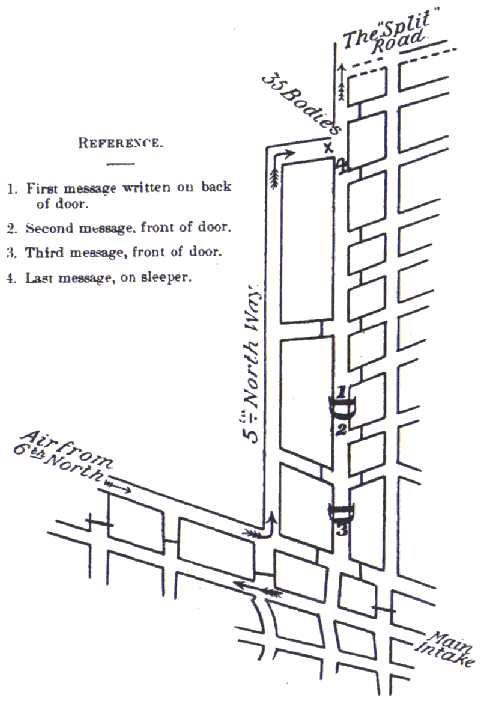
A piece of paper was found suspended from the roof in the 5th North, so that men there had evidently tried if there was any air current passing. Thirty-five men were found right in the air current from the 6th North.
Evidence to the effect that the 6th North men had not realized that an explosion had happened is forthcoming, inasmuch as they had gone on filling tubs, and Wear and Kenmare in coming out saw nothing of them. The first evidence they probably received of something wrong was smoke coming in on them, then most of them would come out by the main road, which accounts for their bodies being in the positions shown on the plan.
| * If this gas is present in the air to the extent of | 0.05 | per cent. | slight giddiness results after half an hour |
| " | 0.10 | " | inability to walk " " " |
| " | 0.20 | " | loss of consciousness " " " |
| " | 1.00 | " | loss of consciousness results after a few minutes, and final death |





 Contains public sector information licensed under the

