


|

|

|

|
|
 |
 |
|||
II. — Narrative Of The Occurrence Of The Disaster And The Attempted Rescue Operations.
The condition of the Mine on the day of the Explosion. — Mr. Henry, the under manager, who had been down the pit on Wednesday, May 11th, from 5.40 a.m. until 4.15 p.m., during which time he was inspecting the pit, stated that "everything was in first-class condition when he came out at quarter past four that afternoon."
Thomas Graham, the overman of the middle shift, which commences to descend at 11.30 a.m., on the morning of the day of the explosion visited the workings in the following order: the "Lock-shop," when the outcoming overman of the "foreshift" told him that all the workings were in "first-class order ;" the 5th North, where the outcoming deputy, T. Swinburne, informed him that the district was in "first rate" condition ; the 6th North district, where he saw Skelton, the deputy of that district, and where there was nothing wrong. He then went to the 3rd North district, and it would be about 4.00 p.m. when he commenced to go round the workings of the same, going up one of the "brakes" and down the other. The only thing that he found wrong was the place the Reeds' were working in (i.e. the place they were working in when he visited them — opinion at the Inquiry differed as to whether they were working in this place at the time of the explosion). The position of this place is noted on the plan II. Here he found the roof was bad and ordered the deputy, John Wilson, to set two props. He then went through the other working places and found them "in first class order."
He came up the Wellington pit at 7.30 p.m. and all was then right. Henry Steel, with Skelly, coal hewers, whose working place was at a stump of coal on the left-hand side of the "dilly" in the 3rd North, were in the second or middle shift, but on the day of the explosion he was with others working at a big fall of coal and stone which had taken place on the day previous, in the level at the bottom of the "dilly" and about 100 yards from his usual working place, and four pillars in from No. 2 Brake.
This witness said that he and his mates were warned by Laidlaw, a "joiner", at a little before 6 p.m. that if they were going to finish their shift up in their usual working place "to be careful as there was a bit of gas in." Both Laidlaw and Wilson (the deputy) were examined on this point ; the evidence was very contradictory, and from it it is impossible for me to state whether or not gas was present in this place, but seeing the place had been "off work" since the 10th May it would be a likely place in which to find it. Wilson examined it before going to the Reeds' place to set the two props already mentioned and found all right then, though the place was not fenced off, a fact which constitutes a breach of General Rule 6.
Mather, who was in the middle shift, said his place had been "working" but was quiet when he got in ; all was well when he came out.
John Wilson came up at 7.30 p.m. All was then right in his district. Though Wilson examined the district he did not record his report in writing ; the Statutory report was made by Graham the overman who also made an inspection. Graham's examination must, I conclude, have been a hurried one, seeing he also had to fire four shots in the drift in order to catch the outgoing set at the "friction-gear" at 6.45*. Wilson passed the night-shift men in-bye although he did not himself make the Statutory inspection, rather a loose war of doing things.
Wilson described the condition of Mather's (for position see plan II.), and Reeds' places. He never saw such a large area of open (unfallen) goaf before in the neighbourhood of these places, but the goaf was not "working" at the time of this visit.
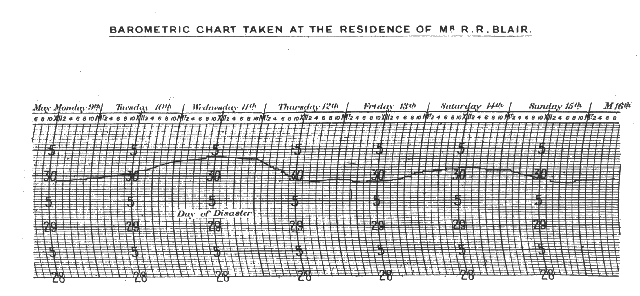
A barometric chart taken at the residence of the Assistant General Manager is inserted from which it will be seen that the condition of the atmosphere did not have any particular bearing on the explosion.
The occurrence of the Explosion. — We know that all appeared to be right up to 7.30 p.m. The first intimation to those out bye side of the "friction gear" that something was wrong was that mentioned by Joseph Walker, a roadman, who with Stephen Gregory, was working at "Benk's Turn" at about 7.40 (Gregory had just looked at his watch); he was timing the last "set" of tubs going out when "all at once the air rushed out," that is to say, a reversal of the sir current took place. The outrushing air, which was accompanied by a buzzing noise and was thick with dust, was so misty that though their lamps continued to burn they could hardly see anything with them. They could not signal, though they tried to, because "the hammer was against the bell," the outrush of the air had injured the apparatus. It had been working all right ten minutes before. About five minutes after the outrush of air Walker lost consciousness. Before doing so he had said to Gregory that an explosion must have occurred ; he advised Gregory to put his jacket over his head, but as Gregory had left his coat elsewhere he lent him his own cap to cover his mouth and put his own jacket over his mouth. He remembered nothing more until he saw Henry, the under-manager, he and Gregory having evidently been brought out-bye 200 or 300 yards.
Thomas Douglas, a roadman, who was working at the "Infidel drift"** when the reversal of the air current took place, described the reversal in very similar terms ; he "tried the wires," but as there was no signal —the wires being broken — he went further in-bye (about 20 yards), put the telephone on and spoke out-bye and said "The air had been reversed," and they said "Yes, they had known." He saw a boy, Ferryman (who had come from Saltom), carrying his lamp. They had travelled a distance of 400 yards, during which time the air was still reversed, and they proceeded in-bye and got to Benks' Turn, where they found Walker and Gregory unconscious, their lamps out. They made efforts to revive them but Douglas began to "feel rather heavy" himself and had to come away and leave the two men after he had been about 10 minutes with them. He and Ferryman went out-bye to get help. Three-quarters of a mile further out they met a party coming in, consisting of Mr. Henry (Under-Manager), Benn, and Williams ; these asked him what was wrong ; he replied they would find two dead men at Benks' Turn ; he said this as he thought Walker and Gregory would be dead by the time the party got to them.
George McLennan, the onsetter at the loading level at the Wellington pit, was engaged in sending men to the surface — the middle shift was riding — when he noticed at about 7.40 p.m. a reversal of the air, and what appeared to him to be a kind of mist and dust coming out. One of his paraffin lamps was extinguished. The reversal of the air would last for about 15 minutes. Two of the men who were waiting to ride said they feared it was an explosion, and would go into the cabin for protection in case of a recurrence, but agreed that if nothing occurred they would say nothing about it lest they should get "into trouble !" McLennan went on as usual sending the men up, and then he sent three tubs of coal up, when telephoning commenced from the surface "to see if they could get any communication from in-bye." Then Mr. Henry came down the pit (about 7.55 p.m.). He said he had heard at the surface about the air reversing, and asked how long it had lasted, and told the onsetter to go on sending up coal. Then Henry and Benn (rope-splicer) set off in-bye, while the onsetter went on sending up coals. At 8.55 p.m. rescue parties began to come down.
The night shift banksman at the top of the Wellington pit saw dust come up the shaft, and observing that it continued to ascend out of the shaft, he sent a messenger for Henry, the under-manager. When the dust ceased — after 10 or 11 minutes — to come out of the pit, he tried the air with bits of paper, which shewed him that the ventilation was re-established. This was just after Benn, the rope splicer, had come up the shaft. He did not receive any message from below. Ten minutes after he had sent for the under-manager, Mr. Henry and Benn descended the shaft at about 8.15 p.m.
The Attempted Rescue Operations. — Benn's narrative of the early stages of the rescue operations is particularly illuminating. He was coming out-bye with a batch of between 50 and 60 workmen, and was about 50 yards from the pit eye when he noticed the reversal of the air. Immediately he got to the shaft bottom he telephoned to the engineman to inform Mr. Henry. Whilst at the pit bottom some men (Wilkinson, Macbain, and Lupton) "came running out and said something was wrong." He went up, after all the others had ridden, and met Henry, who had about that time come to the pit and was visiting different parts of the surface works. He met .Daniel Benn, who said he thought there was something wrong, adding, "the air is coming outbye and the hammer is hard and fast against "the bell." Henry then made for the-fan-house, where he met several men, one of whom said he thought — alluding to the reversal of the air — that there must have been a big fall of stone somewhere. All was right in the fan engine-house, and the air was going all right down the shaft when he arrived at the shaft-top. He and Benn descended the shaft between 8.5 and 8:15 p.m. Clearly, at this time, Henry did not think that anything, other than a large fall, had taken place, for he took no steps to send for Mr. Steele, the manager, or for any other help. After going down the pit Henry and Benn visited that part of the mine known as the Bannock Band, examined the return air, found all right, and continued inbye, being overtaken by Williams. They do not seem to have thought much was the matter until they met Douglas and Ferryman near Saltom, and heard their tale.
Henry, after meeting Douglas and hearing his tale, asked him to go back inbye with him, but Douglas declined to do so. He said he "could not, as he was done up." Benn said he appeared to be all right, Henry then requested him to give instructions about sending word to Mr. Steele and to his (Mr. Henry's) son William, to bring in assistance. When they arrived at the "Pipe Scuttle" they again examined the return air "smelt stythe," and Henry thought it was warm. At Benks' Turn they (that is Henry, and Benn, Williams, and Lupton, who had also overtaken them) found Walker and Gregory unconscious, Walker on his side and Gregory on his back. The air at this point was all right, so they commenced artificial respiration on the men, and in about 15 minutes Gregory regained consciousness ; Walker was longer in coming to. Willans and Luptoin helped Gregory about 300 yards outbye, and then Henry and Benn, having restored Walker to consciousness, helped him out also. Altogether Henry and Benn spent 55 minutes with these two men. Having got the two men so far outbye they met William Henry (master shifter), Ferryman and some other men with Dr. Harris, coming in — five or six in all. Then, as Dr. Harris wanted to telephone for nurses, blankets, and stimulants, Henry, Benn and the others proceeded inbye again to Benks' Turn to telephone, there being a tumbler switch there where they could disconnect and telephone to the surface. Having telephoned, William Henry and Benn walked on about 100 yards in advance from that point, and saw lights. Benn then describes what took place. "I walked a little further on and I shouts 'Hallo,' and Wear, I think it was, answered me by 'Hallo.' I says, 'Where are you from?' He says, 'From No. 5.' Says I, 'Where have you left the others?' He said, 'At No. 5 doors' ; and I says, 'What's things like down there?' and he said, 'The friction-gear is a-fire.' " Then Mr. Henry appeared, and Benn returned l20 to 130 yards to the switch, to telephone to the surface, and on going inbye again found the rest of the party had got to the scene of the smoke, namely, at the low side of the "fan-site."
I now leave them at this point for the moment, and follow the movements of the two men Wear and Kenmare, but before doing so it is necessary to mention the fact that Benn noted the time at which this meeting took place — it is the only time be could definitely speak to, for he looked at his watch then — viz., 9.50 p.m. That is to say (if the latest time given of Henry's descent of the shaft is taken) fully one hour and a half had been expended in getting just inbye side Benks' Turn — most precious time, as after events showed had they only known it.
John Wear, together with his son and a man named W. O'Pray, was working at a place at the face of the 5th North, when, at about 8 o'clock a boy came in with a tub and told them that "a lot of air was coming up the brow." Wear told him to inform the deputy as there might be a "fall" at the bottom, so he shouted down to McAllister (the deputy) to come and see if something was wrong. The deputy went onto the level to the doors, and sent his assistant inbye to tell the men to come out as there was "something wrong," so the three of them came out and met others at the "split" (see plan II.) ; there would be about 27 in all. McAllister told them they could not get out by the way of the intake, there was so much smoke "between the doors" that they must go the return air way, and so he led them by that route, but when they had got to the point where the 5th North return joins the main return they had to retrace their steps owing to the heat and afterdamp, one of the lamps at least being extinguished by the latter, the lamp being on the ground (indicative of the presence of black damp). Having got back to the "split" they sat down and took their "bait" (food), when a boy came up and said it was far cooler on the main road (intake). They therefore came to the bottom of the "split," and O'Pray and a man named Lucas went through the doors, and, on their return, remarked that "it was terribly thick out there between the doors and the smoke." Wear then said that it would be well if somebody kept going backwards and forwards "to see how it was going on or to see what it was," and offered to go out if anybody would come with him, and find out what was wrong. Kenmare volunteered, but no one else, so they travelled out through the smoke. He said the smoke was coming from the fire at the "friction-gear," but the greater of the smoke from the fire was "dragging" through the blown out stopping into the return. They clambered over the bricks and rubbish which had been blown there by the explosion. Wear says on approaching the "friction-gear" they saw the fire "on the left-hand side going up ; there was a little fire also on the right-hand side," but it was so small that it could easily have been put out ; that on the left-hand side was much bigger, the timber and props blazing. They were evidently not greatly affected by the fumes, for after they had got through they sat down 50 yards further out "a little bit to get a wind for a minute or two, and then we travelled up the brow." They sat down a second time 200 to 300 yards further out. They seemed all right when the incoming party met them. Their lamps were not extinguished, and Benn says they were in quite good condition. After meeting Henry and party at a point about 700 yards outbye from the friction gear, they returned to the scene of the fire with them.
 * Graham stated in giving evidence as to the time he went out on the evening of the explosion: "We went away at 20 to 7, our time should be a quarter to."
* The "Infidel Drift" is near where Saltom joins the main intake.





 Contains public sector information licensed under the

