


| Newspaper Articles |

|
Newspaper Articles |
 |
 |
19th April 1941, Page: 321, Column: 1
Colliery Accidents In 1940
Position Reviewed by Mines Inspectors
Statements relating to accidents that occurred in 1940 at collieries in the inspection areas have been prepared by the Divisional Inspectors and circulated among managements and all others concerned, with an invitation to give earnest consideration of measures to effect an improvement. In a recent issue (No. 19, page 292) of this journal the comments by Major H. J. Humphrys on the position in the Yorkshire Division were presented, affording an opportunity to readers to study and discuss the suggestions made to ensure greater safety in working the mines. The problem concerns all who are engaged in the getting, raising, and preparation of coal for industrial and domestic purposes.
North Western Division Comparisons.
In the statement circulated in the North Western Division, Mr. E. H. Frazer, M.Sc, says the following table shows how serious the increase has been from falls of ground at faces and from haulage accidents, though in practically every classification the figures were worse for the year.
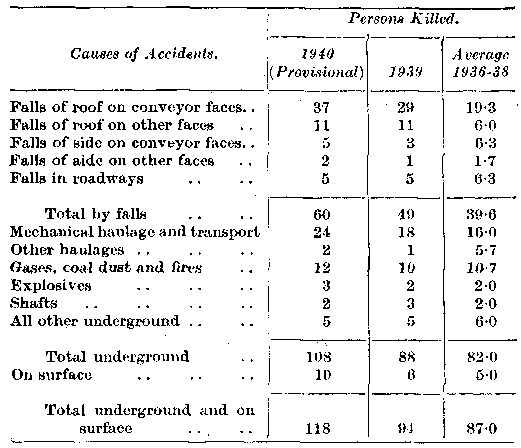
Consideration of the causes of all these accidents leads the Inspector to the belief that conditions in mines, having been little affected by the war, did not contribute materially to the increases : the prime factor was the human element, evinced by lack of discipline, carelessness, rashness and forgetfulness. It is but natural that preoccupation with more stirring events in the theatres of war, including the home front, induces absence of mind and neglect to take some of the usual precautions for safety at work, and that persons who are suffering from lack of sleep, owing to night raids, are not so observant of danger and so alert to avoid it.
Accidents Selected for Consideration.
As an example, an accident in a Lancashire colliery is quoted. A corrugated steel bar, supported by two steel props, was about to be withdrawn from the waste of a conveyor face. A fireman examined the place but gave no instructions that a Sylvester prop withdrawer was to be used and that a temporary support, required setting, fully expecting that these measures would be taken as a matter of course. A timber-drawer pulled out the front prop first and then used a hammer to loosen the back prop. His mate started to wriggle the bar off it. Suddenly a large stone from the roof fell and killed the latter man, who was working in the goaf under roof from which one prop had been withdrawn and another loosened, and where no temporary prop had been set.
At one of the mines in North Staffordshire a loader was killed by a fall of roof when he was casting back loose dirt into the top waste next to old goaf of a district to the rise. When he commenced his shift, shortly before the accident, he found a bar and two steel props reeled out in front of the top pack, but instead of taking this as a warning, he simply threw the supports forward to the face and knelt down to shovel at the place from which they had been displaced. There were other unsatisfactory features about the place, i.e., the props in the top waste had been withdrawn in advance of the packs ; there were bars with only a single prop, and there was an utter lack of system in the setting of supports. None of these things was symptomatic of the general practice, which was almost a model for a text book, so it can be assumed that the fireman was careless and lacking in discipline when he allowed them to exist and the loader was either taking a chance or else very unobservant.
A haulage hand was crushed by a tub of coal against the floor girders of an overhead haulage room whilst endeavouring to release a twisted lashing chain at a bank head. Apparently he was so engrossed in his work that he momentarily forgot the low bridge, which was a trap for the unwary or preoccupied person. The real blame lay on those who constructed the trap, but the accident would not have happened if the young man had been alert.
At a colliery near Wigan a gateway was served by six trunk conveyors working in series. A fireman was riding outbye on one of those belts which was being worked to get a defective fastening into position for repair. The belt above was running in reverse to bring the repairing tools in bye. The fireman failed to get off the belt in time and was precipitated head first over the delivery end on to the belt running in reverse, then drawn in between the two belts and killed. The fireman had been told by the overman that no one was to ride on the belts, and had ignored protests by the belt attendant on previous occasions when he had ridden on them. Not only did he exhibit rashness but he set an example of disobedience of orders that could only result in undermining the discipline or the pit.
In a North Wales colliery a boy, aged 15, fell asleep at the side of a main and tail haulage road whilst waiting for tubs. When a train of tubs ran into the passbye he was caught and severely injured. There had been intense air activity in the area for the previous two weeks and, doubtless, the boy was suffering from lack of sleep.
Suggested Remedial Measures.
As the record of accidents shows that six firemen and other officials were killed and 33 injured by reportable accidents underground whilst engaged on official duties during 1940, it is evident that remedial measures should start at the top. Managers might institute lectures for their firemen and see that they attend. Addresses by the managers themselves carry authority as well as imparting instruction.
Safety officers should be appointed where this has not already been done ; they should be given permanent status on the staffs of mines and could do much to educate firemen, other officials and workmen.
Good work has been done by the safety campaigns in the past and it is suggested that the time is ripe for a new campaign. The old and proved methods, such as safety committees, prizes to officials for accident-free months, safety posters and safety lectures, but in newer and more attractive guise, might be tried again.
The keeping and publishing of statistics, mainly in chart form, is an excellent way of exciting interest, especially if the competitive spirit can be introduced.
Greater interest should be taken in Safety Classes for boys ; managers might make it their personal business to interview youths who are not attending regularly. The very fact that a boy knows the manager's eye is upon him has a stimulating effect.
Those are only a few of the possible methods, and Mr. Frazer says others will commend themselves to individual managers.
Regarding safety clothing, there are still fields for endeavour, particularly in North Wales, but officials must set the example. If safety helmets are considered essential for the army, navy, air force, police and air raid services they must surely be necessary for miners where risk is present every shift and, for some of the men, all the shift. The use of safety boots and gloves should also be expanded.
The Inspector earnestly begs all colliery agents and managers to revive the safety movement where this has fallen into the background since the war began, and appeals to mine officials and workpeople to do all that is possible to guard against avoidable accidents.
Scotland Shows Reduced Rate.
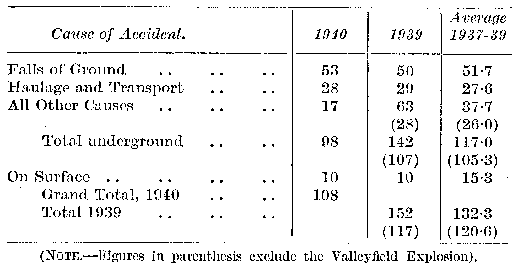
In the Scotland Division the casualties were on a reduced scale. Regarded as a percentage the improvement was equal to at least 29, and excluding the Valleyfield explosion there was still an 8 per cent. advantage. In the circumstances even the inspectorate, whose commendable ambition is to reduce accidents to the minimum, could have but little criticism to offer, even though roof falls rose from 30 to 38.
Regarding the four main classes of fatal accidents, in the table prepared by Mr. T. Ashley, Inspector in Charge, it is shown that, apart from the 35 deaths caused by the explosion at Valleyfield Colliery of 28th October, 1939, the total number of fatalities in 1940 is less than in 1939. In view of the abnormal conditions of the past year and all the trials and difficulties of the war, this cannot be regarded as otherwise than satisfactory. But, Mr. Ashley adds, there is still room for improvement, especially in regard to accidents from falls of ground, which is the only major class of accident showing an increased incidence rate.
Despite the increased use of home grown timber and the transition period in the use of steel props at the working face, investigation in the Scotland Division does not support the view sometimes expressed that these innovations led to any increase of accidents. The main solution of the problem of falls of roof at the face, in the view of the Inspector, lies in the rigid and prompt adherence to close and systematic setting of supports and he trusts that every effort will be made to do this in 1941.
It is unfortunate, he concludes, that "black-out" conditions hamper attendance at Safety First Classes, nevertheless much is still being done and everything possible should continue to be done to stimulate and maintain interest in this work.
In the appended table the accident totals are compared with those of 1939, the average for 1937-39 also being shown.
Heavy Increase in M. and S. Division.
In the Midland and Southern Division 52 persons were killed during 1940, as compared with 42 during 1939. This, the Divisional Inspector (Mr. E. Rowley) informs in his statement, is proportionately a heavy increase and though he appreciates that colliery officials, particularly managers, have now an increasing number of other and very important duties to perform, it is most important that the question of safety should not become a secondary matter. A classification of the accidents, based on the opinion of the Inspectors who investigate them, indicates that 45 per cent. were avoidable.
As in former years, by far the greater number of accidents were caused by falls of ground and haulage, 79 per cent. of the total being attributed to those causes. The following notes, based on analysis of the accidents falling under these categories, show the predominant causes and indicate the measures by which Mr. Rowley suggests they might have been avoided.
Face Hazards.
Twenty-five persons were killed by accidents due to falls of ground. Apart from an excessive number of fatalities occurring in South Staffs., the accidents were more or less proportionally distributed throughout the various districts. Twenty per cent. of the accidents from falls at the face occurred at or near way-heads. The continued high percentage of such accidents suggests that there is even now a lack of appreciation of the increased hazard at this point. The remedy in the form of special systems of support, using long bars or channels, has been repeatedly pointed out, and it is significant that at collieries where such systems are enforced the incidence of such accidents has been greatly reduced.
A large proportion of the accidents by falls, including several classified as unavoidable under existing circumstances, might have been prevented by attention to the following contributory factors :—
(a) Alteration in the System of Work or Method of Operation. — Some of the fatalities were traceable initially to bad practice, either common to the system or on the part of the miner himself. Frequent accidents still occur due to defective methods of stripping, particularly on machine-cut conveyor faces, and it is still common to have reports of accidents from falls primarily caused by the unnecessary exposure of large areas of unsupported roof due to miners stripping coal towards each other or stripping "on face" of the coal. Mr. Rowley knows of no practical argument that can be advanced for stripping a machine face otherwise than by "buttocking," and the enforcement of this method is entirely a matter of discipline.
(b) Improvement in Existing Timbering Systems. — By far the larger proportion of accidents from falls of ground occurred in the area between the last row of props and the coal face, and there is need for a general revision of the method of support in this area. The use of bars instead of lids would effect improvement in this respect. In several instances it was found that the timbering rules stipulated bars to be used only "where required," but unfortunately the decision was too often left to the miner himself. Even on faces where the rule is to use lids, the Inspector says, bars are essential and should always be used at places, such as corners, where cutters have to be turned and conveyor engines advanced. At such places it may not be possible to avoid the removal of some supports, and if the practice is to use only props and lids, the result is to create comparatively large areas of unsupported roof. Moreover, it frequently happens that the roof at the end of the face, where the cutters are turned, has been rendered dangerous by the proximity of old goaf or a fault. In such cases the use of bars should be made compulsory and should be incorporated in the rules.
Though none of the accidents from falls can be directly attributed to abnormal conditions arising from the war, there is reason to believe that these conditions have had some effect on the problem. For instance, in most areas there has been a deterioration in the general standard of roof control, chiefly because of absenteeism, scarcity of labour, and other causes mostly arising from war conditions. These factors result in the normal cycle of operations on mechanised faces being frequently upset, and the packing, ripping and withdrawal of supports, so essential to effective roof control, suffer.
Part, at least, of the difficulty might be overcome by reducing the number of faces, shortening those already being worked, or where practicable, reducing the depth of cut. Efforts should be made so far as possible, so to adjust the workings that faces are operated with the full complement of personnel, thus ensuring normal turnover and avoiding the difficulties of partially stripped faces and irregularities in the work of packing and prop withdrawal, resulting from a shortage of men. If this were done, it would assist the under officials in placing their most reliable men on the more important work.
Cause of Haulage Accidents.
Sixteen persons were killed in accidents in the Midland and Southern Division in connection with haulage operations — an increase of seven as compared with the previous year. Over 80 per cent. of these accidents were classified as avoidable. Such a condition of affairs, in the view of the Inspector, is a serious reflection on all concerned. Admittedly, we are living in abnormal times and sometimes men, possibly not very nimble, have to be taken from the face to unaccustomed work on the roads, but this makes it all the more urgent that everything possible should be done to help them.
An analysis of the accidents shows that most of them could be attributed to one or other of the following causes :—
(a) Failure to Provide or Maintain in Order Suitable, Safety Appliances. — A number of accidents happened to men, engaged on haulage roads in repairing or clearing up after a smash, etc., who failed to protect themselves by placing a bull stump or similar device on the rise side of where they were working. In other cases tubs which had been left standing, held only by timps or some other insecure device, on gradients as low as 1 in 100, subsequently ran away with fatal consequences. Again, a number of accidents occurred at junctions when tubs being drawn out of one road collided with those coming from the other. Those accidents might have been avoided quite easily by the provision of a simple warning signal.
The failure to install suitable runaway devices immediately above and below the junction of branch roads with main inclines, was another fruitful source of accident. Not only is a safety device necessary above junctions to protect men working at the junction, but a similar device should also be provided below it, as there is always a possibility of a runaway from such a junction.
Protection should also be provided to safeguard men working at the bottom of inclines and, wherever practicable, double interlocked blocks, i.e., blocks so connected that when one is open the other is closed, should be placed at the top of inclines.
(b) Inadequate Space. — As in previous years, several accidents were attributable to low and narrow roads, particularly on mechanical and horse haulages.
The Coal Mines Act lays down certain requirements in regard to the space to be provided at coupling places. It needs but little imagination, however, to appreciate that there are many other places, e.g., where ropes and clips are attached or detached, where lockers have to be put in or taken out, and at conveyor loading points, where plenty of space and good lighting are vitally important.
(c) The Human Element (Inexperience, Lack of Discipline, etc.). — Several accidents were due to some failure on the part of the individual. Although such accidents have always occurred, their number may be expected to increase in war time unless special precautionary measures are adopted.
Need for Concerted Action.
In his concluding remarks Mr. Rowley says that sufficient has been said to indicate the need for special and concerted action on the part of officials and workmen, not merely to avert any further increase in accidents, but to improve on the 1940 results. Under war conditions men may have to do work to which they are unaccustomed and for which they are unfitted ; they may be tired and preoccupied by air raids ; they may be "fed-up" owing to curtailment of their usual relaxations. To overcome these adverse influences, the physical conditions in which work is carried on must be made as safe and as favourable as possible. An appeal must be made to the mind by means of posters, lectures and discussions, and effective discipline, based on good and sympathetic supervision, must be maintained.
To evolve and carry out these measures successfully is a full time job, and with the extra work which the war has brought to them many colliery managers cannot give the necessary time and thought to the problem. The solution may be found in the appointment of safety officers, working in conjunction with a committee representative of officials and workmen, and Mr. Rowley would most earnestly urge the managements, of at least the larger collieries, to consider this possibility as rapidly as possible.
 |
 |
| Names mentioned in this article | |
 |
 |
| Name | Age | Occupation | Notes |
|---|---|---|---|
| Ashley, Theodore | H.M. Divisional Inspector of Mines | Whos Who Page | |
| Frazer, Edgar Hamilton | H.M. Divisional Inspector of Mines | Whos Who Page | |
| Humphrys, Herbert John, Major | H.M. Divisional Inspector of Mines | Whos Who Page | |
| Rowley, Elijah | H.M. Divisional Inspector of Mines | Whos Who Page |
 |
 |
| Related Articles | |
|
|
| Pub. Date | Article (Newspaper) |
|---|---|
| 22 Mar 1941 | Yorkshire Colliery Accidents Reviewed, Divisional Inspector on "Safety Measures" (The Science and Art of Mining) |
| 19 Apr 1941 | Colliery Accidents In 1940, Position Reviewed by Mines Inspectors (The Science and Art of Mining) |
| 03 May 1941 | Colliery Accidents In 1940 (The Science and Art of Mining) |
| 17 May 1941 | Colliery Accidents In 1940, Swansea Increase Disconcerting (The Science and Art of Mining) |
| 31 May 1941 | Colliery Accidents In 1940, Cardiff Shows Increase in Falls (The Science and Art of Mining) |



 Contains public sector information licensed under the

