


| Newspaper Articles |

|
Newspaper Articles |
 |
 |
22nd March 1941, Page: 292, Column: 1
Yorkshire Colliery Accidents Reviewed
Divisional Inspector on "Safety Measures"
Coal mine fatalities showed a considerable increase last year, and Major H. J. Humphrys, Divisional Inspector of Mines for Yorkshire, has circulated a statement in which the figures for 1939 and 1940 are given for comparison, inviting the "earnest consideration of the position by all concerned." The fatalities rose from 116 to 162, as shown in the table herewith :—
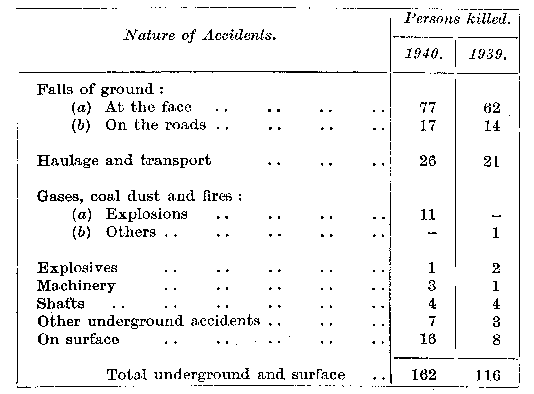
Major Humphrys says that on the general issues he feels that the persistent demand for coal from the mines at a time some of the more vigorous men have joined the Armed Forces or taken up other work, and when, too, there was an abnormal amount of absenteeism, often of skilled men, due to a variety of causes, resulted in men being set to work to which they are unaccustomed or, alternatively, in important bye-work being postponed. The consequent disorganisation has, he suggests, contributed to the increase in accidents.
Extracts from the circular are appended.
Falls of Ground.
The accidents under this heading, particularly those from falls of roof at the working face, are the most unsatisfactory feature of the accident position. Summarising the casualties under occupational headings, the figures are :—
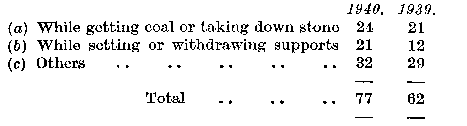
Features of the accidents under (a) are the long lengths of coal or overlying stone comprised in the fall and the large number of men over 50 years of age killed. Investigation disclosed that spragging needs improvement. Reliance should never be placed on a single sprag. Where the seam is thick or there is overlying stone taken down with the coal top bottom sprags are generally necessary, sometimes even when the coal is not holed. Sprags should be sufficiently long and well dinted into the floor. Persons should stand at the side of coal being taken down and not in front of it, using a bar in preference to a pick. They should make certain of a way of escape if the coal falls in an unexpected direction. Sometimes retreat is blocked by a tub or prop.
An alarming increase has occurred under (b). A number of these accidents occurred when props in a waste or at a face ripping lip have been knocked out with a hammer instead of being properly withdrawn by a safety contrivance. Other accidents have been due to failure to set temporary supports prior to the withdrawal of supports, and others again have happened to those, and unfortunately the number is increasing, who neglect to wear their safety helmets ; numerous accidents are due to slips and breaks, and it is suggested that a closer and more frequent examination of the roof would prevent many of them. The failure to set bars or to set them soon enough where their use is prescribed is another fruitful source of accident.
Under (c) the most pronounced increase is by falls of roof on conveyor faces. Half the men killed were over 50 years of age. In two instances men were killed by falls of roof when building packs where the maximum timbering distances were exceeded at the time owing to the withdrawal of supports. Packs should be built in sections so that the roof is supported by the completed part of the pack to such an extent that it is safe to withdraw supports. Failing that, additional supports or long steel bars covering the whole width of the pack should be set before supports are withdrawn. Other accidents occurred where persons ventured into the waste beyond the last line of props in order to procure packing material. Long-handled rakes have been introduced at a number of collieries for drawing forward packers out of the waste and their use should be extended. Other accidents occurred owing to failure to set props in the cutter track immediately behind the coal-cutting machine. This should not be neglected nor the setting of nogs at a time when the roof movement is at its maximum.
Gases, Coal Dust and Fires.
Two explosions of firedamp involving loss of life occurred during the year. Coal dust did not enter into either of them. Each was small, but large explosions often have small beginnings. In one explosion firedamp was being blown out by compressed air, a practice to be condemned. The firedamp was probably ignited by an electrostatic discharge from the coupling at the end of the air hose.
In the other, firedamp was ignited by spontaneous combustion in an inaccessible part of the mine adjacent to a rib-side — the most frequent danger point in mines liable to spontaneous combustion. A long length of solid stowing next rib sides has been frequently advocated, say 20 to 40 yards, in which, of course, a space must be left for an airway gate not less than 6 yards from the rib side. In this instance there was a 2-yard pack next the rib side, then a 6-yard waste, and afterwards the 4-yard gate side pack. Other unsatisfactory features were that the disused rib side gate from which supports were being withdrawn was closed at one end only by a stopping not explosion-proof and that for some days prior to the explosion only the outer end of the gate could be travelled.
The number of persons who die as the result of being burnt in an explosion is a matter of much concern. The best chance of recovery is to give the injured proper treatment from the very first. At all collieries the ambulance man at the surface, or other competent person, should be instructed that in the event of an explosion of firedamp he must send at once to the place stretchers, hot-water bottles, blankets, burn dressings and carbogen reviving apparatus. The injured should be carried out and kept warm after having their injuries dressed and carbogen administered.
Haulage and Transport.
The only matter calling for comment is the occurrence of seven fatalities from runaways. The three due to "backward" runaways could have been prevented by drags of good design or of additional jack catches. Two others, due to lockers accidentally falling out, indicate the need for a more secure form of locker. Drop warricks or such like contrivances should be erected to protect persons working in fixed situations from accidents by "forward" runaways and elsewhere as required.
Surface Accidents.
The number of surface accidents has been abnormal. The fatalities on railways and sidings can be attributed to the severe weather at the beginning of the year. The miscellaneous fatalities are due to a variety of causes, but it frequently appears to be insufficient supervision in surface operations. General instructions are issued, but too little attention is given to detail and too much is left to the discretion of the individual.
General.
Many of the measures suggested for the amelioration of the position have already been indicated, e.g., the more frequent provision and use of safety contrivances and safety equipment. Safety instruction, an intensified safety campaign and the employment of more safety officers are also important. The few safety committees formed have done good work and produced excellent results, and so have the safety classes and instruction given to boys at the commencement of their employment. A safety bonus given to officials in districts with low accident rates stimulates the competitive spirit and has apparently resulted in accident reduction where in force.
Major Humphrys considers that work is too specialised in these days, especially on mechanised faces, and that this is likely to produce a less skilled workman than formerly. Given a more all-round scheme of training a workman could be more readily transferred from one class of work to another or be able to undertake more than one kind of work during his shift.
There is urgent need for increased vigilance on the part of those immediately supervising the work at the working face for stricter discipline there, for the provision and use of the best materials and appliances and for good layouts and systems of support, including the prompt building of efficient packs.
The problem is so to improve discipline that the obvious is translated into action. Risks have probably been taken many times, sometimes in the presence of officials, until taken once too often. Working conditions should be improved as far as possible so that the temptation to take risks is reduced to the minimum.
 |
 |
| Names mentioned in this article | |
 |
 |
| Name | Age | Occupation | Notes |
|---|---|---|---|
| Humphrys, Herbert John, Major | H.M. Divisional Inspector of Mines | Whos Who Page |
 |
 |
| Related Articles | |
|
|
| Pub. Date | Article (Newspaper) |
|---|---|
| 22 Mar 1941 | Yorkshire Colliery Accidents Reviewed, Divisional Inspector on "Safety Measures" (The Science and Art of Mining) |
| 19 Apr 1941 | Colliery Accidents In 1940, Position Reviewed by Mines Inspectors (The Science and Art of Mining) |
| 03 May 1941 | Colliery Accidents In 1940 (The Science and Art of Mining) |
| 17 May 1941 | Colliery Accidents In 1940, Swansea Increase Disconcerting (The Science and Art of Mining) |
| 31 May 1941 | Colliery Accidents In 1940, Cardiff Shows Increase in Falls (The Science and Art of Mining) |



 Contains public sector information licensed under the

