


| Newspaper Articles |

|
Newspaper Articles |
 |
 |
16th September 1933, Page: 74, Column: 1
Some Medical Aspects Of Coal Mining
By S. W. Fisher, B.A., M.D., B.Ch. (H.M. Medical Inspector of Mines.)*
Boils, Carbuncles, etc.
Occasionally men working in coal mines develop boils, often men working in certain stalls, or places in the mines, in such numbers as to suggest a mild epidemic. The observation of this fact led to inquiries which had for their object the determination of a specific cause. Many factors were blamed by the workmen, such as hardness of the drinking water, the type of coal, inadequate ventilation, the water which either dropped from the roof or in which men might stand while working. In order to decide which, if any, of these causes was actually responsible, I obtained information from twenty-nine coal mines, and medically examined about two hundred men. The investigation proceeded along two main lines — (1) the examination of the men, and (2) the examination of conditions prevailing at various mines.
The examination of the men did not reveal any one definite factor; it was noticed that many of the men had recently resumed work after having been idle for a year or more, and during this period, being out of work, were probably under-nourished. On the other hand, boils were found among men who were obviously hale and hearty.
In many cases a crop of boils could be traced to an initial lesion such as a tiny pimple, a scratch or place rubbed when working, such as elbow or knee. Also, where a group of men work together, it is possible for one to infect another, and in other cases infection could be traced to other people living in the same house.
As regards conditions in mines, many points were taken into account; for instance, depth (shaft and workings where a marked difference existed), thermometer readings as given by the ordinary wet and dry bulb temperature, type of coal, state of ventilation, and the quality of drinking water. The depths of the mines visited ranged from 300 to over 1,000 yards, and the distances inbye to the working places up to 2½ miles.
As regards temperature, the occurrence of boils was most noticeable in mines where the wet bulb thermometer registered 75°F. or over. It was also observed that boils occurred more often on men who sweated profusely and whose bodies were covered with a fine film of coal dust. The highest temperature met with at the coal face was 93°F. dry bulb and 85°F. wet bulb; the lowest was 53°F., dry and wet bulb. In mines where the wet bulb temperature was about 75°F. or over the men worked partially stripped, i.e., in shorts and boots.
Several Petri dishes containing a culture medium were exposed in the intake and return airways, and at the working face, in order to test the bacteriological purity of mine air, the exposure in some cases being for 15-20 minutes; in no case was any pathological micro-organism found.
There was no reason to think that the composition of coal had any influence, apart from the facts that some seams were hot and some coals generate a very fine dust which is more difficult to remove.
As regards water underground, irritation and smarting of the skin, which are especially severe when in bed, have been caused by droppings from the roof. At one colliery a supply of vaseline is kept underground for the men to rub into their skin after working.
The effect of drinking hard water is not easy to determine. The water drunk by miners at the colliery where the greatest number of cases occurred was found to have 160 of hardness, but a neighbouring mine with a similar water supply had very few cases. A mine which had never had many cases, and at which there were none when it was visited, had drinking water of 40° hardness. It was also noticed that at some mines boils occur only in certain stalls, although the drinking water is the same for all.
It is an interesting fact that no mines having pithead baths (with one exception where boils were very few) were reported as having cases of boils.
The conclusions arrived at were that, as far as mines are concerned, boils do not present a serious problem except in a few isolated cases, and that the main factor in the causation of boils underground (apart from predisposition to them of the individual, e.g., malnutrition, seborrhoea, etc.) is a high wet bulb temperature (75° and over) which, at one and the same time, provides suitable conditions (warmth and moisture) for the vitality of the organism and opens the sweat glands and hair follicles, and thus facilitates the entry of the staphylococcus.
At a mine where boils occur every effort should be made to improve the ventilation, lower the temperature, and minimise wetness. Workmen should apply an antiseptic, such as tincture of iodine, to the smallest scratch, cut, or boil, as soon as possible, and avoid touching the boil with the fingers.
Carbon Monoxide Poisoning.
In recent colliery explosions all the men found dead underground (with one exception where death was instantaneous due to a head injury), died of carbon monoxide poisoning. This suggested to me that many of those who were recovered alive were also affected by the gas, and this must be kept in mind when considering underground treatment.
Carbon monoxide poisoning is evidenced by the bright red colouring which is seen in the mucous membrane of the lips, wherever the superficial layer of the skin has been removed by burning, or in the vicinity of a wound. It is clearly shown when the coal dust is removed from the body by gentle washing — a procedure which is often neglected.
The carbon monoxide gas is, of course, a product of the explosion and is an ingredient of "afterdamp." It affects men by combining with the haemoglobin of the red corpuscles as the blood passes through the lungs. The gas combines with haemoglobin about 300 times as freely as oxygen does. When the blood contains a certain percentage of carbon monoxide it is said to be saturated to that amount. Thus when a little less than 0.1 per cent. carbon monoxide is in the inhaled air the blood will contain about 50 per cent, of CO and is said to be 50 per cent. saturated. According to Dr. Haldane, shortness of breath on exertion is brought on by 20 per cent. saturation. Just over 50 per cent. saturation will probably cause fainting. Loss of power, when the absorption of CO is slow, comes on before loss of consciousness. Treatment of a man overcome by carbon monoxide gas consists in the administration of a mixture of 7 per cent. CO2 and 93 per cent. oxygen at the very earliest moment and keeping the patient warm.
Burns.
Cases of burning following an explosion are strikingly similar to one another in appearance, the differences being more in the surface area affected than in the degree of the burning. The burns are nearly always of the second degree, with here and there a patch going deeper, where presumably a burning article has touched the body. Slight as these differences may appear, however, they often afford useful evidence as to the place where the ignition started.
Following four recent explosions twenty-three men who did not succumb to the effects of afterdamp were brought out alive, although in many cases severely burned. Fourteen of these died in hospital (i.e., 61 per cent. of those rescued), and nine survived. These facts, together with the knowledge that, in some smaller explosions, although all the men burned have been recovered alive many died later, show the great importance of the early and effective treatment of burns.
In order that a proper investigation into the treatment of men burned in colliery explosions should be made, a committee of which I am a member has been set up at the request of the Secretary for Mines.
I want to stress the importance of a detailed examination of the bodies; for example, two kinds of marking of the skin by coal particles are met with: (a) the type showing when a person has been flung down by the violence of the explosion and part of his body rubbed in coal (lust; and (b) where very hot particles have impinged on exposed parts of the body. In the first ease a large patch of long, parallel abrasions is seen; in the second, each separate particle is embedded in the skin and surrounded by a narrow zone of inflammation.
Complete absence of bleeding from a wound indicates that the wound was caused after death.
I advise that every effort should be made to prevent a man involved in an explosion from exerting himself or from being exposed to cold. As far as possible he should be covered by blankets and carried outbye. At the surface of the mine, if an ambulance car is in readiness, he should be transported to hospital; if an ambulance car is not ready, he should be taken into a warm surface ambulance room. In most cases, but not all, a doctor is in attendance at the mine by the time serious cases reach the surface.
Miners' Beat Hand, etc.
Miners' beat hand, beat knee, beat elbow and inflammation of the synovial lining of the wrist joint and of the tendon sheaths, entitle the patient to Workmen's compensation.
In the case of the knee and elbow the trouble is caused by constant friction against a hard surface. Infection can gain entrance through a minute scratch or through the sodden skin if the conditions are wet and an inflammation of the part follows.
In the case of the hand, continual jarring by the handle of the pick, especially if it is rough, damages the tissues and again renders infection and inflammation easy.
The wrist and tendon conditions are also caused by repeated small shocks.
The effect of subcutaneous cellulitis and synovitis is of comparatively short duration, namely, from three to four weeks in cases of beat knee and beat elbow, and rather longer in cases of beat hand. A comparison of the figures for 1930 and 1931 is as follows:
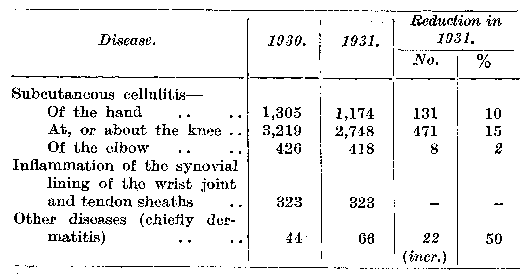
Beat knee may be prevented by the use of kneeling pads and seeing that minute coal particles do not become rubbed into the skin. Similar care of the elbow will have a beneficial result.
Attention to the handle of the pick, i.e., seeing that it is smooth, will help to avoid beat hand. I would suggest that rubber grips such as are used on hockey sticks might be tried on pick handles at least until the skin of the hand is hardened.
In all these cases, the early and thorough cleansing at pithead baths, together with the first aid treatment of trivial abrasions which can be obtained there, should be of great value in eliminating these painful and disabling conditions.
Miners' Nystagmus.
Miners' nystagmus is a complex disease giving rise to very distressing symptoms, much misery and a heavy charge on the industry. The most familiar sign is the rotatory movement or oscillation, as it is called, of the eyeballs. Mental or psychoneurotic symptoms also make their appearance, such as headaches, insomnia, depression, etc.
The third report of the Miners' Nystagmus Committee, while agreeing with the conclusion of the previous reports of the Medical Research Council that defective illumination is the fundamental cause of the disease, lays great stress on the necessity for recognising and understanding its mental manifestations. The report states that the mental or psycho-neurotic element is the main cause of disablement. It is a matter of regret that no degrees of disablement with their appropriate treatment could be suggested, for until this is done the certification and disposal of cases will remain haphazard.
A comparison of the number of certificates given in 1930 and 1931 is as follows :—

Miners' Cramp.
This is a painful condition of muscles which often comes on suddenly. The muscles most in use are usually affected. In cases where the abdominal muscles have been involved it has sometimes been difficult to diagnose the condition from that of an acute condition for which an urgent operation is indicated. It attacks men who work in high temperatures, especially when the air is humid.
Many research workers have investigated the condition, which I think is now generally agreed to be caused by loss of salt, and the suggestion for its prevention is that men working in hot and humid atmospheres should add a small amount of salt to their drinking water (about 10 grams to the gallon).
Finally, there has been a general brightening up underground which is bound to have a good effect on the men, both physically and psychologically. The more extensive whitening of the roadways, the increased use of steel arches and girders, the high candle-power illumination at the coal face, good ventilation, and the suppression of harmful dust, are all tending to make conditions of work more favourable, and one cannot but think that extension of these improvements, together with the increasing popularity of pithead baths with their canteens and facilities for the re-dressing of minor injuries, will have a beneficial influence on the safety and health of the miners.
* From lecture before the Armstrong College Mining Society and published in Volume 9 of the Society's JOURNAL. Concluded from No. 4, page 53.
 |
 |
| Names mentioned in this article | |
 |
 |
| Name | Age | Occupation | Notes |
|---|---|---|---|
| Fisher, Sydney Walter, Dr. | H.M. Medical Inspector of Mines | Whos Who Page | |
| Haldane, John Scott, Dr. | Whos Who Page |
 |
 |
| Related Articles | |
|
|
| Pub. Date | Article (Newspaper) |
|---|---|
| 02 Sep 1933 | Some Medical Aspects Of Coal Mining (The Science and Art of Mining) |
| 16 Sep 1933 | Some Medical Aspects Of Coal Mining (The Science and Art of Mining) |
| 27 Mar 1937 | Some Medical Aspects Of A Miner's Life (The Science and Art of Mining) |



 Contains public sector information licensed under the

