


 |

|

|

|
|
 |
 |
|||

August, 1959
Shap Granite — Part 1
A brief description is given of the granite quarrying operations carried out by the Shap Granite Co. Ltd., in Westmorland. In this first article details are given of the geology of the deposits being worked at their Pink and Blue quarries, and reference made to methods used at the former
By E. G. Holland
The main works and quarries of the Shap Granite Co. Ltd., are situated on the A6 main road between Kendal and Shap. There are two quarries operating, these being known as the Pink Quarry and the Blue Quarry which are 1,200 and 1,050 ft. above sea level respectively.
Activities commenced here during 1875, the company constantly improving and adding to its plant until at present a large variety of products are manufactured. These include granite chippings for a number of purposes and granite masonry for docks, dams and construction work in general. Polished granite in a wide variety of patterns is also produced for architectural, monumental and ornamental uses. In addition a wide variety of pre-fabricated concrete products are made and these include steps, curbstones, paving flags, pipes and fence-posts.
The granite is admirably suited to monumental and ornamental application as it takes an excellent polish of unusually rich tone, its distinguishing feature being the size of the porphyritic felspar crystals. The pleasant colour of the rock and its uniformity, together with the fine polish that can be imparted, has resulted in its extensive use as a facing on the concrete and steel of modem buildings.
However, despite the fact that this stone is an excellent building material, few buildings today are actually being constructed of granite masonry. This is due, without doubt, to the high cost of present day production, and the modem trend of steel and concrete fabrication. Shap granite has been used, amongst other places, in the construction of the King George V graving dock at Southampton, Queen Elizabeth II dock on the Manchester Ship Canal, and Goole Docks. It has also been used in the construction of several reservoirs.
Geology
The Shap granite intrusion is situated on the eastern side of the Lake District and occurs in the form of an irregular oval, with its longer diameter from east to west about two miles long, and the shorter diameter about one mile from north to south.
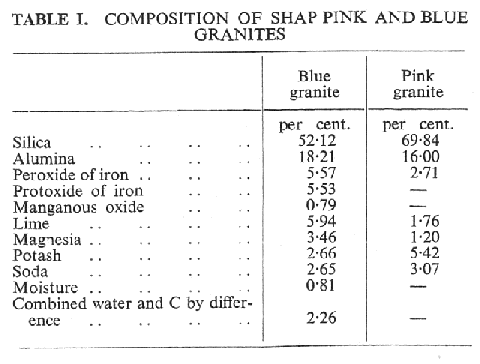
The granite is everywhere in contact with rocks of the Borrowdale Series, but may also make contact at its southern extremity with the Coniston Limestone at which point it is covered in detritus. The rock consists of numerous flesh-coloured porphyritic crystals of felspar up to 2 in. in length, embedded in a fairly coarse matrix of quartz and black mica (biotite). This matrix is usually grey in colour but may occasionally have a pink or reddish tint.
The intrusion is in the form of a laccolith with sub-parallel sheets meeting in the centre. It thus presents in cross-section a rough resemblance to a cedar tree, and is, therefore, termed a cedar-tree laccolith. The dykes radiating from the parent mass cut through and alter not only rocks of the Borrowdale Series, but through rocks of all ages up to and including Ludlow strata. This in conjunction with other more conclusive evidence* shows that the granite was intruded in Devonian times.
The surrounding area is naturally considerably metamorphosed, the production of new minerals being confined to within 1,300 yd. of the contact, although hardening has occurred to even greater distances. The mineral character of the granite itself is altered at the junction with the beds through which it passes, the beds themselves showing little disturbance; the granite alters neither their inclination nor their relative positions.
The Pink Quarry is on the southern side of the mass at Wasdale Head, and is entirely in the granite as indicated in Fig. 2. It is from this quarry that the granite for masonry work, together with a considerable amount of stone that is crushed for aggregates, is obtained. Shap Pink granite has a specific gravity of 2.57, and weighs approximately 165 lb. per cu. ft. It has a crushing strength in excess of 30,000 lb. per sq. in.
The Blue Quarry is situated some two and a half miles to the north of the Pink. It is located adjacent to the A6 road, and about half a mile from the main works. The quarry is in the Ordovician rhyolites, and the material worked has been described as a bio-hornfels. It is a dark blue, fairly fine-grained rock, being used exclusively for a hardcore purpose and in the company's tarmacadam and concrete plants. It has a crushing strength in excess of 40,000 lb. per sq. in.
Pink Quarry
The working face at this quarry has a total length of a little less than a quarter of a mile, the maximum height being 200 ft. It is divided into two sections by a narrow ridge of ground which has been left undisturbed.
The granite of the left hand section is of a rather darker hue than usual, and is known as "Dark Shap." It is used mainly for monumental work, and facings for buildings. The right hand section produces a slightly lighter coloured rock, "Light Shap," used mainly for construction work, etc. Both rocks can take the same good polish, however, and are of similar quality, the colour alone rendering them distinguishable. Waste material from both sections is, of course, utilised in the crushing plant.
Overburden
The amount of overburden on top of the granite is insignificant and as a result it is ignored. A coarse soil is found between boulders and in depressions, but this averages only about 2 in. in thickness over the whole area. However, any of this material falling into the quarry is effectively removed by the grizzley screen feeding the primary crusher.
Blasting
Heading blasting, to a standard pattern, is employed at the quarry for primary breaking. A main drive is tunnelled, at quarry floor level, at right angles to the face for a distance of about 50 ft. From this a back drive is driven off at right angles in both directions, for distances of about 40 ft. Four chambers are used, these being excavated to suitable dimensions for containing the required charge of blasting powder. Two of these chambers are placed about 15 ft. from the main drive, with the other two at the ends of the back drive, as indicated in Fig. 6, which shows the arrangement for a typical heading blast. The layout and blasting operation is supervised and fired by Imperial Chemical Industries Limited, who supply all the explosives used by the company.
Initiation of the heading blast is achieved by means of Cordtex instantaneous detonating fuse. A double length, taped together, is led into the "mine," to and from each chamber, and returning to the collar of the main drive. The Cordtex is taped securely to a primer of gelignite and placed in the centre of each charge. After placing the stemming, the two double lines are connected at the entrance, and two electric detonators arranged in parallel are then fixed to the Cordtex.
Generally, the chambers are quite dry, but as an extra precaution they are lined with roofing felt, the charge itself being raised slightly above the floor on wooden planks.
The drives are usually 2 ft. 6 in. to 3 ft. 6 in. wide, and 4 ft. to 5 ft. in height. Normally, 18 holes are drilled to a depth of 3 ft. 6 in. in each round, and these are fired in sequence using half-second electric delay detonators. The drilling pattern used is illustrated in Fig. 5. This drilling is carried out with a Holman drifter and Ingersoll-Rand J.30 & J.50 machines, using compressed air at 90 lb. per sq. in. The holes are started at a diameter of 1 in., and finished off at 1 3/8 in., the tungsten carbide tipped steel used being supplied by the Sheffield Hollow Drill Steel Co. Ltd. The total time taken to prepare a mine for the charges is about eight weeks, this development work requiring a total of 1,000 lb. of gelignite in 4 oz. by 1 in. diameter cartridges. In each heading blast, eight to ten tons of blasting powder are used, bringing down up to 100,000 tons of granite and giving a yield of over four tons per pound of explosive. Blasting powder is used to provide the minimum of fragmentation as large blocks of stone are required. If, however, a higher degree of fragmentation is required, or a patch of "heathen" (inclusions of earlier rock caught up in the granite) is encountered, Ammonal No. 3 is used.
The stemming is done carefully using granite and sand. A system of dry stone walling, the crevices being filled with sand, is used to fill the total length of the back and main drives. The stemming is strengthened at the drift junction by placing old railway sleepers across the mouth of the main drive. During stemming, the Cordtex is protected by old sacks, turf and clay, etc., the ends being kept in a safe position inside the tunnel mouth until the operation is completed. They are then joined together and fired in the manner previously described.
* J. E. Marr, Sc.D., F.R.S., "The Geology of the Lake District," chap. XII, p. 92. Cambridge University Press, 1916.
Drawings and Photographs accompanying the article


Article reproduced from a copy of the magazine held at National Mining Museum Scotland, Newtongrange, Midlothian.




 Contains public sector information licensed under the

