


 |

|

|

|
|
 |
 |
|||
August, 1954
Lead Mining in the British Isles — can it be revived? — Part 1
by W. W. Varvill, M.Sc., M.I.M.M.
The subject of this series of articles may seem too large for a technical journal, but it is hoped, by avoiding excessive detail, to present a summary describing the past history and future possibilities of this industry in a manner likely to interest both technical and non-technical readers.
With the exception of those associated with the industry or dwellers in the thinly-populated and derelict mining districts, the majority of our countrymen and most foreigners are unaware that Britain ever produced any metals but iron and tin and, regarding the latter, only the Cornish know more than the brief mention of the trade which they learned from their school history books.
It is nevertheless, a remarkable fact that the United Kingdom, with an area not much larger than a single American State, has been in the past, the world's leading producer of coal, iron, copper, tin and lead, in addition to a number of other important mineral products.
This statement may prompt the reply that the leadership was the natural result of the Industrial Revolution having originated in Britain, but this ignores the fact that it required a unique combination of mineral wealth, geographical position, a climate conducive to hard work, and a stable form of government to give rise to it.
The geography and climate remain much the same and possibly the government is not so bad as some believe, but the cream of all our minerals has gone and we are dependent in an ever increasing degree on imports to maintain our manufactures — in the case of the non-ferrous metals to the extent of almost 100 per cent.
Under present day conditions of the balance of trade, when every effort is being made to encourage the production of home-grown food, it is obvious that any other commodity which can be economically produced at home, should receive similar attention because metals, like food, must be paid for by exports.
Probably hard economic laws will, in due course, make themselves felt and depreciated rates of exchange will result in higher cost of imports ; attention will then be forced towards the possibilities of all home resources.
This does not envisage a call for State financial aid or subsidies, because the British lead-mining industry is never likely to employ labour on a scale which would provide sufficient political pull to outweigh the lead-consuming industries, now almost entirely dependent on imported metal. From the strategic aspect the great weight-for-bulk ratio of lead makes it simple to import sufficient quantities in war-time, and its imperishable nature makes it ideal for stockpiling.
For these reasons British lead mining must be able to stand on its own feet in the future as in the past, and the only government assistance to be sought, is the removal of controls and restrictions which now impede exploration and development, and (it is to be hoped) a taxation policy which will give greater incentive to risky enterprise.
This brief introduction has been prompted by the fact that the state of the metal market is, and always has been, the most vital and unpredictable problem in base metal mining in Britain, as elsewhere, but, so far as can be foreseen, world economic conditions are likely to keep lead prices high enough to be attractive to home producers.
The articles will first deal with economic factors which, in the past, have affected the prosperity of the industry, and this requires a historical summary. This will be followed by a discussion on the outlook for the future, and the extent to which the grade and cost of production of British ores will enable them to compete with foreign and overseas sources. A geological summary will come next to describe the types of ore deposits found in the various districts and their mode of occurrence, with emphasis on the possibilities of new discoveries. The later articles of the series will deal with past and future methods of prospecting, mining and ore-dressing and conclude with some general remarks.
Historical
Although we are concerned more with the industry's future than the past, some knowledge of its history is essential, because new ventures must necessarily start from the places where the old workers stopped, and excepting the unlikely event of accidental discoveries by excavations made for other purposes, future prospecting will be concentrated near areas where lead ore has been worked in the past.
New discoveries of intact reserves will require a successful combination of geological study with a certain amount of geophysical and geochemical surveying, where these methods can usefully be applied, followed by diamond drilling for more precise location of the deposits. The traditional methods of surface prospecting are very unlikely to discover anything new in a well-trodden country like Britain where minerals have been sought for 2,000 years.
For these reasons, old workings, plans and records, even the stories of "the oldest inhabitant" or in other words "history" will provide the master key for the outer door of the search.
There is not space here to give anything beyond the briefest summary of the history of lead mining. The spectacular nature of galena must have drawn the attention of primitive man at a very early stage of evolution. The Chinese used lead for coinage before 2000 B.C. and the Laurium Mines in Greece were worked in 1200 B.C. The ancients used the metal mainly for plumbing and (in the Mediterranean) for sheathing their ships. The Romans were very active lead miners and although it is uncertain that the metal was worked in Britain before the Roman invasion there is no doubt as to their activities during their occupation of these islands.
The evidence of Roman lead mining in Britain takes the form of lead ingots with Roman inscriptions found in various lead mining districts, as well as actual workings which from their appearance and style are attributed to the Roman period. Until actual Roman relics have been found in workings it is not possible to give definite opinions as to their age, but the discovery of inscribed ingots in their vicinity seems to provide strong circumstantial evidence.
Recent explorations at Matlock have discovered an ancient drainage level which is once again being used for the purpose for which it was driven. Its exit is not known but it must be one third of a mile long and measures 4 ft. high by 1 ft. 4 in. wide; it has been carved out of solid limestone with hammer and chisel, or picks.
It is possible that the underground lead workings in Britain are older than those made for tin in Cornwall because the Cornish industry originated on the alluvial deposits. Britain's oldest mines are the flint workings in the chalk.
Besides being an industry of the greatest antiquity, in Britain lead mining has never entirely ceased excepting perhaps during the disturbed period following the Roman evacuation. The Saxons resumed where the Romans left off and they were followed by the Normans who listed lead mines in the Domesday Book.
In medieval times the monasteries were active miners, requiring lead for the roofing of their abbeys and churches, and it seems probable that all the more important lead mining districts in England and Wales had been discovered by the end of the Tudor period. Some of the Scottish and Irish districts were discovered later.
The earliest mines seem to have been worked nearest to centres of stable government where in Roman times there were large garrisons, such as York, Chester and Bath. The seniority of the industry in the Mendips, Wales, Derbyshire and the southern Pennines can probably be attributed to this reason.
In the important northern Pennine region, no evidence has been produced of Roman mining, although Hadrian's Wall is sited in such a manner as to have all the English lead mines on its south side. But the wall was built on the best defensive line available and the escarpment of the Whin Sill provided an admirable "Maginot Line" against the Scots. Nevertheless it is difficult to believe that the Romans never found any of the innumerable lead veins in their rear. The explanation may lie in the fact that military garrisons on a turbulent frontier rarely have the time or desire to start industries.
Mining everywhere was on a very small scale up to the late 16th century when the introduction of German experts and technique gives proof of the dawn of interest amongst the great landowners and the Crown, in the potential wealth of Britain. But it was not until the 18th century that the industry really expanded and became the largest producer of non-ferrous metals in the world. Expansion continued steadily until the middle of the 19th century by which time the bulk of the more readily worked deposits was becoming exhausted.
The increased output from Spain and the discovery of great and easily-worked deposits in the U.S.A. and elsewhere overseas, led to a severe drop in metal prices with which many British mines could not compete, and there are to this day a very large number of mines which have not produced any ore since about 1875 onwards.
Cessation of work at so many mines had a disastrous effect on the industry as a whole, depending as it did, on the continuous discovery of fresh orebodies to maintain production, for British mines have, for the most part, worked relatively small ore shoots which require an active development policy to replace the exhausted deposits.
Exploratory development was reduced or stopped entirely in order to save expenditure, there was no capital forthcoming for new shafts, and as the stopes became exhausted these too ceased to be worked, thereby depriving the mines of their most fruitful areas of search for new orebodies.
Most of our lead deposits are of the type where "ore leads to ore" and ambitious cross-country drivages in search for ore were not usual, except for drainage purposes.
The reduced scale of exploration had a reversed "snowball" effect and the nation's output fell rapidly, with capital turning its attention to ventures overseas.
Some of the better mines managed to carry on for several decades of low metal prices and also to make profits. This was due to their naturally high grade and the generally good conditions for low working costs. But, as a rule, their eggs were all in one basket and when this was empty, they too stopped work, with no new mines to replace them.
A solitary exception was the Greenside Mine in Cumberland which has a record of over 100 years of continuous working, and is still in production. Since the 1880s, there have been several short-lasting revivals which did not mature — these arose from periodic upward movements of metal prices, from war, or from demand for subsidiary products such as zinc, fluorspar and barytes.
During and after the First World War, improvements in the flotation process of mineral separation brought into economic range an immense tonnage from complex ores all over the world in which the intimate nature of the mixtures of various ores had resisted separation by the older gravity methods. The prolonged price slump which occurred between the Great Wars was partly due to this cause and it was only the great increase of consumption of base metals in the U.S.A. which restored the market to a level more in tune with the higher cost of production.
There was a spectacular recovery in British lead production from 1929 to 1939 mainly from the Mill Close Mine in Derbyshire where the employment of electric pumps allowed a very rich ore-shoot to be followed to greater depths than was possible with the old-fashioned installations. During this period, when lead prices fell to nearly a record low level, this mine continued to work at a profit in spite of very heavy pumping and royalty charges. This exceptional performance gives encouragement for the revival of the industry, because it was one of the very few instances where modern pumping methods were employed in Britain to follow the ore to depths beyond the reach of the old pumps.
The above brief historical summary has been given not so much for its romantic interest, which is great, as to emphasise the importance of the historical aspect to the prospector. The ability to "date" old workings is highly important when attempting to assess their extent within the limits imposed by the technique of the period to which they belong.
Past and present production
During the decade 1861-70, the annual average output of metallic lead produced from British ores reached its highest level and amounted to 67,529 tons, and this would represent about 24 per cent. of the present day average of home consumption and worth at today's prices, about £5,500,000.
The nearest recent approach to this tonnage was in 1934, when 53,816 tons of lead were produced from home-mined ores. Since then, there has been a severe fall in output with only 2,763 tons produced in 1946, with a small recovery to the present rate of about 4,600 tons per annum.
If the output can be restored to the 1934 level, it would represent a saving in imports to the amount of about £4,400,000 per annum at present day metal prices. From this it is clear that the restoration of the industry to the level prevailing only 20 years ago would be well worth while from a national standpoint.
The outlook for the future
Following the above summary of the historical background, the outlook for the future will be reviewed and in doing this, it is first necessary to consider the economic requirements for making possible any serious revival. It has already been stated that the industry must be able to stand on its own feet in the face of world competition and State aid is improbable.
In attempting to forecast the future, there are two considerations of major importance, namely the average grade of ore to be expected from British mines and the cost of producing the metal, as compared with overseas sources. The cost of production depends as much on the grade of the crude ore as it does on the cost of operating. For this reason the problem of the grade will be considered first and if the grade from British mines is found to be impossibly low, there is no object in pursuing the subject.
To make the comparison it is first necessary to consider the standard set by the more important overseas mines. The figures given in Table I have been collected from reliable sources although they are more than ten years old. There is, however, no reason to think that any circumstances have arisen since their publication which render them unsuited for this comparison on the grounds of being too low. The reverse is more probable
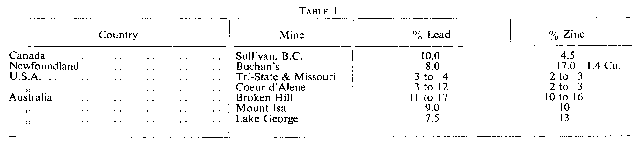
Some of the mines mentioned in this table also contain appreciable quantities of silver in their ores. All of these are in countries with higher wage standards than in Britain and they are jointly responsible for more than half the world's output of lead and zinc.
There are important lead-zinc producing mines in many other countries, some of which have lower wage standards than in Britain, but the market price of the metals can be said to be controlled by the output of the dollar countries, and of Australia where the wage standards are very high.
From the above figures it will be seen that there are wide differences even between mines operating in countries where both high and low grade propositions have to pay much the same rates for wages and services. Nevertheless they can compete and survive in the world market (probably with different margins of profit) owing to compensating differences in natural conditions which affect working costs.
Wide differences in grade and natural conditions will also be found in British mines affecting the cost of production of the metal, but they will be not so wide as those existing between the huge massive sulphide replacement deposits of the Sullivan Mine B.C., and the shallow low-grade deposits in the limestones of the Tri-State and Missouri districts.
In Britain, deposits of the Sullivan B.C., or Broken Hill class have never been found; if they had been they would have been worked out long ago, because they lend themselves to rapid exploitation. There is, however, considerable resemblance between the "flats" of our Pennine mines and those of the Tri-State district, although the bulk of our lead has been won from fissure veins which are very numerous, although generally narrow.
The survival of the British lead mining industry for so many centuries has been due to the great number and widespread distribution of the veins and it is necessary to attempt to strike an average estimate for their grade in order to compare them with the standards set by the foreign mines previously mentioned.
Unfortunately the great majority of British mines ceased production long before modern systems of valuation and accountancy were introduced, and very few of those which have survived till recent times conducted systematic sampling of the veins in situ, or even of the mill-feed. In some cases we have records of the output of concentrates and occasionally of the tonnage milled, or dressed, but this was not the same as the tonnage mined owing to the practice of underground sorting and stowing of the "deads" or waste.
The system of employing miners on "tribute" was such an important feature of the industry that a short digression is worth while to describe it. By this system a "partnership" of miners were let a "bargain" to work a given place or stope for a period ranging from a month up to three months or longer. They were paid at an agreed price per ton for the dressed ore (concentrate) they produced, after deductions had been made for explosives, tools, lights, blacksmith, haulage to the shaft and milling. It was an excellent system from the point of view of the mine owner because his expenditure was to a large degree proportionate to his sales of mineral. From the miner's point of view it was not so good, because the vagaries of ore deposition were added to his other hazards. If his working became poor during the period of his bargain he might earn no wages at all or even run into debt. On the other hand some partnerships did very well and this supplied the necessary incentive to the others. On the whole the system worked well and produced a race of men who were keen to start ventures on their own, which occasionally led to small fortunes. Most of them had small farms which helped them over the bad times. It bred a tough and self-reliant community which did not queue up for doles when times were bad, but packed up and moved to the coalfields or overseas to the new mining camps, where their descendants are now so often the leading citizens.
An excellent description of life in a Pennine lead mining village in the 1870s is given in a recently published novel by Thomas Armstrong, titled "Adam Brunskill."
The underground sorting to which freshly broken ore was submitted increased the grade of the mill feed, although much ore was discarded which would be worth milling by modern methods. The system still prevailed at the Boltsburn Mine in 1907-9, when the writer worked there, but was being replaced by a system of contract work by measurement.
For the above reason, the returns for this mine, which are given in the G. S. Memoir "Geology in the Northern Pennine Orefields," although no doubt accurate, are misleading.
Summary of the grade of the ore from British mines
Broadly speaking the grade of the veins in the Pennine limestone mines has been higher than that of any of the numerous districts, where the veins are in Ordovician or other Palaeozoic rocks and of the Pennine Mines it is probable that the Derbyshire mines were richer than the Northern Pennine areas. The Derbyshire mines are older and the records fewer because the greater part were worked by small proprietors.
Nevertheless Derbyshire has possessed the richest British lead mine of all time in the Mill Close Mine, which ceased operations only 13 years ago, and there are accurate records for this mine.
The Boltsburn Mine in Co. Durham, already mentioned, belongs to the Northern Pennine area and although closed since 1931, it maintained long and steady production over many years through wide variations of metal prices.
At the Boltsburn Mine, it is recorded that from 1901 to 1931 513,609 tons of ore were "mined" (i.e. hoisted and milled) for a yield of 17.4 per cent, of lead cones, averaging 77 per cent. Pb. Allowing for 80 per cent, mill recovery this is equivalent to 16.7 per cent. Pb., and on the supposition that 25 per cent. of the ore broken was sorted underground the average grade of ore in the vein or flats was about 12½ per cent. Pb.
This mine had a good record of production by the standards of the 19th century over a long period, but it was remarkable more for the continuity of the deposits than for exceptional grade, although this was high. It must always be remembered that the vagaries of the metal market were met by selective mining and the metasomatic nature of the ore-bearing flats led to wide variations of grade in the ore, not all of which would pay to work when metal prices were low.
The majority of the mines in the Northern Pennines worked ordinary fissure veins with "ribbon" type ore-shoots of great continuity, and it was customary to describe their grade in terms of "cwt. of ore per square fathom." This implied the yield in cwt., of concentrate per square fathom of vein without reference to its width, although normally this would be 3 ft. to 4 ft. The estimates were not made by sampling and assay, but by visual examination by the "agents," who were engineers of life-long experience often gained in the hard school of the "tributers." Their estimates were generally remarkably accurate, although this did not always apply to the statements in the Press where the state of the mines was recorded.
It was the custom to estimate that a continuous rib or band of galena in a vein would produce 11½ cwt. of dressed ore per square fathom stoped, for every inch of thickness of the galena.
In their payable parts, the veins were considered to be moderately good if they yielded 20 cwt. of dressed galena per square fathom after allowing for 20 per cent, loss in milling. This would be equivalent to about 10.5 per cent. Pb.
It is reasonable to believe that this grade (10½ per cent. Pb.) represents the average of the Northern Pennine veins where they have been worked in the past. Some were much richer and others much poorer but this is the grade we may reasonably expect in the future if new ground is opened up on a scale large enough to embrace a number of veins.
Further south, in Derbyshire, which is generally reputed to have been the richest lead mining field of Britain, we find fewer reliable records of the grade of the ore than in the Northern Pennines, with the single exception of the Mill Close Mine.
The reason for this lack of records in Derbyshire lies to a large extent in the system which prevailed (and still survives) whereby individuals or small companies of working miners could take up claims on the areas where the minerals are owned by the Duchy of Lancaster. The workings were regulated by special Mining Laws which are still in force and resemble closely those which prevail in the gold "diggings" in new countries. In fact, it is probable that the new countries based their laws to a large extent on the systems which had been evolved in parts of Britain and Germany.
Excepting for the records of royalty ore collected, there is not much useful information to be derived which would help in estimating the average grade of the veins, because there are no records of the tonnage broken in the workings.
With the exception of the mines located on land of private ownership the records state only the tonnage of ore (concentrate) weighed off for royalty purposes and this is often of doubtful accuracy owing to the universal dislike by diggers for disclosing their winnings.
Nevertheless an approximate estimate of the grade of the ore milled can be made by sampling and assaying the old heaps of hand-jig tailings and assuming that the value of the lead in these represents about one quarter of that in the original ore. The result cannot be regarded as anything but approximate because it takes no account of the large proportion of high grade lump galena which was sorted out by hand.
On the average, these old dumps will be found to contain from 2 per cent. to 3 per cent. Pb. This has been proved by a large number of assays done in many places for the purpose of finding the fluorspar contents — sulphides being objectionable in fluorspar. By this method of estimation the average grade must have been from 8 per cent. to 12 per cent. Pb. but in view of the fact that the best ore was not jigged at all, we can safely accept the higher figure.
As an example of a high grade Derbyshire lead mine, we can take the Mill Close Mine for which accurate records are available, because it was at work until 1940. Admittedly it stands in a class of its own, at any rate within the memory of man or records — that is to say, for the past 200 years — but it is also the only mine which explored ground far below the local water level to depths never before reached.
Mill Close Mine during the last 20 years of its life — it was about 200 years old when it closed — recovered about 250,000 tons of 82 per cent. Pb. concentrate from 1,000,000 tons milled. Allowing for mill losses this is equivalent to about 25 per cent. Pb., and may be taken as the average grade of ore mined because there was little underground sorting. This places Mill Close among the world's richest lead mines. Its grade is about double that obtained from the tailings estimate so it is probable that the Derbyshire average will lie somewhere between 12 per cent. and 25 per cent. Pb.
When estimating the value of the ore mined it is necessary to take into account the production and sale of other minerals which are mined with the lead ore. These are more important in the Pennine mines than in some of the other mining districts of Britain.
The first to be considered is zinc blende. From past records it seems that the average zinc content of the veins is not more than 1 per cent, to 1.5 per cent., but in individual mines the grade was considerably higher than this. In some cases, notably Alston Moor and Allendale, the zinc content was much higher than this, but it rarely exceeded the lead, and the output of this metal is unlikely to assist the competitive position of the Northern Pen nines as a whole unless more important discoveries are made in the future than in the past — and it has been a long past. In this area, zinc production is not likely to be more than a useful side-line at a limited number of mines.
The present high price of zinc, compared with pre-war, is misleading and not fully reflected in the selling price of the concentrates. For example, a concentrate with 50 per cent. Zn does not sell for more than about 33 per cent. of the value of the metal content.
It is noteworthy that in the past, the most active mining for zinc both in England and Wales was conducted by smelting firms who produced the finished metal, because no single mine or group of mines in Britain was likely to produce enough concentrate to keep a smelter busy. Zinc smelters buy their ore from many sources and this gives them an advantage over mining companies which produce only the concentrate. Possibly in the course of time, the long predicted base-metal famine will arrive and the zinc mining companies will be able to demand a fairer price. Although zinc is unlikely to contribute very much to a general revival of the Pennine mining industry, increasing benefits will come from the production of fluorspar and, to a less extent, barytes.
Fluorspar, which finds its largest use in the steel industry as a flux, is in demand for an increasing number of purposes in other industries, and is one of the few minerals which Britain does not have to import. In fact, until recently, it was exported to the U.S.A.
The plentiful supplies and low cost of fluorspar in Britain have been due to the immense number of old waste "hillocks" or dumps at the Pennine lead mines, particularly in Derbyshire, which is very near Sheffield. The Weardale district in Co. Durham has also produced much of this mineral for the Tees-side steel makers but this has mostly been won by renewed mining in the old lead mines. With the rapidly exhausting production from the Derbyshire hillocks an increased quantity will in future have to be freshly mined, and lead mines in which the ore contains sufficient spar to be worth recovering will obtain substantial benefit.
In addition to fluorspar, many of the Pennine mines have barytes, calcite and limestone as gangue to their lead ore, all of which have a market. In fact, there is little of the vein stuff which cannot find a ready market owing to the proximity of the great industrial areas of the North of England. These conditions improve the competitive position of the mines when selling lead in a world market in many cases it will be equivalent to adding 2 per cent. or 3 per cent. Pb. to the grade of the ore.
For some unexplained reason the ores which are richest in lead are often poor in fluorspar and vice versa. This provides a natural compensation for poverty to such an extent that there are mines now working at a profit on fluorspar ores containing less than 1 per cent. Pb. — whereas a mine with 10 per cent. Pb, in its ore should not require by-products to be profitable.
There are many abandoned mines whose extensive dumps give proof of active lead-ore production in the past and at the same time contain sufficient fluorspar to render them marketable in their present condition without further concentration. This shows that many veins contain a large proportion of fluorspar and at the same time far richer galena than is found in the fluorspar mines now working.
The reason why no lead-rich veins have been worked in recent times for fluorspar is because a number of easily accessible deposits were available in which there is abundant fluorspar but insufficient galena to attract the old lead miners. With such deposits remaining intact there has been no reason for going to the expense and risk of re-opening the more extensively worked and richer lead mines.
The high price now obtained for the better grades of fluorspar is a comparatively recent development and is largely the result of the exhaustion of the old Derbyshire "hillocks" which have for so long been the mainstay of the British fluorspar output.
Any lead mine of the future which has in its veins a moderate grade of galena plus sufficient fluorspar to be worth extracting, will reap considerable benefit from the important by-product and by being able to work economically fluorspar veins with low lead contents it will greatly enhance its ability to explore veins which may well lead to important lead discoveries.
Barytes and witherite make an important contribution to the mineral output of the Pennine areas and are likely to continue to do so but, based on past experience, they are not likely to help any major revival of lead mining. This is because they occur mainly in the upper and outer mineral zones of the non-ferrous fields and are removed from the emanative centres.
The barytes zones are either located on high ground where the veins have been easy to locate and work and the associated lead ores have long since been worked out, or they are found in the Coal Measures of Co. Durham, filling fault fissures in certain collieries with a lead content less than 1 per cent. Possibly these fissures may contain more lead at greater depth but there is little likelihood at present of the fissures being followed down to depths where galena forms an important fraction of the ore.
To sum up the competitive position of the Pennine mines, it can be said with confidence that taken as a whole and based on their past and present history and records they can compete in the British market with any overseas source, provided fresh reserves of ore can be found. This possibility will be discussed later.
The Pennine districts have, in the past, proved to be richer and more extensive than any other in Great Britain and Ireland and they possess the additional advantages of marketable by-products and proximity to consuming areas.
The important district of Flintshire should be included in the Pennine class on account of its geological similarity. In this district the grade of ore has been much the same as in the Pennines, but there is no fluorspar as a by-product, although in recent years an important sideline has been developed in the from of ground limestone.
These two districts in the Carboniferous Series which, during the past 100 years have been responsible for over 60 per cent. of the British lead production, are more likely to witness an important lead-mining revival than the Ordovician or older geological districts because their ore-shoots tend to conform to the stratification of the country rocks in which they occur, and the angle of pitch of these ore-shoots is less than that commonly found in the steeper ore shoots in most of the Ordovician veins
For this reason a greater tonnage of ore-reserves is likely to be found at relatively shallow depths.
Nevertheless, when assessing the grade of ore in Britain lead mines the important contributions from districts where the veins are in rocks of pre-Carboniferous age, cannot be overlooked. These districts are numerous and it would be impossible to describe them all in detail in this article. They have possessed some famous and important mines in the past, and as already mentioned, the Greenside Mine in Cumberland is the only mine now working in Britain which has a record of continuous production for over a century. This mine is in rocks of Ordovician age.
Regarding the average grade of the ores which have been mined in the past from mines in pre-Carboniferous rocks, this presents an even more difficult problem to make an estimate than is the case with the Carboniferous mines.
Taken as a whole one can say that the lead contents were lower, the zinc contents higher and the silver, which is recoverable from the lead, a good deal higher. Regarding non-metallic by-products, as a rule they have not produced much fluorspar, but in certain districts there has been an important production of barytes.
Nevertheless, it is in a pre-Carboniferous area that we have found the only records which compare the tonnage mined with the concentrate produced. According to estimates published in Trans. Roy. Geo. Soc. of Cornwall, Vol. XII, 1903, by J. H. Collins, in the lead mines of Cornwall and Devon 586,667 cu. fathoms were mined for a yield of 560,000 tons of dressed lead ore. This is equivalent to about 5 per cent, of the total weight of ground excavated. This was low grade for galena but its average silver contents amounted to 40 oz. per ton of lead, which would be an important additional product. There was also some zinc ore and to judge from the Welsh mining districts, the output of zinc would equal in tonnage that of lead.
The pre-Carboniferous mines have had some abnormally rich orebodies which have become famous in the industry, possibly on account of the contrast with the average. To quote examples. we can mention the Comet Lode at Cwm Ystwth in Cardiganshire, the Van Mine in Montgomeryshire, or the Foxdale in the Isle of Man. At the last mentioned, it is recorded that the lode averaged 10 ft. to 15 ft. wide down to the 70 fathom level, it gave an average yield of 15 tons of galena per square fathom, and was as rich as the "best veins seen in the Spanish mines." As a rule, these bonanzas took the form of rich pipes at vein junctions and were soon worked out. They served, however, to build up reputations which enabled speculators to reap a richer harvest in the share market.
We hear less about rich strikes being made in the Pennine and Flintshire mines, possibly because private or family ownership was far more common, and the public company ownership which was customary in Wales and Cornwall did not prevail to the same extent.
There were many instances of sharp practice in the Welsh and Cornish areas where the London financier was looked on as fair game; and who can blame the Welsh and Cornish when the London financier was playing just the same game in the share market? The Pennine areas were more free from this kind of enterprise, not because the north countryman is more honest (as anyone who has attempted to buy a horse in Yorkshire will know) but because the mines were owned by small local syndicates who knew what they were about, or by the great landowners who worked their own mines, or large combines such as the London Lead Company.
Nevertheless, in spite of the absence of high sounding names such as "The Welsh Potosi" the Pennine mines have had records of steady production and high average grade which cannot be equalled by any of the other districts excepting perhaps, the limestone mines of North Wales.
It is now possible to summarise in terms of lead and zinc, the average grade of ore to be expected from base metal mines in the U.K. if new reserves can be located which are equal to those which have been worked in the past.
The numerous other districts in Great Britain and Ireland do not differ from those in the table below to a degree which would affect the national average, and the figures can be taken as representative when comparing our mines with those overseas. The comparison shows that for lead, our mines have compared well with those overseas which are now supplying our markets, although our ore deposits are individually much smaller. Regarding zinc, our grade has been a good deal lower than that of the important overseas mines, but as compensation we are better placed for non-metallic by-products.
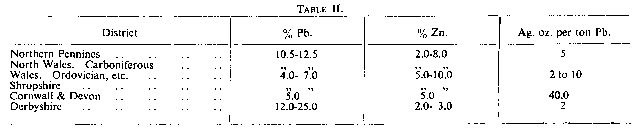
From the foregoing review it is clear that the average grade of ore produced by British lead mines in the past has been sufficiently high to justify the belief that it could nowadays compete with the overseas sources and our best mines would be classed as high grade anywhere in the world.
British mines have a great advantage denied to those overseas, of being closer to their markets and, in addition the provision in Britain by public authorities of numerous services such as electric power, housing, roads and sanitation, etc., such as are not always available abroad, reduces considerably the capital outlay required to start operations. This is a very important advantage because it leaves more capital to be devoted to development.
In the future, the ability of British mines to compete in the open market will depend on :—
(a) Finding fresh ore reserves as rich as those of the past.
(b) The organisation, management and equipment being up to overseas standards.
(c) The existence of natural conditions making for low working costs.
The first of the above conditions is the most important and will present the greatest difficulties — it will be discussed in detail later. The second condition is largely dependent on the first because new discoveries of sufficient importance are likely to attract the attention of mining companies with the experience and capital resources required to ensure success. Regarding the third requirement, the natural conditions which prevailed in the past, in the majority of our mines, would be considered excellent by overseas standards.
Drawings and Photographs accompanying the article


Article reproduced from a copy of the magazine held at National Mining Museum Scotland, Newtongrange, Midlothian.




 Contains public sector information licensed under the

