


|

|

|

|
|
 |
 |
|||
Safety Lamps
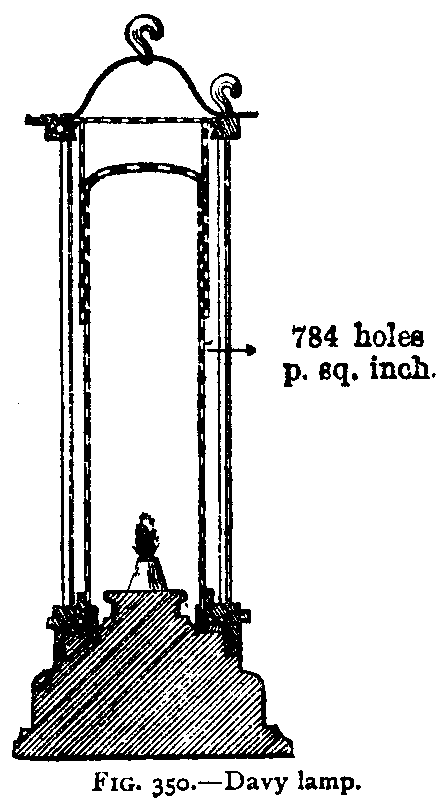 Davy Lamp. – The Davy lamp (see Fig. 350) consists, therefore, of an ordinary oil-lamp covered with a cylinder of gauze about 1½ inch in diameter and 7 inches in length. The top of the gauze is covered over with a second cap. The wires are about 1/50 of an inch in diameter, and there are 28 parallel wires in an inch, forming 784 apertures in a square inch; the area of opening is thus less than 1/5 of the area of the gauze. Through these openings the air can freely enter so as to produce a good flame; but if gases should enter with the air, and, taking fire, fill the interior of the lamp with flame, as soon as this flame touches the gauze it is instantly cooled, and therefore cannot pass outside. Should a current of burning gas be kept against the gauze it will soon get hot, and the flame will pass, and the stronger the current of burning gas the more rapid will the heating of the gauze become; so that, whilst the Davy lamp is safe in a place where there is no current for a short time, it is unsafe in a current or if held in inflammable gas for more than a few minutes. The time required for the gauze to cool the flame is evidently only a very little time; but if the wires were made thinner without being placed closer together, the flame would have a less distance to travel in passing through the apertures, and less time would be occupied; and if the wires were too thin there would not be sufficient time for cooling, or, if the flame were projected with great velocity against the gauze, there might not be sufficient time to cool it before it passed through. Thus a sudden shock, as of an explosion, may sometimes cause the flame to pass through the gauze. If the lamp is suddenly lifted into gases, there will be an explosion inside the lamp; for that reason the lamp should never be intentionally raised rapidly in a mine. The effect of the explosion is to force the burning gases inside the lamp against the gauze. The larger the lamp the greater the force of the explosion, and if the lamp were too large, the explosion would force the flame through the gauze; for that reason the diameter of the gauze must never be larger than 1½ inch. If part of the gauze is taken away, and glass or solid metal substituted, then, in case of an explosion inside the lamp, the gases have a less area of opening through which to escape, and must therefore go more quickly, and there is a danger of the flame being forced through the gauze; so that the proportion between the contents of the lamp and the openings in the gauze through which the heated gases may pass must be observed. The Davy lamp is not perfect for several reasons. It will freely burn in an explosive mixture until it is red hot, and then it will ignite the external gases. The flame readily passes in a current exceeding 6 feet a second, and sometimes in a current of less speed, even 4 or feet a second; and the light it gives is very poor, owing to the fact that of the cover is opaque wire, and less than 1/5 opening. The wire pillars that unite the lamp top and bottom, together with the oil-pot and the top to which the suspending ring is attached, also diminish the light, so that the illumination produced by a Davy is between 1/13 and 1/30 of that given by a standard sperm candle. |





 Contains public sector information licensed under the

