


|

|

|

|
|
 |
 |
|||
Safety Lamps
 In the last century coal-mining was a comparatively small industry, and the methods of dealing with noxious gases but imperfectly understood; ventilation was frequently defective, so that accumulations of gas were very common. Experience having taught the miner the danger to be encountered on entering the mine with a candle, it became a practice in some parts to send in a man of bold and resolute character, wrapped in damp clothes, with a light at the end of a pole, with which he could set fire to accumulations of explosive gases, and thus render the place comparatively safe for the collier. These men received the appropriate name of “firemen,” a title which is still given to the deputy who searches for gas at the present day. Other methods of working in mines containing explosive gas were attempted, such as the faint illumination given by the phosphorescence from the scales of fishes’ skins, or the sparks produced by holding a piece of flint against a rapidly rotating wheel of steel.
Several ingenious lamps were tried by Humboldt, Dr. Clanny, and George Stephenson, but the first thoroughly good safety-lamp was invented by Sir Humphrey Davy in 1817. The Davy lamp now in use only differs in comparatively unimportant details from that constructed seventy-five years ago. The principle of the lamp is as follows: The flame is due to the union of gas – produced by heating the oil – with oxygen from the surrounding atmosphere. This union will not take place unless the temperature of the uniting gases is 1500° Fahr.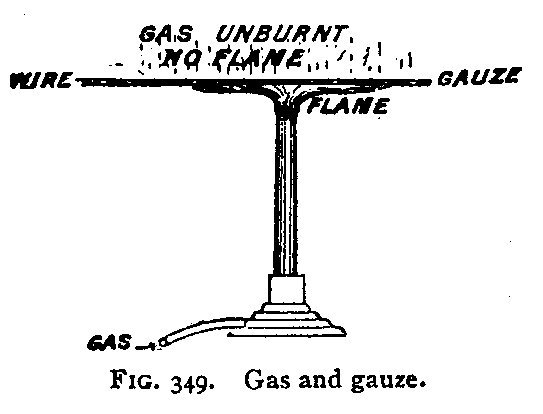 If a gas-flame is brought in contact with a cool material, the flame is extinguished, and the gases pass away unburnt. This may be tested by holding a wax match against a cold poker, when the size of the flame will be greatly diminished. If, instead of a thick bar of iron, a number of small wires, woven into a gauze, are placed over the flame, the gases will pass through, but not the flame, because the gases are cooled by contact with the gauze. That the gas has passed through the gauze may be easily proved by lighting it with a match at the upper side (see Fig. 349). That the stoppage of the flame is due to the cooling action may be proved by holding one part of the gauze in the hottest part of the
flame until it is red hot, when the flame will pass through, and the gas above will burn.





 Contains public sector information licensed under the

