


|

|

|

|
|
 |
 |
|||
Sinking
Blasting. – For blasting, a drill, perhaps, is used 6 to 10 feet long, made of iron or steel; if the former, with a steel end. The
bit will be inches wide to drill a hole 3 inches in diameter if gunpowder is to be used. If dynamite is used, a bit 1¼ inch wide will be sufficient, although 2-inch holes are sometimes used for dynamite. One or two men will take hold of the drill (see Fig. 126)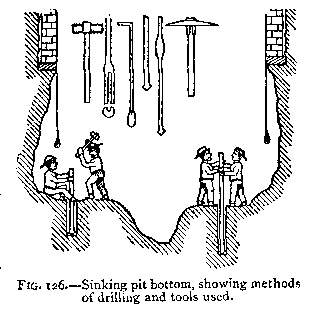 , lifting it up and down and striking blows at the bottom, turning the drill between each stroke, pouring water down the hole to assist the action of the chisel, and cleaning the hole of sludge with a scraper. For hard ground a shorter drill is used, which is struck by a hammer, one man holding the drill and turning it whilst the other strikes, and sometimes two men strike. "Sumpers" are generally drilled at an inclination of from 15° to 35° from the vertical, and side shots perpendicular; single shots are seldom drilled much deeper than 3 feet in hard ground, though in soft ground they may reach 4 or feet. The miner sets a shot say in the centre of the pit, and the blast breaks up the rock around the hole, which, when cleared away, forms an excavation. Shots are now set round this first excavation to break off the sides until the whole width of the pit is extracted. Great judgment must be displayed in selecting the place for the holes, and the direction and depth of the boring. Frequently three or four shots are drilled and charged together, the fuse of each being lighted at the same time, but they are so arranged as not to go off simultaneously, owing to the difference in length of the fuse from each hole; so that the separate detonations of the shots can be counted, and the miners know if any have missed fire. Sometimes a number of shots are exploded simultaneously by means of electrical blasting. Fig. 127
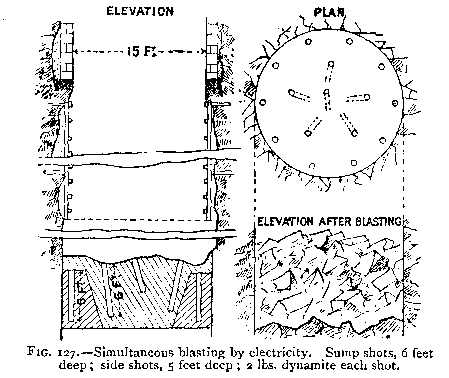 shows the plan and section of a pit. Six holes are shown in and near the centre; these are the "sumping" shots, and are drilled to a depth of 6 feet; they are each charged with 2 lbs. of dynamite, and their simultaneous discharge blows up the whole centre of the pit, as indicated in the section. When the dirt from this discharge has been cleared away, ten more holes are drilled round the sides, as shown in the plan; and they are each charged with 2 lbs. of dynamite and discharged simultaneously, breaking off the sides, and filling up the pit with debris as indicated in the sketch.
The ordinary method of charging a blast-hole is shown in Fig. 128.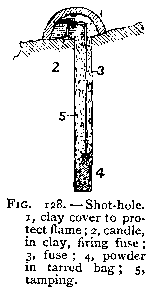 If gunpowder is used, the hole must either be made dry by putting in dust, which, when cleaned out, takes away the water, or else the powder must be in a waterproof cartridge-case – such a case is sometimes made of paper and sometimes of calico. The end of the fuse is put in the middle of the powder, and then the neck of the bag or case is tied fast round the fuse. Melted pitch may then be placed all over the bag and over the junction with the fuse; when this is dry it makes a good water-proof cartridge. The cartridge with the requisite length of fuse attached, say 4 or feet, is lowered to the bottom of the hole, against which it is pressed with a scraper. Pounded shale or clay, dry and not gritty, is then pushed into the hole, and gently pressed, and very gently rammed upon the cartridge; more stuff is pushed in and rammed rather harder; small hits are put in and rammed. When about 8 inches of ramming is put in, the ramming is still harder. The rammer is generally made of iron, with a copper or brass end, or else it is entirely of brass. The hole is tightly rammed up to the top. When all the holes it is intended to fire, say three, four, or five, are rammed, the fuse is bent across a candle, which is not lighted. The tools are all sent out of the pit, and all the workmen go out but one or two. A signal is given to the engine-man when a blast is about to be lighted; the short pieces of candle under each fuse are then lighted; the man jumps into the hopper and signals the engine-man, and is immediately drawn up. The candle burns through the exterior covering of the fuse until it lights the powder in the fuse. As soon as this is lighted a fizzing is heard, and the fuse is said to have "struck." The miner is landed at the top, and the bridge drawn over, and the number of explosions counted, so that the sinkers may know that every shot has exploded before they descend. If the rock is hard, fragments may be thrown to a great height. If dynamite is used, a waterproof cartridge-case is not necessary, as a short immersion in water will not injure the dynamite; it is also not absolutely necessary to put in any ramming, or "tamping," as this ramming is called, because, owing to the great velocity of the explosion, water in the hole constitutes sufficient tamping; but, as a rule, tamping is employed, better results being obtained, although it is not necessary to ram so hard. The same kind of fuse is employed as for gunpowder. The dynamite does not explode with a simple flame or spark; it is necessary to employ an explosive cap to light the dynamite. This is a copper cap with fulminate of mercury; the fuse is slipped into the cap, which is squeezed tight with a pair of nippers, and some grease is put over the end of the cap to prevent water getting in, which would destroy it; the cap is pushed into the middle of a piece of dynamite. Dynamite is about three times as powerful as gunpowder, so that 2 lbs. of dynamite will do about as much work as 6 lbs. of powder.





 Contains public sector information licensed under the

