


| Whitwell Colliery | Index | Whitwell Colliery | ||
 |

|
 |
||
Whitwell Colliery
 |
 |

|





|
|
|
| Location: | Whitwell 2½ miles [4 km] ESE of Durham |
| Map Ref: | (Sheet 88) NZ308407, 54° 45' 37" N, 1° 31' 17" W |
| Maps: |  1898 map from Reid's Handy Colliery Guide |
| Opened: | 1836 |
| Closed: | 1875 |
| Pits: | A Pit, locn: (Sheet 88) NZ245403, sinking: 02 May 1836 |
| Shaft details for A Pit |
|
| B Pit, locn: (Sheet 93) NZ312396, opened: 1838, sinking: 1838 | |
| Shaft details for B Pit |
|
| C Pit, locn: (Sheet 93) NZ310399, opened: 1855, sinking: 12 Nov 1855 | |
| Shaft details for C Pit |
|
| Owners: | 1730s - Abraham Teasdale & Mrs. Ann Wilkinson |
| 1830s - Andrew White | |
| 1850s - J. M. Ogden | |
| Output: | 1855 - Coal. |
| 1860 - Coal. | |
| 1865 - Coal. | |
| 1873 - Coal. | |
| Employment: | 1854 - 0 [Working] |
| 1882 - 0 [Standing] | |
| 1883 - 6 [Standing] | |
| Catalogue of plans of abandoned mines for Whitwell Colliery |
|
| Notes: | 1836, May 02 - Commenced to sink from the surface the A Pit, Whitwell Colliery. Got the Hutton Seam on 21 June, 1837. |
1837, Jun 20 - The workmen engaged in sinking Whitwell colliery, Durham, after thirteen months labour, succeeded in reaching the Hutton seam, at a depth of 59 fathoms. Much rejoicing took place in consequence of the event. |
|
1838 - The B Pit, Whitwell Colliery, was sunk from the surface to the Hutton Seam. |
|
1841 - A bore-hole was put down below the Hutton Seam, proving lower coals in the A Pit, Whitwell Colliery. |
|
1855, Nov 25 - Commenced to sink the C Pit, Whitwell Colliery ; reached the Main Coal Seam on 26 December, 1855, and Low Main Seam on 24 March, 1856. |
|
1873 - Boring operations were being carried out on the Whitworth estate, near Durham, near the Whitwell Colliery, proving the Low Main Seam. |
|
1884 - Main Coal, Low Main and Hutton seams abandoned |
|
|
|
|
|
|
|
Description
This colliery is situated near the Durham and Sunderland Railway, about 2½ miles southeast from the city of Durham, and commands a splendid view of the beautiful cathedral, the castle, and the surrounding scenery of that ancient city. It comprises the whole of the extra-parochial place or township of Whitwell House, the property of the Master and Brethren of Sherburn Hospital, and is held by lease for three lives by John Gregson, Esq., of Shotton Hall. The colliery is carried on by the Messrs. Whites, Robson, and Ogden, under the firm of the Whitwell Coal Company, who lease it of Mr. Gregson for a term of years. The sinking of the A pit was commenced on May 2, 1836; and the Hutton seam was won on the 20th June, 1837, at the depth of 59 fathoms. The sinking of the B pit was completed to the Hutton seam, at the depth of 65 fathoms, in 1840. There are three workable seams in this royalty, all of which are of excellent quality.
The coals are called, in the market "Whitwell Wallsend," and are produced from the Low Main and Hutton Seams; the High Main having been worked to a very slight extent since the opening of the colliery in 1837. There are two engines on the A pit; one of 100 horse power for pumping water, and the other of 45 horse power for drawing the coals out of the mine. The engine used for drawing the coals from the B pit is of 36 horse power. The coals are transmitted by the Durham and Sunderland Railway, a distance of 14 miles, to drops at the latter place. The first were shipped on November 6, 1837.
The village of New Durham, situated about a mile east of the city, was built in 1836-7, for the workmen of the colliery. It consists of upwards of 200 dwellings, and, with two or three exceptions, is entirely occupied by parties employed about the establishment.
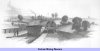
Views of the Collieries (1844)
Coal was extensively worked in this township [Whitwell], and was known in the market as "Whitwell Wallsend." The "Hutton" seam was worked at a depth of 57 fathoms, having been commenced as early as 1836 ; and in 1840, at a depth of 95 fathoms, the "Low Main" was worked, but all operations ceased about 1875.
The village of Whitwell Grange is now almost deserted, and the colliery plant and buildings have fallen into complete ruin. The few houses that are occupied are inhabited by the pitmen employed at Sherburn House Colliery.
Whellan's 1894 Directory of County Durham
|
|
|
|
|
|
|
Disasters (5 or more killed)
None Found
|
|
|
|
|
|
|
Names of those killed at this colliery
Please note that this collection of names is by no means complete!

 |  | Ainsley, Robert, 21 Mar 1846, aged 33, Robert Ainslie, 33, and some others were descending Whitwell Pit shaft early on Saturday, 21 March, to go to the Hutton Seam. When the cage had been lowered as far as the Low Main Coal seam, it was stopped to let out one or two men and take in Ainslie's father. When this had been done, the brakesman was told to let them down. The cage eventually stopped, allowing the men to get out, but as Ainslie stepped out it slipped and he fell 16 fathoms to the bottom of the shaft. His body was recovered and he was found to have broken his neck. At the inquest, it was said that : "The accident was occasioned by some ice in the slides not allowing the cage to run freely." | ||||
| | Ainsley, William, 21 Jul 1851, (accident: 15 Jul 1851), aged 35, he was severely injured at Whitewell Colliery on 15 July when a large stone fell from the roof onto him. His right leg was extensively damaged and fractured; he died from his injuries on the 21st | ||||
| Beasom, Ralph, 27 Jun 1859, aged 24, Shifter, killed by a fall of roof | |||||
| Cook, Matthew, 21 Nov 1870, (accident: 02 Nov 1870), aged 38, Stoneman, explosion of gunpowder | |||||
| Dent, Charles, 02 May 1861, aged 23, Hewer, killed by a fall of stone | |||||
| Grey, Robert, 02 Oct 1860, aged 25, Onsetter, fell from cage in shaft | |||||
| Hovern, Robert, 09 Apr 1863, aged 61, Hewer, killed by a fall of stone | |||||
| Maddison, Ambrose, 16 Mar 1853, aged 51, killed by a fall of roof [More information ...] | |||||
| | McCoy, Michael, 24 Apr 1856, he was engaged in leading water out of a hole when a large stone fell from the roof and killed him instantly | ||||
| McDermot, Michael, 20 Aug 1873, aged 13, Putter, crushed between two tubs | |||||
| McDermott, Michael, 17 Jul 1858, aged 45, Labourer, killed by apparatus tub | |||||
| | Pattison, Isaac, 06 Mar 1853, (accident: 25 Feb 1853), he had been blasting stone when a shot unexpectedly exploded, throwing him violently to the ground. His skull was fractured and he died on 6 March | ||||
| | Roberts, Isaac, 28 Aug 1857, he and his marrer were hewing when a large stone fell from the roof and injured Roberts' back, he died an hour after being taken home | ||||
| Slater, William, 16 Mar 1853, aged 47, killed by a fall of roof [More information ...] | |||||
| | Snowdon, Story, 10 Dec 1851, aged 28, while at work at the top of the staple he was putting a tub of coals in the cage when it fell down the shaft pulling him with it to his death | ||||
| 15 names found | ||||||
If you know of any fatalities missing from the above list then please contact us with the details and we will add them to our database.
Those names marked with ,
have a web page providing individual details of the accident, the page may
also include a photograph of the deceased.
Click on the symbol
next to the name to see the web page.
Some of the names of mining fatalities on this web site have been kindly provided by
Jim Grainger from his research into early newspapers (primarily the Durham Advertiser
and Durham Chronicle) and are marked with
.
more information on some of the fatalities shown above
The following unnamed fatalities are listed in the Mines Inspectors Reports, once again this collection is not complete!
| Date |  |
 |
 |
 |
 |
 |
Inspectors Remarks |
|---|---|---|---|---|---|---|---|
| 02 Jun 1851 | – | 1 | – | – | – | 1 | Error ; should be fall of stone |
| 22 Oct 1852 | – | – | – | 1 | – | 1 | |
| 06 Mar 1853 | – | – | – | – | 1 | 1 | blasting the coal |
| 01 Aug 1854 | 1 | – | – | – | – | 1 | in shaft |
| 21 Sep 1855 | – | – | – | 1 | – | 1 | |
| 22 Nov 1855 | – | – | – | 1 | – | 1 |
|
|
|
|
|
|
|
Collieries and Pits within 5 miles (8km)
a simulated map showing the immediate vicinity of Whitwell Colliery
list of collieries/pits etc. near to Whitwell Colliery
|
|
|
|
|
|
|
Gallery Images:
|
|
|
|
|
|
|
Credits
Sources:
- 1854 List of mines by T. Y. Hall, published in Vol II (1853-4) of the Transactions of the North of England Institute of Mining Engineers
- 1858 Mines Inspectors Report, Southern District by John J. Atkinson, H.M. Inspector of Mines
- 1859 Mines Inspectors Report
- 1859 Mines Inspectors Report, Southern District by John J. Atkinson, H.M. Inspector of Mines
- 1860 Mines Inspectors Report
- 1860 Mines Inspectors Report, Southern District by John J. Atkinson, H.M. Inspector of Mines
- 1861 Mines Inspectors Report, Southern District by John J. Atkinson, H.M. Inspector of Mines
- 1863 Mines Inspectors Report, Southern District by John J. Atkinson, H.M. Inspector of Mines
- 1870 Mines Inspectors Report (C 456) Where to find this report
- 1873-4 List of Mines - Government report from the Mines Department
- 1873 Mines Inspectors Report (C. 1056), South Durham, Westmoreland, and Cleveland District by James Willis, H.M. Inspector of Mines Where to find this report
- 1881 Mines Inspectors Report (C 3241)
- An Account of the strata of Northumberland & Durham as proved by Borings & Sinkings, Volume U-Z, published by the North of England Institute of Mining & Mechanical Engineers, 1897
- Banners of the Durham Coalfield, Norman Emery, 1998, Sutton Publishing Ltd., ISBN 0-7509-1708-3
- Contributions by members of the Public
- History, Topography, and Directory of the County Palatine of Durham by Francis Whellan. Second edition published in 1894.
- Local Records or Historical Register of Remarkable Events by John Latimer, published in 1857
- Mineral Statistics for 1855 (Memoirs of the Geological Survey of Great Britain, and of the Museum of Practical Geology), compiled by Robert Hunt, F.R.S.
- Mineral Statistics for 1860 (Memoirs of the Geological Survey of Great Britain, and of the Museum of Practical Geology), compiled by Robert Hunt, F.R.S.
- Mineral Statistics for 1865 (Memoirs of the Geological Survey of Great Britain, and of the Museum of Practical Geology), compiled by Robert Hunt, F.R.S.
- Mineral Statistics for 1869 (Memoirs of the Geological Survey of Great Britain, and of the Museum of Practical Geology), compiled by Robert Hunt, F.R.S.
- Mineral Statistics for 1883 - Government report from the Mines Department (C 4058), published in 1884 — includes List of Mines and Mineral Works
- Victoria History of the Counties of England – Durham. Published in three volumes in 1907.
- Views of the Collieries in the Counties of Northumberland and Durham by T. H. Hair. First published in 1844.
Pictures:
- Views of the Collieries in the Counties of Northumberland and Durham by T. H. Hair. First published in 1844.
|
|
|
|
|
|
|
Related Links:
| On this site | |
| | Newspaper articles |
| | Views of the Collieries in the Counties of Northumberland and Durham by T. H. Hair (1844) — Whitwell Colliery |
| | Pictures in the Gallery section for Whitwell Colliery |
Further Reading:
- Banners of the Durham Coalfield, Norman Emery, 1998, Sutton Publishing Ltd., ISBN 0-7509-1708-3, provides a brief history of the colliery along with the history of the associated Miners Lodge Banner
Further Research:
Research Notes for Whitwell Colliery



 Contains public sector information licensed under the

