


|

|

|

|
|
 |
 |
|||
Whitwell Colliery
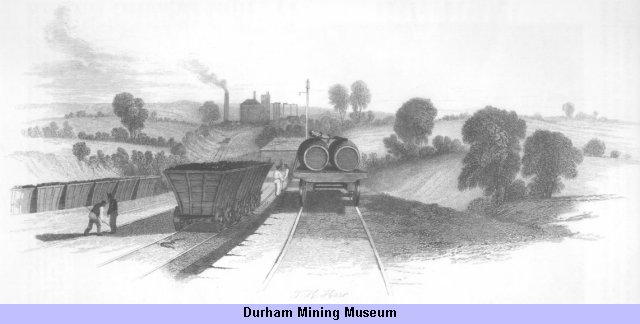
Whitwell Colliery
 This colliery is situated near the Durham and Sunderland Railway, about 2½ miles southeast from the city of Durham, and commands a splendid view of the beautiful cathedral, the castle, and the surrounding scenery of that ancient city. It comprises the whole of the extra-parochial place or township of Whitwell House, the property of the Master and Brethren of Sherburn Hospital,01 and is held by lease for three lives by John Gregson, Esq., of Shotton Hall. The colliery is carried on by the Messrs. Whites, Robson, and Ogden, under the firm of the Whitwell Coal Company, who lease it of Mr. Gregson for a term of years. The sinking of the A pit was commenced on May 2, 1836; and the Hutton seam was won on the 20th June, 1887, at the depth of 59 fathoms. The sinking of the B pit was completed to the Hutton seam, at the depth of 65 fathoms, in 1840. There are three workable seams in this royalty, all of which are of excellent quality, viz :—
| Feet. | Inches. | |
| The High Main, at 24 fathoms | 4 | 0 thick. |
| The Low Main, at 42 do. | 3 | 0 do. |
| The Hutton Seam, 59 to 65 do. | 4 | 6 to 6 feet thick. |
The coals are called, in the market "Whitwell Wallsend," and are produced from the Low Main and Hutton Seams; the High Main02 having been worked to a very slight extent since the opening of the colliery in 1837. There are two engines on the A pit; one of 100 horse power for pumping water,03 and the other of 45 horse power for drawing the coals out of the mine.04 The engine used for drawing the coals from the B pit is of 36 horse power. The coals are transmitted by the Durham and Sunderland Railway, a distance of 14 miles, to drops at the latter place. The first were shipped on November 6, 1837.
The Newcastle and Darlington Junction Railway, (now in course of formation, and which will complete the railway communication between London and Newcastle-upon-Tyne), passes through the royalty, and within a quarter of a mile of the A pit. By this railway the colliery will have the means of transit for its produce to the river Tyne, in shipment, where vessels are able to enter of a larger burthen than at Sunderland, and which is, in other respects, a superior port.
This colliery is almost entirely free from hydrogen gas or fire damp; and the accidents from other causes have been very few. One life was lost in sinking the A pit, and three others since the commencement of working the mine.
The village of New Durham, situated about a mile east of the city, was built in 1836-7, for the workmen of the colliery. It consists of upwards of 200 dwellings, and, with two or three exceptions, is entirely occupied by parties employed about the establishment.05
01 Founded about the year 1181, by Bishop Pudsey, for the reception of 65 poor lepers, a master, and other officers; and now containing 30 poor brethren, under the auspices of a master, who is appointed by the bishop, and must be a preacher, having no cure or charge of souls elsewhere. Several eminent men have held this office, amongst whom may be named the late Dr. Bell, founder of the Madras system of education. The present master is G. S. Faber, B. D., well known in the literary world as the author of several learned theological works. [Return]
02 The High Main seam, in the southern portion of the royalty was formerly wrought for landsale, on a scale which would be considered very small in this age of improvement. From a book in the possession of the present viewer, giving an account of the workings of the colliery for 1737, 1738, and 1739, it appears that it was then carried on by a Mr. Abraham Teasdale and Mrs. Ann Wilkinson. On exploring some of the old workings, in the High Main seam, in the year 1839, a quantity of work tools and other articles were found, of ancient date, also a pump which had been used for draining the dip workings, of very curious mechanism. From the position in which these articles were found, it appeared that the working of that part of the mine had been suddenly abandoned. [Return]
03 It appears from a return made in 1841 to the British Association for the Advancement of Science, that average quantity of water delivered per minute" was 380 gallons, and the "pounds lifted one foot high per ton of coal" were 145,920,000. [Return]
04 "The following statement, showing the extraordinary despateh used in drawing the coals out of the Whitwell Colliery, in the county of Durham, will astonish those unacquainted with mining operations — The engine upon the A pit, which is of forty-five horse power, has drawn from the Hutton or Wallsend seam, at a depth of 60 fathoms, in one day of twelve hours working, 1607 tubs, containing 8 cwt. of coals each; or a gross quantity of 642 tons 16 cwt.; which shews a despatch almost unparalleled in mining operations, when it is taken into consideration the time necessary for attaching and detaching the tubs at the top and bottom of the shaft, and the delay occasioned by the descending and ascending of the men and boys employed in the different departments of the mine. The engine draws one tub on each rope, and is 18 seconds in performing it, which is an average speed of 20 feet per second: the greatest speed attained by the tub in the shaft is 26 feet per second, or at the rate of 18 miles per hour — railway speed — Mining Journal January 21, 1843. [Return]
05 There are in the village two schools (boys and girls) conducted on the National System, the master and mistress of which are paid a salary of £30 per annum by the owners of the colliery. The children pay each one penny per week, and one halfpenny per week for books, &c. Two other day schools and and two Sunday schools are also carried on here; and the place supports two circulating libraries, the subscribers to which are supplied with books at the low rate of one halfpenny per week. A sick fund is supported by a subscription of 3d. per week, which entitles each member, in case of sickness, to an allowance of 5s. per week. — Return to Children's Employment Committee. [Return]





 Contains public sector information licensed under the

