


 |

|

|

|
|
 |
 |
|||

July, 1934
Static Dry Washer at Thornley Colliery
The Static Dry Washer process of coal cleaning was introduced in 1928 and has now been adopted at fifteen collieries, in Durham, Northumberland and South Wales. Its essential feature is its ability to treat coal usually below 2 or 1½ in. without prescreening or de-dusting and to produce, from suitable coals, a satisfactory clean coal product whilst rejecting a high ash refuse. The simplicity of the layout enables the process to be installed at a low capital cost, and, with the simple control required, the labour costs are low, whilst the excellence of the design keeps maintenance costs at a low figure.
The standards of purity of most of the coals to which it has been applied have become stricter during the last two or three years, and the process has proved flexible enough to be developed to meet these requirements. The plant has therefore successfully met the requirements of the problems to which it has been applied, one of the most important of which is the cleaning of Durham gas and coking coals.
In Durham, the field in which dry cleaning is used more than any other, the coals are friable and produce a large proportion of small coal, 70 to 75 per cent. below 2 in., which cannot be cleaned by hand. The general practice is to screen the run-of-mine coal at 2 in. or 1½ in. and to hand-pick the oversize, subjecting the undersize to a mechanical cleaning process, before remixing the two grades for sale as gas coal. The standard of cleanliness required has gradually advanced during the last few years, and the mixed product must now usually contain not more than 5½ to 6½ per cent, of ash. The degree of purity necessary in the mechanically - cleaned small coal depends to some extent upon the percentage of over 2 in. or 1½ in. and its ash content. The large coal can usually be handpicked to about 5 per cent. ash, but, as the proportion of smalls is so high, mechanical cleaning must reduce its ash content to about 6 or 7 per cent. At Thornley Colliery, where a special quality gas coal is marketed, the small coal must be cleaned to an ash content almost as low as that of the hand-picked large, and, since the ash content of the raw coal increases in the finer sizes, an efficient cleaning process is essential.
In the later Static plants erected certain improvements have been incorporated and have served to make them more flexible in dealing with a variable feed, in improving the cleaning performance for a given type of coal, and in simplifying the inspection and control of the plant. These improvements may be instanced in reference to the Thornley Colliery plant, which I have recently inspected. The Static process consists essentially in subjecting a thick bed of unsized coal in a perforated trough to the supporting effect of a static air pressure which has a critical value directly related to the thickness of the bed and its bulk density. Under such conditions the bed distends by approximately 20 per cent., the separate particles attaining a degree of freedom which enables them to tend to stratify according to specific gravity, the heaviest particles sinking to the bottom. The use of an unsized feed containing a large proportion of fine coal gives a bed of high resistance to air passage, and indeed the conditions are carefully chosen to minimise air leakage. If pressures slightly higher than the critical are used, the bed is disrupted or it is said to "pipe and boil" It is therefore important to preserve a uniform depth of bed to avoid local disruptions and the trough is reciprocated at a rapid rate, namely, 400 impulses per minute, the stroke being ½ in. The motion of the deck affords very little, if any, propulsive effect to the bed of coal, for the deck is declined from the feed to the discharge end and the flow of coal can be obtained without any deck motion. The deck motion being required only to preserve a uniform depth of bed of coal, it must be smooth. This is ensured by the use of a drive which avoids play in the simple eccentric, and by the support of the trough by suspension from spring steel hangers 6 ft. long.
In most dry-cleaning processes a portion of the feed coal is discharged along the length of the table, and the depth of the bed varies in different portions of the table. In the Static process, precautions are taken that the removal of part of the feed does not alter the depth of the bed. To this end the upper layers of coal (from which the heavier particles have settled) are removed in three stages, the trough being narrowed with each removal to preserve the depth of bed. The perforated base of the trough in each cell is flat, is horizontal in the plane at right angles to the flow of the coal, and is unruffled. There is no variation of pressure along the length of the trough as in most other dry-cleaning processes, and steps are taken to ensure that, in generating the static pressure below the bed, no disturbance arises. This can be ensured most satisfactorily by producing a series of pressure waves in the air box below the table, a fresh wave being generated at the moment the previous wave, after several reflections from the remote end of the air box has returned to the feed end. Since the rate of travel of the pressure waves is the speed of sound, synchronisation can be simply effected. To avoid the disturbance of the bed which may result if the number of pulsations in the air box and of reciprocations of the table is the same, the number of pressure impulses is made less than the number of reciprocations. The use of a pulsating pressure is also effective in avoiding channelling in the bed and enables stratification of light and heavy particles to be attained more quickly. The air box is large and rectangular in plan and cross section, the pulsations being produced by a multiple pulsator which occupies the whole depth of the feed end. The direction of the pressure waves is parallel to the flow of the coal, whereas in other dry-cleaning processes a directive effect is given to the air supply to make it pass through the coal bed. The process is illustrated diagrammatically in Fig. 1.
In regular operation, the coal is fed by a star feeder over the whole width of the table, the air pressure is adjusted to the critical value and removal of part of the clean coal, and the narrowing of the bed between adjacent cells are arranged to take place with as little interference by frictional and other forces as possible. In the earlier designs the narrowing of the trough was made by a straight taper, but this has been improved by curving the sides gradually between two cells as illustrated in Fig. 2. Between two cells a skimmer serves to deflect the upper layer of clean coal from the bed. This skimmer consists of an unperforated horizontal metal plough, with a perforated foot extending forward towards the feed end. The plough deflects the layer of coal above the perforated foot to side shoots, the perforation in the foot maintaining the fluid condition of the bed until discharge has taken place. The 3 in. depth of coal which passes under the skimmer passes over a more steeply declined unperforated plate to reform immediately into a 5 in. bed in the narrower cell which follows. The dead space of and near the step has been reduced by the adoption of a special casting, with a curved forward edge (Fig. 2). The slope of the casting is therefore steeper at the sides than at the centre, the difference allowing for the greater retardation of the flow of coal by friction at the sides. With the new design of the skimmer steps and of the side joists, the reformation of the bed is more rapid and uniform. The skimmers are suspended from a bridge over the trough, the cutting height being controlled by a spindle and nut, the required adjustment being fixed by steel distance pieces at the sides.
There are four cells in the newer design compared with only three formerly. Of the clean coal product approximately 50 per cent, is recovered from the first cell, 30 per cent, at the second and 20 per cent. at the third. From the fourth cell the upper layer is middlings for recirculation with the feed coal, the underflow being final refuse. This passes to a pivoted refuse chute, whose inclination controls the rate of discharge, which is adjusted by a simple screw device. To prevent middlings from building up against the inclined stone chute and putting a back pressure on the bed, two adjustable ploughs are used in the fourth cell to remove the middlings gradually. The lower surfaces of the ploughs are also curved upwards at the centre of the bed to allow more refuse to pass forward than at the sides where middlings are more liable to collect.
Perhaps the most important improvement which has been made is to alter the relative areas of the different cells. A comparison of the dimensions of the earliest and latest practice is made in Table I for tables dealing with about 50 tons per hour.
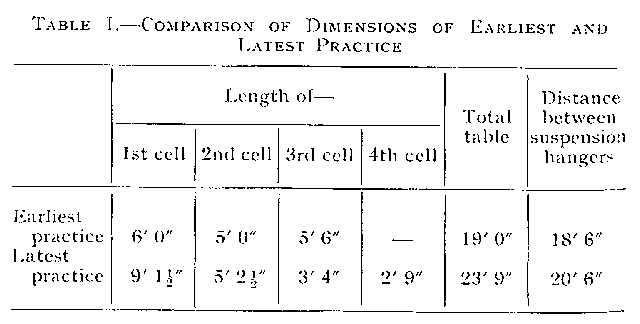
In the earlier practice the trough was suspended at the feed end and near the end of the third (and final) cell. This practice is still followed but the fourth cell is suspended as a cantilever to avoid the use of the very heavy joists required to resist the bending moment in a wider suspension. The first cell length has been increased by 50 per cent., and since the width has also been increased, the portion of the clean coal which is discharged after passing over the first cell has been subjected to a greater separating area per ton of coal. In the earliest plant the total perforated area was only 0.9 to 1.0 sq. ft. per ton of coal treated and this has now been increased to 1.2 to 1.8 sq. ft. per ton. The clean coal discharged from the first cell had (with the coal which passes to the other cells for further treatment) been subjected to only 0.38 sq. ft. of separating area per ton of coal fed, but this has now been increased by 60 per cent. In addition the improved design of the skimmer steps and the narrowing of the table has made the available separating area more effective. As a result it is now possible to clean the finer sizes of coal more effectively.
Drawings and Photographs accompanying the article


Article reproduced from a copy of the magazine held at National Mining Museum Scotland, Newtongrange, Midlothian.




 Contains public sector information licensed under the

