


 |

|

|

|
|
 |
 |
|||

April, 1934
Colliery Re-Organisation on the North East Coast - II
The Cowpen Coal Co. Ltd. have adopted intensive coal mining methods, laid down new coal treatment plant and are now sinking a new pit
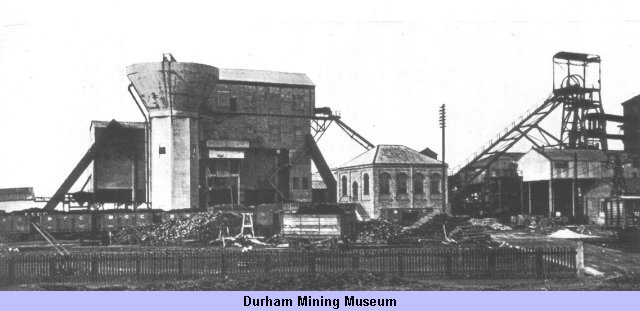
Cambois Colliery
Although common enough in South Wales, it is unusual in any other of the coalfields to bank out at ground level, and we were interested to see that this practice had been adopted at the Bates pit. As will be seen from Fig. 18, which shows the layout of the new screening plant, the full tubs are discharged from the cages at ground level and run to a creeper which elevates them to a point from which they gravitate to the four tipplers. After passing through the tipplers the empty tubs are lowered by a retarder to a sufficient level to enable them to run back to the pit again. The system has the advantage of saving about 300 ft. of gantry and a higher headgear, at the expense of installing an extra creeper, the power consideration being, of course, practically negligible.
The screening plant as a whole was supplied by Head, Wrightson & Co. Ltd., and consists of four main units designed to deal with 2,500 tons of coal per day of 15 hours, although a peak of 3,000 tons can readily be handled during rush periods. Each unit consists of a 6 ft. 6 in. diameter tippler, a main screen 16 ft. long by 5 ft. wide, a picking belt of 60 ft. centres and 4 ft., 6 in. wide, a secondary screen 18 ft. long and 5 ft. wide, and a loading band, 26 ft. long by 3 ft. wide, complete with raising and lowering gear.
The tipplers are of the automatic two-speed type, and are designed to deal with two sizes of tub at the rate of two per minute. They discharge the coal on to shaking distributing chutes, which give a gentle, even delivery to the main jigging screens. Here the small coal is removed through 1.125 in. perforations, the oversize passing to the rubber and canvas picking belts where the stone is removed by hand. The cleaned coal is then delivered to the secondary jigging screens, where the nuts and cobbles are taken out through 2½ in. and 4½ in. perforations, the large passing over the deflecting jibs to the wagons. The cobbles are handled by a transverse belt and delivered on to a loading band on the fifth road. All the anti-breakage jibs are power operated.
The smalls and nuts are also collected by transverse belts, and are delivered to an inclined conveyor running to the tippler end of the plant. From here a further conveyor takes them over the sidings to the washing plant.
The stone removed in the picking is deposited into hoppers; these feed a further sequence of belt conveyors which are also connected with the washery, the two sources of refuse being served by the one system. Various views of the plant are reproduced herewith, that in Fig. 14 showing the exterior of the building. This is a steel framed structure with 4½ in. brickwork panels in the sides and reinforced-concrete floors, the roof being covered with corrugated asbestos sheeting. Needless to say, great attention has been given to the lighting arrangements, and ample glazing has been provided.
The adjoining washery is of the British "Baum" type built by Simon-Carves Limited, and has a capacity of 160 tons per hour of 2½ in. to zero coal. The raw coal feed is brought by the belt conveyor, to which reference has already been made, and delivered into a ground-level hopper of 80 tons capacity, a scraper conveyor traversing the top of the hopper to pass the coal progressively forward in order to avoid breakage. Alternatively the coal may be brought in wagons and discharged direct into the hopper.
Four sizes of cleaned coal are normally produced: trebles (2½ in.-1½ in.), doubles (1½ in.-1.125 in.), singles (1.125 in.-¼ in.), duff (¼ in.-zero). Storage bunkers are provided for each of these sizes, and are arranged over two sidings. Provision has been made here for the loading of 20-ton wagons.
Special care has been taken to avoid breakage and to ensure that the coal leaves the colliery in the best marketable condition. Thus, anti-breakage chutes are provided in the bunkers for the treble and double sizes, and the coal is loaded by means of adjustable jibs ; also, in order to give the coal a clear, bright appearance it is passed over reciprocating sieves, fitted below the bunkers, and sprayed to remove any slime or adherent particles.
Slurry is settled out of the circulating water in the usual overhead conical tank, to which the water is raised from the pump sump. The thickened solids from this tank are cleaned and dewatered by means of a patent slurry plant consisting of vibrating screens which oscillate at a high rate. The slurry can either be kept separate in a bunker or mixed with the washed duff. Refuse is delivered to the common bunker already mentioned, and is removed by railway wagons. The washery building is carried out in reinforced concrete up to the level of the bunker tops, and above this consists of a steel framework with brick filled sides and a corrugated asbestos roof.
Cambois screening and washing plant
The new screening and washing plants erected at Cambois Colliery have been designed with sufficient capacity to handle the coal raised at the North Seaton pit, the output from which is brought by a tubway about 1¼ miles in length. Apart from the economies to be secured by erecting a large single plant, as opposed to two smaller ones, there was a further object in centring the plant at Cambois in that this pit is close to the loading staiths. Moreover the arrangement has enabled the cost of transport from North Seaton colliery to be greatly reduced, as there are now no railway charges, it being no longer necessary to utilise the L. & N.E. railway as hitherto. The tubway requires little maintenance, in spite of the fact that a 660 ft. bridge had to be erected over the river Wansbeck. This bridge, which consists of five spans of lattice girder construction, was erected by F. Turnbull & Co., of Heaton, the foundation caissons having been fixed by the colliery company. The lower caissons are 10 ft. in dia. and the upper 5 ft., the average depth being 20 ft. The tubway is operated by an endless rope haulage, supplied by John Tinsley Limited, of Darlington, the power requirements being met by a Metrovick motor of 150 h.p. A view of the Cambois terminus is given in Fig. 19 and shows the way in which the haulage gear is housed under the creeper ramp leading to the screening plant.
A layout drawing of the screening plant and washery is reproduced in Fig. 27 from which the tub circulating system will be readily followed. As the tubs from the two pits are slightly different in gauge they are kept separate and a cross-over bridge has been erected at the one point where the tracks meet. Six automatic tipplers are provided, these being of the two-speed type giving a slow motion during the actual period of discharge and then a quicker one to complete the revolution. Both pits work the same seams — the Yard and Low Main — about equal quantities, the Yard seam being a high quality household coal, while the Low Main is largely used for steam raising purposes. Five sizes are made in each case: hand-picked best, cobbles, trebles, doubles and slack, provision being made for the two last-named to be mixed and taken to the washery. This small is removed by the preliminary shakers through 1.125 in. holes, the oversize passing to the 4 ft. 6 in. wide plate-type belts from which the best coal and the dirt is hand picked. At the extremities of these belts are secondary screens to remove the nut sizes, the round coal passing over lowering jibs to the wagons. Undersize from the secondary jiggers is taken by two cross belts — one for each seam — to two nut jigging screens which separate out the cobbles (3½ in. to 2½ in.), trebles (2½ in. to 1½ in.), and doubles (1½ in. to 1.125 in.). These sizes are also loaded into the wagons by means of lowering jibs.
When necessary to meet the marketing demands of the moment the cobbles and trebles can be remixed with the large coal by means of two plate-belts, this arrangement having the double advantage of enabling the nut sizes to be cleaned and obviating the need to change the mesh plates of the secondary screens. Each of the preliminary shakers with its picking belt is driven separately by a 15 h.p. Crompton-Parkinson motor, the secondary screens and jibs all being operated from a line of shafting driven by duplicate 50 h.p. motors, one of which acts as standby. Two further motors, all by the same makers, and of 25 h.p., are employed, one to drive the two cross belts serving the nut screens and the other to drive the line shafting which operates the nut screens themselves together with their picking belts and jib ends. The hoisting gear for the whole of the twelve lowering jibs is driven through line shafting by a 15 h.p. motor.
All the dirt picked from the belts is passed to a cross conveyor and deposited in a bunker, being removed thence by a ropeway which also handles the stone brought from the pit. An extremely cheap and convenient refuse tip is available, since, as will be gathered from Fig. 23, the sea absorbs all these unwanted materials.
The whole of the screening plant, which was supplied by F. Turnbull & Co. of Heaton, is housed in a well lit building of steel-framed brick-filled construction having reinforced-concrete floors and a corrugated-asbestos roofing.
As the washery which has been erected in conjunction with this plant is practically identical with that already described in connection with the Bates pit it is unnecessary to give further details.
Coal loading plant
The steps taken in erecting these expensive preparation plants indicate the importance which the Cowpen Coal Company attaches to having their coal put on the market in the best possible condition. The object of these plants would be largely frustrated, however, if a similar solicitude were not shown to eliminate breakage in the loading of the coal into the sea-going vessels in which it is mainly transported. To this end the old staiths serving the Cambois and North Seaton pits have been equipped with conveyors which operate in conjunction with a Hancock anti-breakage loader. This plant, which is illustrated in Fig. 29, was supplied by F. Turnbull & Co., of Heaton. It is this firm which are also erecting the new coal loading arrangements for the Bates pit. A layout of this plant is shown in Fig. 30, and Fig. 28 gives a view taken in the course of erection, at the time of our visit. When complete the plant will be capable of loading 800 tons per hour and will be equipped with two conveyor booms each fitted with the Hancock anti-breakage device. Each delivery point can be elevated 50 ft. above high water, and as will be seen from the layout diagram has a loading range of 140 ft.
Drawings and Photographs accompanying the article


Article reproduced from a copy of the magazine held at National Mining Museum Scotland, Newtongrange, Midlothian.




 Contains public sector information licensed under the

