


 |

|

|

|
|
 |
 |
|||
| Colliery Engineering | July, 1926 |
Output.
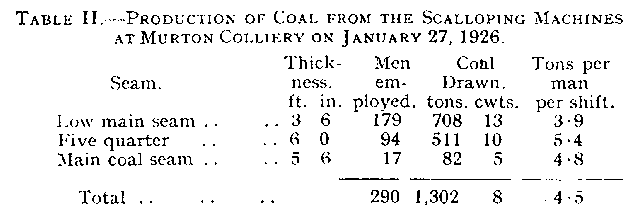
Table II gives a statement showing the amount of coal dealt with in the various seams by the scalloping machine at Murton Colliery on January 27 of this year. This represents about 30 per cent. of the total output of the colliery. On this date the total output raised at the colliery was 4,475 tons, without any shots being fired in the coal. This is believed to constitute a world's record in coal-getting without the use of explosives.
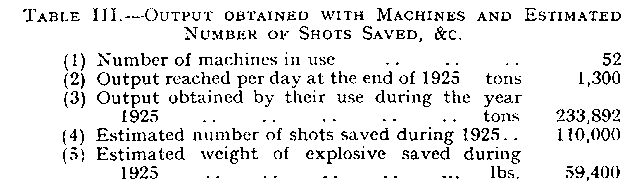
In Table III is shown the actual number of machines in use, and the estimated number of shots saved for the year 1925.
Thorough Organisation Necessary.
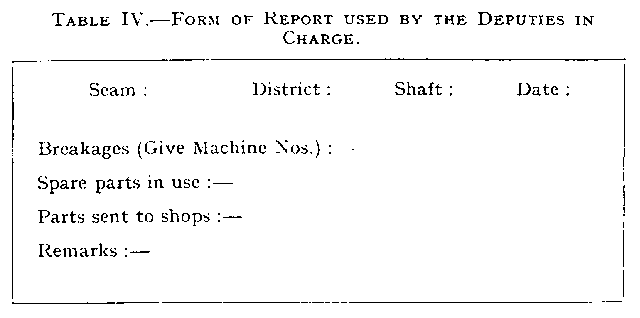
In order to obtain the foregoing results from these machines the work had to be thoroughly organised — indeed, too much stress cannot be laid upon this point — and the different methods of working the coal must be utilised to the best advantage. It was necessary for a complete set of "spares" to be kept in the district so as to reduce delays due to breakages. The person in charge of the district (the deputy) reports, on a form (Table IV) made out for the purpose, at the end of each shift, what breakages have occurred and what spare parts have been used. This report is considered, and the spare parts used are replaced as early as possible. The breakages, particularly when the men become used to the machines, are comparatively small in number.
It is claimed that, apart from the desirability of reducing underground shot-firing, the danger from falls at the face is lessened where these machines are used, as the coal filler has then more time to devote to timbering the face.
The question of transport of coals is also an important item for the successful working of the system. In all districts where the machines are employed secondary compressed air haulages are installed, and the tracks laid with rail of 28 lb. per yard section. Landings are kept in close contact with the working face, and are never allowed to fall more than 100 yards behind the face of leading place. This is very necessary because, once the operation of kirving and nicking of the coal is completed and the process of punching is begun, the coal is produced very quickly, and unless landings are kept in close touch with the face the putters are unable to cope with the output successfully.
Miscellaneous Considerations.
So far as capital expenditure is concerned it is estimated that the difference between the "shot-firing" and the "machine" districts is £100 more for the machines and their attachments in the latter case. But against this must be taken into consideration the reduced outlay for pit timber. Owing to the machine faces travelling so much quicker — practically 50 per cent. — the timber is much sooner drawn and is invariably sound enough to be set once or twice afterwards. Actually the average rate of travel of the faces is 12 yards per week in the "machine" districts, as against 8 yards in the "shot-firing" districts. Again, the capital outlay for pipes, rails, plates, &c., has been found from experience to be considerably less in the "machine" districts owing to the concentrated working, so that the extra outlay for the machines is more than compensated by the saving thus effected.
With regard to payment, the operator and filler are each paid the same score price, no yard work of any description being paid. In the seam to which the comparison figures relate there is only one instance on record where hand hewing was attempted, the cost being 3s. 0.50d. more than that in the machine faces, no shots being fired. A further comparison with the rest of the seam shows that the "machine" district is 4.01d. per ton more expensive in the whole than the rest of the seam in the brokens, the average earnings of the coal-getters in the "machine" district being 2s. per shift more than the hewers in the brokens. No minimum has been paid in any district into which the machines have been introduced. In one district where longwall machines were formerly used, the method of working has been changed to bord and pillar, so effective has been the performance of the hewing machines. The system would appear to have peculiar advantages when there is dirt parting more or less in the middle of the seam, as this can be cut out in the kirving. With longwall machines it is impossible to follow a dirt band with anything like the same degree of accuracy — if, indeed, it can be followed at all — and a dirty class of coal frequently results. At any rate, it is obvious from the success which has attended the use of these machines at Murton, that there is a distinct field for their more extended application to British colliery practice. No machinery of this kind can be successfully introduced without the goodwill and co-operation of the workmen employed, and in this respect Mr. Oliver's experience has been a very happy one. The lodge officials and the men themselves seemed to recognise immediately the advantages of such a method of coal-winning — a fact which foreshadows the growing tendency to regard machinery as a distinct aid to wages. This, and the present economic pressure in the industry, infers that machine mining in general will gather great impetus during the next few years. In the foregoing we have an instance of a machine-mining method which has proved a clear success under a range of difficult conditions, and which, therefore, merits the attention of all engineers.
Drawings and Photographs accompanying the article


Article reproduced from a copy of the magazine held at National Mining Museum Scotland, Newtongrange, Midlothian.




 Contains public sector information licensed under the

