


 |

|

|

|
|
 |
 |
|||

July, 1926
Coal Winning without Explosives
An account is given of the "Murton" Compressed-Air-Operated Coal-Cutting and Hewing Machine.
Various attempts have been made from time to time to introduce methods of breaking down hard coal at the working faces to obviate the use of explosives; patent forms of wedges, lime cartridges and hydraulic pressure — to mention only a few of the principles used — are all methods of achieving this end more or less familiar to readers, and although many of these devices have passed out of the experimental stage, and have met with a certain amount of success, yet none of them have been adopted by British mining engineers. A method that has, however, been adopted in a British mine, and after having been fully tried for a number of years, has proved so economically sound that it has altogether banished the use of explosives for breaking down coal in this mine, can now fairly claim to have established a case for itself.
We refer to an invention of Mr. E. H. Oliver, the manager of Murton Colliery, in Durham, who, after much experimenting, has developed a form of percussive coal-cutting machine which is capable also of functioning to break down the coal with more satisfactory results than explosives. The arrangement consists essentially of a "Hardiax" coal-cutting machine fitted with "Murton" gearing, the main feature of the latter being that the relative positions of the two handles which operate "kirving" or horizontal movement, and the "nicking" or vertical movement, do not alter relatively while they are being turned, and the machine is thus very easy to manipulate. The nicking and kirving is done in much the usual way with an ordinary cutting pick, which is then replaced by a single, square pointed pick 3 in. in diameter, with which the coal is punched down. The system formed the subject of a paper read by Mr. E. H. Oliver before the North of England Institute of Mining and Mechanical Engineers* in 1923, and as the Murton gear and its application to coal winning was fully described therein we have abstracted a considerable amount of information from this source. We were granted facilities to see the machines at work at Murton, however, and through the courtesy of Mr. Oliver have been enabled to publish supplementary data embracing the progress which has been made during the past two years.
*"The Economic Aspect of Winning Goal Without the Aid of Explosives." Transactions of the Institution of Mining Engineers, lxvi, Part 4, pages 212-218.
Description of the Gear.
Fig. 4 gives a side elevation, and Fig. 5 a sectional elevation of the gear, showing the essentials of the Murton attachment, the sole manufacturing rights of which have been acquired by the Hardy Patent Pick Co. Ltd. A hollow spindle with a conical recess at one end receives a correspondingly shaped boss on the cradle or casing; the other end of the spindle has a worm-segment keyed thereto, and the cutter-casing is secured to the spindle by means of a bolt which passes through the boss on the cutter-casing, through the hollow spindle, and is secured at the other end by a nut. The action of the machine (Figs. 4 and 5) is as follows :— The gearing is housed in a cast-steel box A, which in its turn is hinged to the column by a hinged clamp B. For kirving, the handle C works a worm D geared to a horizontal wheel E, which is fixed on the column and revolves the gear-box round the column. For shearing, the handle F at the back of the gear-box works a worm geared to a half-wheel G fixed on a hollow spindle H, which also carries the cradle and cylinder and rotates to any vertical position. The cradle is kept in position by a through-bolt I, which passes through the hollow spindle.
This procedure is carried on across the whole width of the face, except that only the one operation of shearing is necessary. The places are driven 4 to 5 yards in width and all this work is done with one setting of the machine. If the places were to be driven any greater width the machine would have to be moved across the face and set up again — an operation taking about ten minutes.
Recently a lifting device has been added which enables the machines in gear to be lifted up the column quite easily and without delay.
Comparison of Results.
The first trials showed that it was possible to obtain with the machine an output of something like 4 tons per coal-getter. Theoretically, if this figure could be maintained as an average for a number of machines, coal could be won in this way as cheaply as, or even cheaper than, by shot-firing. In order to test this point, the machines were given a practical trial, and the following are the results obtained from a district worked entirely by them, these being compared with those from a district worked with percussive coal-cutters and shot-firing. The conditions in both districts were identical; the districts were adjacent to each other, and were situated 2 miles from the shaft. The men walked to and from their work. The seam had a section of 5½ to 6 ft. of coal, with a band of stone 4 or 5 in. thick about 6 in. from the top of the seam, which was worked on the bord-and-pillar system (whole working). The air pressure was 50 lb. per square inch when the machines were working.
For a full fortnight of 10½ days in the "shot-firing" district seven percussive machines were employed, which produced an output of 2,677 tons. The employees engaged at the face in coal-getting were 67, comprising 21 fillers, 21 cutters, 21 scrapers and 4 drillers.
In the "machine" district nine machines were employed for a full fortnight of 10½ days, and these produced an output of 2,515 tons. The employees working at the coal face numbered 54.
The cost at the face for labour alone showed that it was 2.04d. per ton more expensive in the "machine" district than in the "shot-firing" district. The real saving effected, however, is due to the fact that a number of machines can be concentrated in a small area. All the different classes of work, such as putting, shift, stone-work, &c., are eliminated, as they have no bearing on the cost saved by concentration. The classes of labour that are affected can be put under two heads, namely, supervision and the transit of coal from flats of auxiliary landings to the main landings.
In the "shot-firing" district six deputies and shot-firers were engaged, and they had the assistance of six boys to operate a stone-dusting machine, which was devised to act simultaneously with the firing of the shots. This percentage of boy labour (about 33) very largely accounts for the cost being 2.04d. higher in the machine district. Nine boys were employed in the transit of the coal from two auxiliary landings or flats to the main landing.
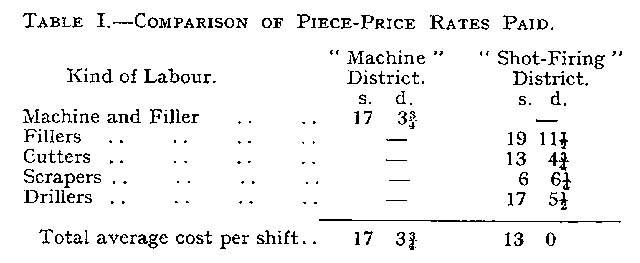
In the "machine" district only three deputies were engaged, and as no shots were fired, no boys were required for stone-dusting as in the "shot-firing" district. Table I gives a comparative statement showing the wages paid at the face in both districts. Six boys were required for the haulage of the coal from one auxiliary landing or flat to the main landing.
The saving effected under these two headings was 4.35d. per ton in favour of the "machine" district, so that the adverse cost of 2.04d. per ton on the face working was not only eliminated, but a saving of 2.31d. per ton was effected. To this figure must, of course, be added the cost of the explosives used in the "shot-firing" district, which was 4.47d. per ton, making a total saving of 6.78d. per ton. In addition to this, it is obvious, from Table I, that if the average earnings had been anything like equal, the cost per ton in the "machine" district would still be less than in the "shot-firing" district. Furthermore, from actual tests made it was shown that the output from the "machine" district produced 13.6 per cent, more round or best coal than that from the "shot-firing" district. These results were carefully worked out in connection with all the different grades of coal made at the colliery, and were found to be equal to 6d. per ton extra on the selling price. This amount, when added to the saving effected on the underground working cost, represents a saving of 1s. 0.78d. per ton on the cost of coal won in the "machine" district as compared with that won in the "shot-firing" district.
The increased consumption of compressed air used in the "machine" district was an item of cost that was carefully worked out, and was found to represent 1.25d. per ton — that is, assuming the cost of compressed air in the "shot-firing" district to be 1s. per ton it would be 1s. 1.25d. per ton in the "machine" district. This increase when deducted from the saving otherwise effected still leaves a margin of 11.53d. per ton in favour of the "machine" district.
No account has been taken in these figures of the saving that is effected due to concentrated working, although approximately only half the "pit-room" is needed owing to coal-getters being employed in one place.
In the "shot-firing" district the output per coal-getter per shift was 3.72 tons; this figure is lower than that obtained prior to stone-dusting at the face, as it was found that the fillers, rather than work amongst the stone-dust remained back from the face until the dust was practically "settled." Prior to the use of stone-dust at the face, the average output per coal-getter was 4.25 tons, whereas that from the "machine" district at the face was 4.72 tons.
The output per person per shift in the "shot-firing" district from the face to the main landing, eliminating putters, shifters, stonemen, &c. (which are common to both districts) was 2.70 tons, as against 3.88 tons in the "machine" district. This large difference (1.18 tons) is accounted for by the fact that the time occupied in flitting the machines in the "shot-firing" district was spent in getting coal in the "machine" district. In addition, owing to the concentration of men, fewer hands are required for supervision, and for the transit of the coal from the face to the main landing.
It must not be assumed that these machines do all the work of coal-getting; their function is to assist the coal-fillers by doing the hardest work, and leave the easier work to be done by these men. In practice it has been found necessary to have with every machine a filler who has had experience of coal-hewing to give advice to the operator as to the best way in which the place should be worked.
Drawings and Photographs accompanying the article


Article reproduced from a copy of the magazine held at National Mining Museum Scotland, Newtongrange, Midlothian.




 Contains public sector information licensed under the

